

Open your council tax bill and you’ll spot a single letter, usually between A and H, sitting next to your address. That one letter has a surprisingly big effect on your finances, and yet most people have never stopped to question it.
This guide to council tax bands explains how the system works, what each band means in England, Wales and Scotland, how much you can expect to pay this year and what to do if you think your home has been put in the wrong band. We’ll also cover discounts, common myths and simple ways to make sure you’re not paying a penny more than you should.
If you’re looking for reliable and affordable travel options, explore Cheap Flights from UK to USA and find the best deals for your next journey.
What Is Council Tax?
Council tax is a local tax that helps pay for services in your area, including bin collections, road maintenance, libraries, parks, social care, fire services and the police. If you live in England, Wales or Scotland, you’re usually required to pay it, whether you own or rent your home. Northern Ireland doesn’t use council tax. It has a domestic rates system instead.
Your bill depends on two main things: which band your home is in and how much your local council charges for that band. Since councils set their own rates, two identical houses in different parts of the country can have very different bills.
How Council Tax Bands Work
Every home is placed into a valuation band based on what it was estimated to be worth on a fixed date, not on what it’s worth today. Lower-value homes sit in the lower bands, such as A, while the most valuable properties sit in the highest ones.
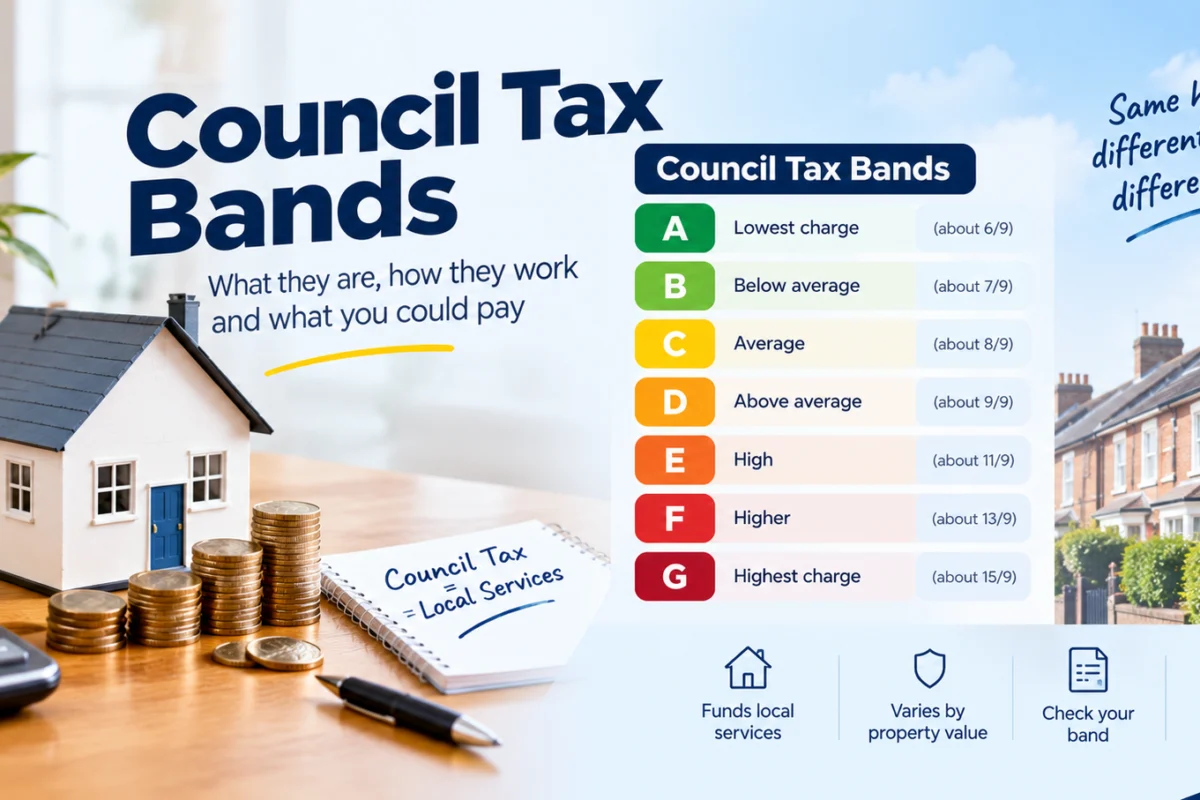
Each band pays a set fraction of the amount charged for Band D, which is the benchmark band. In England, the proportions are measured in ninths. For example, a Band A home pays six-ninths of the Band D charge, while a Band H home pays double it. When councils announce their yearly increase, they set the Band D figure, and every other band adjusts automatically.
Council Tax Bands in England
In England, homes were valued as at 1 April 1991, and there are eight bands from A to H. The table below also shows an illustrative annual bill for each band, based on the 2026/27 national average Band D charge of £2,392. Your actual bill will differ depending on where you live.
| Band | 1991 property value | Share of Band D | Illustrative bill at £2,392 |
|---|---|---|---|
| A | Up to £40,000 | 6/9 | about £1,595 |
| B | £40,001 to £52,000 | 7/9 | about £1,860 |
| C | £52,001 to £68,000 | 8/9 | about £2,126 |
| D | £68,001 to £88,000 | 9/9 | £2,392 |
| E | £88,001 to £120,000 | 11/9 | about £2,924 |
| F | £120,001 to £160,000 | 13/9 | about £3,455 |
| G | £160,001 to £320,000 | 15/9 | about £3,987 |
| H | Over £320,000 | 18/9 | about £4,784 |
These are illustrative figures, not exact bills. Always check your own bill or your council’s website for the real numbers, because every authority sets its own rates.
Council Tax Bands in Wales and Scotland
Wales has nine bands, from A to I, and homes were valued as at 1 April 2003. The extra Band I exists to capture the highest-value properties.
| Band | Wales (2003 values) |
|---|---|
| A | Up to £44,000 |
| B | £44,001 to £65,000 |
| C | £65,001 to £91,000 |
| D | £91,001 to £123,000 |
| E | £123,001 to £162,000 |
| F | £162,001 to £223,000 |
| G | £223,001 to £324,000 |
| H | £324,001 to £424,000 |
| I | Over £424,000 |
Scotland has eight bands, A to H, and still uses 1991 values, but with different thresholds from England.
| Band | Scotland (1991 values) |
|---|---|
| A | Up to £27,000 |
| B | £27,001 to £35,000 |
| C | £35,001 to £45,000 |
| D | £45,001 to £58,000 |
| E | £58,001 to £80,000 |
| F | £80,001 to £106,000 |
| G | £106,001 to £212,000 |
| H | Over £212,000 |
Scotland also changed the proportions from 2017, so households in the higher bands pay a bigger share than they used to. Water and sewerage charges in Scotland are billed alongside council tax, but they’re a separate charge.
How Much Is Council Tax in 2026/27?
Bills went up again from April. According to official government figures, the average Band D council tax in England for 2026/27 is £2,392, an increase of £111, or 4.9%, on the previous year. Most councils with social care duties chose to raise bills by close to the maximum allowed without a local referendum, which is roughly 5%. Some areas increased by much more, and a few cut their bills.
Wales also saw an average rise, and in Scotland, increases varied between councils, with some going above inflation. London boroughs tend to have lower averages than many other parts of England, while some southern and south-western areas are among the most expensive.
The bottom line is that where you live matters just as much as your band, so always check your own council’s published charges.
How to Find Out Which of the Council Tax Bands You’re In
Finding your band takes about a minute. Here’s how:
- Check your bill. Your band is printed on your annual council tax statement.
- Use the official checker. In England and Wales, GOV.UK has a search tool run by the Valuation Office Agency (VOA). Enter your postcode and you’ll see the band for your address.
- In Scotland, use the Scottish Assessors website, which lists bands by address.
- Ask your council if you’re unsure.
It’s also worth checking a few similar homes nearby. If your neighbours’ identical houses are in a lower band, that could be a sign you’ve been placed too high.
Why Do Similar Homes Pay Different Amounts?
Even if two homes are in the same band, bills can differ because:
- Different councils charge different rates. Each area sets its own Band D figure.
- Parish and town councils add their own precepts in some places.
- Police, fire and combined authority charges vary by region.
- Adult social care levies are applied differently by different councils.
- Discounts and exemptions can change what each household pays.
So your bill is really a combination of your band, your local charges and any reductions you qualify for.
Are Council Tax Bands Out of Date?
Yes, many people feel they are. In England and Scotland, bands are still based on 1991 values, and in Wales, on 2003 values. That means a home’s band says very little about its modern price. A flat in a once-cheap area that has since become fashionable may still sit in a low band, while a house in a less popular area could be in a higher band than its current value suggests.
Calls for a revaluation have been around for years, and the Welsh Government has been moving towards a revaluation of its own system, so it’s worth keeping an eye on the latest plans. In England, the government has announced a surcharge for the most expensive homes from 2028, but the standard bands themselves haven’t been reset. Check GOV.UK for the details as they develop.
How to Challenge Your Band
If you think your home is in the wrong band, you have the right to question it. In England and Wales, you do this through the VOA, and in Scotland, through your local Assessor.
Here’s the process in simple terms:
- Gather evidence. Compare your band with similar properties on your street. Note things like size, age and type.
- Make your case online. The VOA runs a free service to check, challenge and appeal your band.
- Wait for a decision. If the band changes, you could get a refund, usually backdated to when the band was set or when you moved in.
- Appeal if necessary. If you disagree with the outcome, you can appeal to a tribunal.
One rule worth knowing about council tax bands is the time limit. You can generally challenge within six months of becoming responsible for the property, such as when you move in. After that, you can usually only challenge in limited circumstances, such as if the property has changed or the area has seen significant changes.
There’s also a risk. A review can result in your band staying the same, going down or, in rare cases, going up. And be wary of companies that charge a fee to challenge on your behalf, because the process is free to do yourself.
Council Tax Discounts, Exemptions and Support
Whichever of the council tax bands you fall into, you might be entitled to pay less. Many people miss out because they simply don’t know. Common options include:
- Single person discount: You can usually claim 25% off if you’re the only adult in the home.
- Student exemption: Households where everyone is a full-time student are generally exempt, and students are disregarded when working out discounts.
- Disabled band reduction: If you’ve adapted your home for a disabled person, for example with an extra bathroom, an extra room or space for a wheelchair, your bill may be reduced to the band below.
- Severe mental impairment: People who qualify may be disregarded when working out the bill.
- Annexes and empty homes: Some annexes or unoccupied properties qualify for discounts or exemptions, although long-term empty homes and second homes can face higher charges in some areas.
- Council tax reduction schemes: If you’re on a low income, you may be able to get help. In England, schemes are run by each council, so rules vary. Wales and Scotland have their own reduction schemes.
Contact your council to apply, and keep supporting evidence handy. You can often claim a backdated discount if you should have qualified earlier.
Paying Your Bill and Getting Help With Debt
Most councils collect payments over ten monthly instalments, from April to January, but many will let you spread the cost over twelve months, which can make budgeting easier. Ask your council if you’d like to change.
If you fall behind, don’t ignore it. Contact your council as soon as possible, because they can often agree a payment plan. Missing payments can lead to reminders, court action and extra costs. Free, impartial help is available from Citizens Advice, StepChange and MoneyHelper if you’re struggling with arrears.
Council Tax Bands When Buying or Renting
If you’re buying a home, check the band before you make an offer. Two similar houses might sit in different bands and cost hundreds of pounds a year apart. Remember to look up your future council’s Band D rate as well, because that has a major effect on affordability.
A few other points to remember:
- Extensions and improvements usually don’t change your band until you sell the property, but a new owner may see a rebanding.
- New-build homes are banded when they’re completed.
- Tenants normally pay council tax unless the landlord arranges otherwise, so check your tenancy agreement.
- Houses in multiple occupation (HMOs) are often billed to the landlord.
Before moving, let your old council know your leaving date and register with your new council straight away to avoid being billed twice or falling into arrears.
Common Myths About Council Tax Bands
A few popular beliefs can cost people money or cause confusion:
- “My band reflects my home’s current value.” It doesn’t. It reflects a historic valuation date.
- “Extending my home will put me in a higher band straight away.” Usually not until the property is sold.
- “Band D means the same bill everywhere.” Not at all, because each council sets its own rate.
- “Challenging my band is risky and expensive.” It’s free to do, though a band can go up as well as down.
- “Only low-income households get help.” Many discounts, such as the single person discount, depend on circumstances, not income.
- “I can’t change my payment dates.” Many councils allow you to move your payment date or switch instalment plans.
One of the most common myths about council tax bands is that nothing can be done once you’ve been placed in one. In fact, errors do happen, and checking is simple.
How to Lower Your Council Tax Bill
You can’t haggle with your council, but you can make sure you’re paying the right amount:
- Check your band against neighbouring homes and challenge if it looks wrong.
- Claim every discount you’re entitled to, especially the single person discount.
- Apply for council tax reduction if your income is low.
- Tell your council about changes, such as someone moving out or becoming a student.
- Check for disabled band reductions if you’ve adapted your home.
- Review your bill each year to make sure the discounts have carried over.
Even a small error can add up to hundreds of pounds over several years, so a five-minute check is time well spent.
Council Tax Bands Checklist
Before you finish, run through this quick list:
- I know my band and have checked it against similar nearby homes
- I’ve checked my council’s current Band D charge for 2026/27
- I’ve claimed every discount or exemption I qualify for
- I’ve considered applying for a council tax reduction if my income is low
- My payment plan suits my budget, and I know how to change it
- I’ve told my council about any recent changes to who lives here
- I’ve kept evidence in case I decide to challenge my band
Frequently Asked Questions
How many council tax bands are there in the UK?
It depends on where you live. England and Scotland have eight bands, A to H, while Wales has nine, A to I. Northern Ireland doesn’t use council tax and charges domestic rates instead.
What is the average Band D council tax in England?
For 2026/27, the average Band D charge in England is £2,392, an increase of 4.9% on the previous year, according to government figures. Your own council’s rate may be higher or lower.
Can my council tax band go up?
It can, usually if the property changes significantly, such as being rebuilt, or following a successful challenge by someone else. Extensions normally don’t trigger a change until the property is sold.
Who pays council tax, the owner or the tenant?
Usually the person living in the property, whether they own it or rent it. In some cases, such as houses in multiple occupation, the landlord is responsible.
Do students pay council tax?
Full-time students are usually exempt, and households made up entirely of students don’t normally pay. You may need to provide a certificate from your university.
How do I get a refund if my band was wrong?
If a challenge is successful, your council will usually refund the overpayment, typically backdated to when the incorrect band began. Contact your council to arrange it.
Can I pay council tax over twelve months?
Many councils let you do this on request. Ask yours if you’d like smaller monthly payments.
Final Thoughts
Council tax bands can feel confusing, but the basics are simple. Your band depends on an old valuation, your bill depends on your council’s rate, and plenty of people qualify for discounts they never claim. Take a few minutes to check your band, look at your neighbours’ homes and review your bill.
If something looks wrong, don’t be shy about asking questions. A free check might save you hundreds of pounds over time, and even if your band is correct, you may find a discount or payment plan that makes life easier. Look up your band today, and make sure your money is working as hard as you are.

Join the conversation