

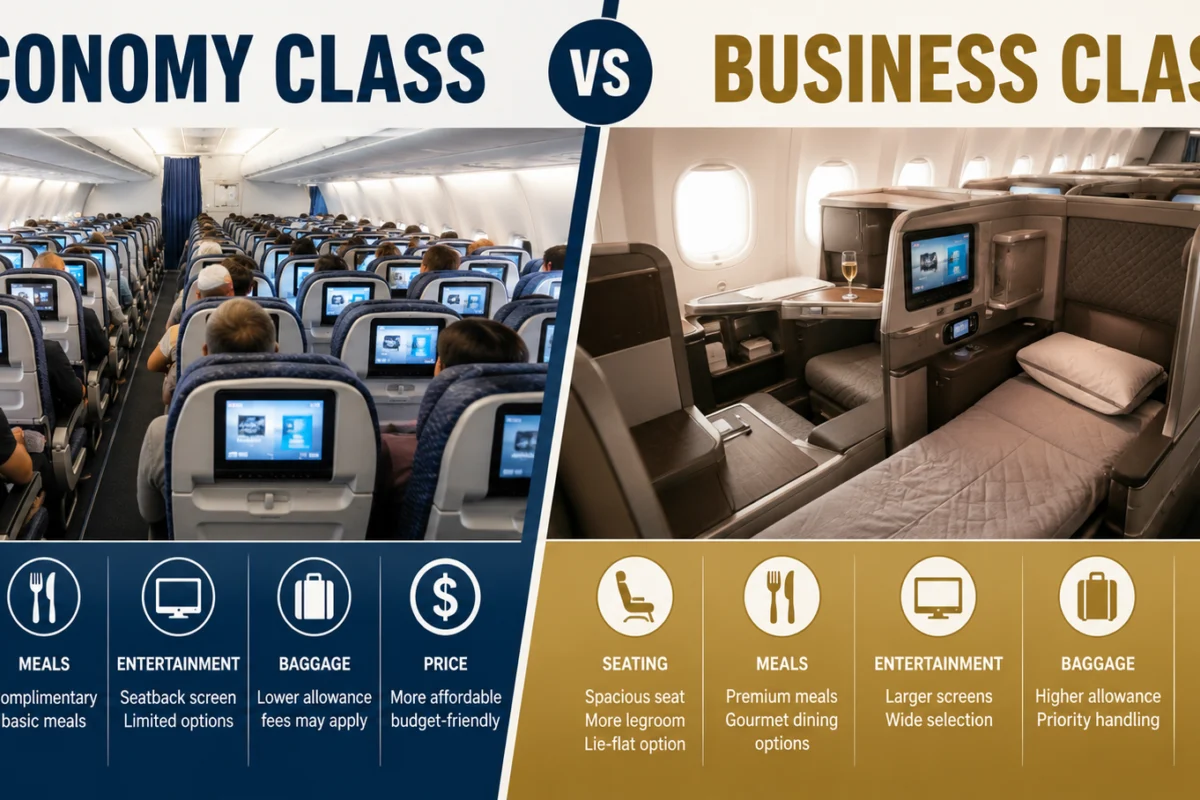
Economy Class vs Business Class :- Every long-haul traveller eventually asks the same question while browsing fares: should I just pay more and get it over with? The economy class vs business class decision isn’t just about money — it’s about comfort, sleep, and how you actually feel when you land. This guide breaks down every meaningful difference between the two cabins in 2026, from seat dimensions to real pricing data, so you can make an informed call the next time you’re staring at two very different numbers on a booking screen.
Why This Comparison Matters More Than Ever
The economy class vs business class gap has genuinely widened in recent years. In 2026, newer widebody aircraft like the Boeing 787 Dreamliner and Airbus A350 have pushed cabin design further apart than at almost any point in aviation history. Business class increasingly means a proper lie-flat bed with direct aisle access, while economy has, in many cases, stayed roughly the same size it’s been for decades. That growing divide is exactly why the economy class vs business class question deserves a genuinely careful look rather than a snap decision based on price alone.
The Seat Itself: Where the Difference Really Starts
Nowhere is the divide more obvious than in the seat. Economy class seating is functional but compact, typically offering 16 to 19 inches of width and a pitch, or legroom, of somewhere between 30 and 34 inches. That’s sufficient for a short hop, but it can feel genuinely restrictive once you’re several hours into a longer journey. Seating is also arranged in a tightly packed, open-plan configuration, which can feel crowded even when the cabin isn’t full.
Business class seats are a different proposition entirely. Widths reach up to 20 to 22 inches, pitch frequently exceeds 60 inches, and many modern business class seats feature genuine lie-flat capability with a full 180-degree recline and a bed length of 78 to 82 inches. The layout matters just as much as the dimensions — rather than economy’s open rows, business class typically offers individual pods or enclosed suites, giving passengers genuine privacy rather than simply more space. Some of the newest products, including Qatar Airways’ Qsuite, JAL’s A350-1000 suites, ANA’s The Room, and Singapore Airlines Suites, go a step further still, adding closing doors that turn a seat into something closer to a private room. This structural difference, rather than anything incremental, is really at the heart of the economy class vs business class comparison.
Sleep: The Feature That Actually Justifies the Price
If there’s a single factor that defines the economy class vs business class debate on long-haul flights, it’s sleep. The defining feature of business class isn’t the food or the lounge access — it’s the flat bed. That’s not a marketing term; it’s a seat that reclines fully flat, allowing genuine horizontal sleep for the entire flight. On a journey of ten to fifteen hours, sleeping properly has a real, measurable effect on how you feel when you land, and it’s the single biggest reason business travellers and long-haul leisure flyers alike are willing to pay a significant premium.
Economy simply can’t replicate this. Limited recline, tight legroom, and cramped seating compound fatigue rather than easing it, turning a ten-hour-plus flight into something closer to an endurance test for many passengers. This is arguably where the economy class vs business class comparison becomes less about comfort preference and more about genuine physical wellbeing, particularly for travellers with early meetings, physical demands, or health considerations waiting for them on arrival.
Direct Aisle Access and Cabin Layout
A detail that often gets overlooked in the economy class vs business class conversation is aisle access. Modern long-haul business class seats increasingly offer direct aisle access as standard, meaning you never have to climb over a sleeping neighbour to reach the toilet or stretch your legs. In economy, by contrast, a middle or window seat can mean disturbing one or two other passengers every time you need to move, which adds a genuinely underrated layer of stress to an already long journey. It’s a small-sounding detail, but on an overnight flight it can meaningfully affect how much actual rest you get.
Food, Drink, and Service
Service standards form another clear dividing line in this comparison. Business class typically includes a genuinely elevated dining experience, often featuring multi-course meals, a curated wine list, and dedicated cabin crew attention, since each flight attendant is generally responsible for far fewer passengers than in economy. This difference in cabin size and crew ratio changes the overall pace and feel of the flight even before you consider seat comfort specifically.
Economy service, while perfectly functional, tends to be more standardised and efficient by necessity, given the sheer number of passengers a smaller crew has to serve within the same flight time. Many economy passengers also find themselves paying separately for extras like premium snacks, alcohol, or seat selection, whereas these are typically bundled into the price in business class. None of this makes economy a bad experience — it simply reflects a fundamentally different set of priorities on either side of the economy class vs business class divide.
Lounge Access and the Ground Experience
The economy class vs business class gap doesn’t end once you’re off the plane, either. Business class passengers typically gain access to airline lounges at both departure and connecting airports, offering a genuinely calmer pre-flight experience with proper seating, food, showers in many cases, and a break from the general bustle of the main terminal. Priority check-in, security, and boarding are also standard business class perks, which can save a meaningful amount of time and stress, particularly at busy hub airports during peak travel periods.
Economy passengers generally don’t receive these perks as standard, though some airlines offer limited lounge access for a fee, or through elite frequent flyer status even on an economy ticket. For travellers who value a smoother, less chaotic airport experience as much as the flight itself, this ground-level dimension is a genuinely important part of the overall economy class vs business class calculation, not just an afterthought.
The Real Cost Gap: What You’ll Actually Pay
Money is, understandably, the factor most people weigh most heavily in the economy class vs business class decision, and the headline numbers can look genuinely eye-watering. Business class tickets typically cost three to five times more than the equivalent economy fare. On a transatlantic route, that might mean an economy fare of around $750 to $950 set against a published business class fare of $3,500 to $5,000 for the same flight. On longer transpacific routes, such as Los Angeles to Tokyo, published business class fares can run $4,500 to $9,000, against economy fares closer to $700 to $1,200 for the same twelve to fourteen-hour journey.
It’s worth understanding, though, that published retail fares don’t always tell the full story in the economy class vs business class comparison. Airlines allocate a meaningful portion of their business class inventory to wholesale and consolidator channels that aren’t accessible through standard booking platforms. Travellers who access these fares through a specialist flight concierge or a consolidator can regularly pay considerably below the published retail price for the identical seat — sometimes bringing what looks like a three to four times premium down closer to a 1.7 to 2.1 times gap once the real, negotiated price is factored in. That’s still a significant premium, but it’s a very different economy class vs business class equation than the sticker price alone would suggest.
Ways to Close the Price Gap
Smart travellers increasingly focus on genuine upgrade strategies rather than simply booking full-price business class tickets outright, and this is where the economy class vs business class decision becomes considerably more flexible than it first appears. Mile-based upgrades are one of the most common routes, typically costing somewhere between 30,000 and 90,000 miles for an international business class seat, depending on the airline and route. Travellers who collect miles strategically through credit cards or frequent flyer programmes can sometimes turn what would otherwise be a $4,000 ticket into something costing as little as $100 to $300 in taxes and fees.
Many airlines also run upgrade auction systems, letting economy passengers bid for a business class seat closer to departure, often at a fraction of the standard fare difference. Alaska Airlines, for instance, has offered upgrade bids starting from as little as $29 on certain domestic routes, while international upgrade bids more commonly land in the region of $350 plus miles. These kinds of strategies mean the economy class vs business class choice doesn’t always have to be an all-or-nothing decision made weeks in advance at full published price.
When Business Class Genuinely Isn’t Worth It
Despite everything covered so far, there are situations where the economy class vs business class premium simply doesn’t make sense. On short-haul routes under four to five hours, business class is rarely worth the price difference. On many intra-European flights specifically, a business class seat is often functionally identical to economy — the same cabin, the same general seat, just with a blocked middle seat and a noticeably higher price attached. Without a lie-flat bed, direct aisle access, or a meaningfully different service experience, the value proposition on these shorter routes largely disappears, and frequent flyers who understand this tend to save their business class budget exclusively for genuine long-haul, overnight journeys where the difference is dramatic rather than marginal.
Where the Middle Ground Fits In
No modern discussion of economy class vs business class would be complete without acknowledging the middle-tier option that’s reshaped this decision for many travellers: premium economy. Sitting between the two, premium economy typically costs somewhere between 1.4 and 2 times the price of standard economy, considerably less than the three-to-five-times premium commanded by business class. In exchange, it offers meaningfully more legroom, a wider seat, better food, and priority boarding, without the full lie-flat bed or private suite that defines true business class.
For travellers weighing the economy class vs business class question purely on comfort-per-dollar grounds, premium economy has become a genuinely popular compromise, particularly on long-haul flights of eight hours or more where the extra space makes a real difference without the steep business class price tag. It won’t replicate a proper night’s sleep the way a flat bed can, but for travellers unwilling to pay several thousand dollars extra, it narrows the gap considerably.
How to Decide for Your Own Trip
Ultimately, the economy class vs business class decision comes down to a handful of practical questions specific to your own journey. How long is the flight, and is it overnight? Do you have something demanding — a meeting, an event, physical activity — waiting immediately on arrival that genuine rest beforehand would meaningfully improve? Can you access the fare through miles, an upgrade auction, or a consolidator rather than paying full published retail? And finally, does the specific route and aircraft actually offer a lie-flat business class product, or would you simply be paying a premium for a blocked middle seat and slightly better food?
Answering these honestly turns the abstract economy class vs business class question into a much more concrete, personal calculation. A ten-hour overnight flight to a destination where you need to function the next day is a very different proposition from a ninety-minute domestic hop, even though both technically offer the same two cabin choices.
Regional Differences Worth Knowing About
The economy class vs business class comparison doesn’t play out identically everywhere in the world, and it’s worth understanding a few regional quirks before you book. Around 45% of widebody aircraft globally now carry a premium economy cabin, with that figure climbing to roughly 90% across North America specifically, which has quietly changed how the space between the two main cabins is used on many routes. On aircraft without a premium economy cabin, the practical gap tends to be even starker, since there’s no intermediate step softening the jump in either price or comfort.
Airline positioning also varies considerably by carrier and region. Some Middle Eastern and Asian airlines have invested particularly heavily in flagship business class products, treating the cabin as a genuine differentiator against competitors on the same route, while some budget-oriented long-haul carriers offer a business product that’s closer in spirit to a slightly enhanced economy experience. It’s genuinely worth researching the specific aircraft and cabin configuration for your exact route before assuming a business class ticket automatically means a lie-flat suite, since the comfort gap can vary meaningfully even among airlines charging similar headline prices.
A Quick Checklist Before You Book
Given everything covered here, it helps to have a simple checklist in mind the next time you’re weighing this decision for a specific trip. Check the flight duration first — anything under four to five hours rarely justifies the premium. Check whether the specific aircraft and route actually offers a genuine lie-flat seat, rather than an enhanced economy seat with a blocked middle. Look into whether miles, an upgrade bid, or a consolidator fare could meaningfully close the price gap before paying full retail. And finally, be honest about what you actually need from the flight — a website’s marketing language describing either cabin is far less useful than knowing your own priorities around sleep, budget, and what’s waiting for you on the other side.
Running through this short list before every long-haul booking turns the economy class vs business class question from a recurring source of second-guessing into a quick, repeatable decision you can make with genuine confidence each time you fly.
The economy class vs business class gap in 2026 is genuinely wider than it’s ever been, driven by newer aircraft, increasingly elaborate business class suites, and a growing willingness among airlines to differentiate sharply between what each cabin actually offers. Business class delivers real, tangible benefits — a flat bed, direct aisle access, elevated dining, and lounge access — that go well beyond simple marketing language, particularly on long-haul overnight routes where sleep genuinely matters.
But the premium is real too, even after accounting for consolidator pricing and smart upgrade strategies, and it’s rarely worth paying on shorter routes where the two cabins barely differ. The smartest approach to the economy class vs business class question isn’t choosing one cabin permanently, but learning to match the right cabin to the right flight — saving the splurge for the journeys where a proper bed and genuine rest will actually change how your trip begins.
Join the conversation