

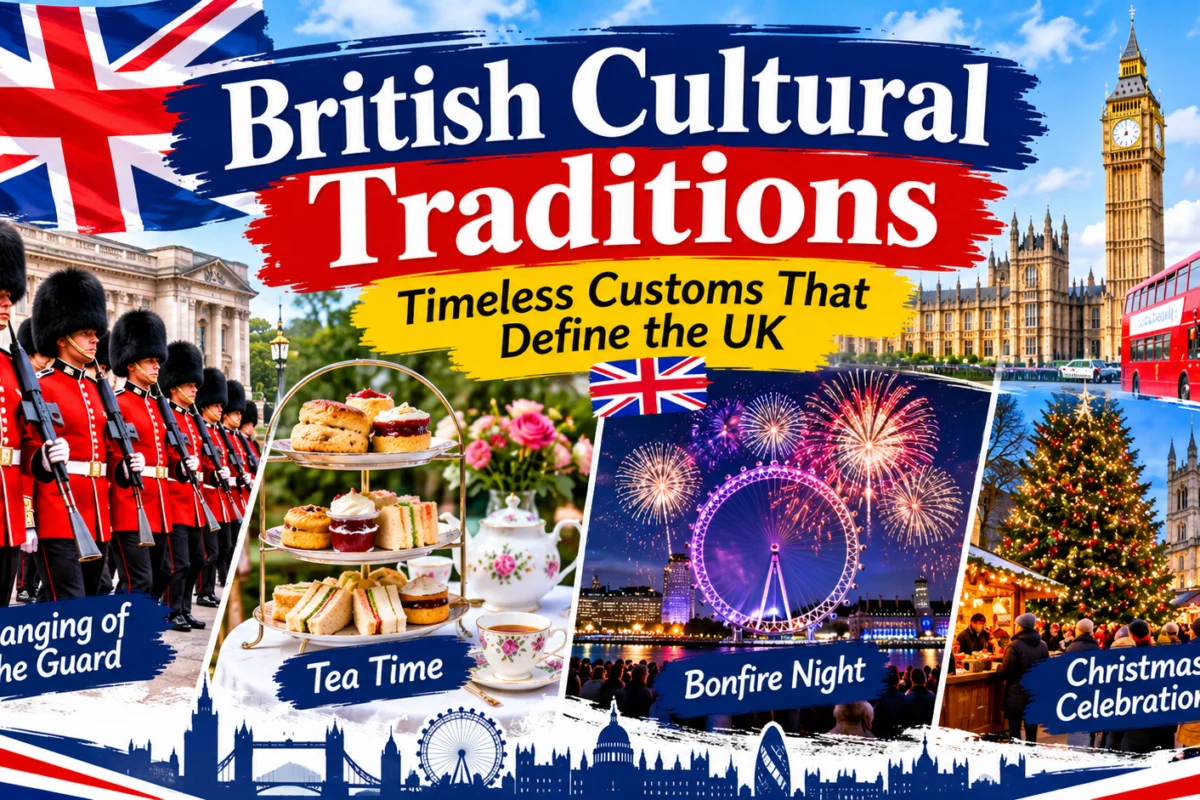
Where else do people chase a wheel of cheese down a hill, stand in perfectly polite queues and apologise when somebody else bumps into them? Britain has a gift for mixing the solemn with the silly, and it has been doing so for centuries. Spend a year here and you’ll find yourself eating pancakes on a Tuesday in February, watching fireworks on a cold November night and arguing about whether the jam goes on the scone before the cream.
This guide to British Cultural Traditions explores the customs, celebrations and everyday habits that shape British culture. We’ll cover royal ceremonies, seasonal festivals, food and drink, regional favourites from Scotland, Wales and Northern Ireland, and the unwritten rules of UK customs that confuse even the locals. Whether you live here, are planning a visit or simply love the subject, there’s plenty to enjoy.
Planning a trip to Australia requires a little research, especially when comparing flight prices and travel options. Anyone looking for cheap flights to Australia can explore different options before booking. Comparing airlines, travel dates and routes can help make the journey more comfortable and affordable.
What Do We Mean by British Traditions?
First, a quick note on terms. “Britain” technically means England, Scotland and Wales, while the “United Kingdom” also includes Northern Ireland. In everyday conversation, people use the words loosely, but each nation has its own distinct culture, language, history and celebrations.
So when we talk about British Cultural Traditions, we’re describing a patchwork. Some customs are shared across the whole country, such as Christmas, Remembrance Sunday and the weekly Sunday roast. Others are proudly local, from a Shetland fire festival to a Welsh poetry competition. Together they form the picture of modern British culture: old and new, serious and playful, rooted in history and constantly evolving.
Royal and Ceremonial Traditions
Many of the most famous British Cultural Traditions are tied to the monarchy and the machinery of state. They draw huge crowds and a lot of global attention.
- Changing the Guard: Soldiers in scarlet tunics and bearskin hats perform the ceremony at Buckingham Palace, with marching, music and precision drills.
- Trooping the Colour: Held every June on Horse Guards Parade in London, this grand parade marks the monarch’s official birthday.
- The State Opening of Parliament: A ceremony full of pageantry in which the monarch delivers a speech setting out the government’s plans.
- The Ceremony of the Keys: Every night, the Tower of London is locked up in a ritual that has been repeated for centuries.
- Swan Upping: In July, swans on the River Thames are counted and checked in a tradition that dates back to the Middle Ages.
- The ravens of the Tower: Legend says that if the ravens ever leave the Tower of London, the kingdom will fall, so they’re looked after very carefully.
Opinions on the monarchy vary widely, but these ceremonies remain a defining part of how Britain presents itself, and they’re hugely popular with visitors.
Seasonal British Cultural Traditions Through the Year
The best way to understand British Cultural Traditions is to follow the calendar. Here’s a tour of the year.
January: On Burns Night (25 January), Scots celebrate the poet Robert Burns with a supper of haggis, neeps and tatties, accompanied by poetry, whisky and music. In Shetland, Up Helly Aa sees torch-bearing “Vikings” burn a replica longship in Lerwick, usually on the last Tuesday of the month. Some communities also hold wassailing ceremonies in orchards, singing to the trees to encourage a good apple harvest.
February: Pancake Day (Shrove Tuesday) is celebrated with lemon and sugar, chocolate spread or anything you fancy. Some towns hold pancake races, where people run while flipping pancakes in a frying pan.
March and April: St David’s Day on 1 March sees Welsh people wearing daffodils or leeks, while St Patrick’s Day on 17 March brings parades and Irish music, especially in Northern Ireland. St George’s Day on 23 April honours England’s patron saint, although it’s celebrated more quietly than in many countries. Easter brings hot cross buns, chocolate eggs and family get-togethers.
May: May Day (1 May) brings maypole dancing, Morris dancers with bells and sticks, and the famous ‘Obby ‘Oss festival in Padstow, Cornwall. Late May is also when the cheese-rolling at Cooper’s Hill in Gloucestershire has traditionally taken place, which we’ll come back to later.
June and July: Summer means Royal Ascot with its elegant hats, Wimbledon with its strawberries and cream, and village fêtes with cake stalls, tombolas and tug-of-war contests.
August and September: The Edinburgh festivals take over Scotland’s capital, while the Notting Hill Carnival fills west London with Caribbean music and colour. In September, the Last Night of the Proms at the Royal Albert Hall features flag-waving and rousing anthems, and Highland gatherings such as Braemar showcase caber tossing and bagpipes.
October and November: Halloween is widely celebrated with pumpkins and costumes. Bonfire Night (5 November) marks the foiling of the Gunpowder Plot in 1605 with bonfires, fireworks, sparklers and toffee apples. Then, on Remembrance Sunday and Armistice Day (11 November), the nation falls silent at 11am to honour those who died in war, and red poppies are worn.
December: Christmas lights, markets and carol services lead into Christmas Day, while Hogmanay on 31 December is Scotland’s huge New Year celebration.
Christmas: A Very British Affair
Few British traditions are as loved as Christmas, and many of its customs are unmistakably British. Families pull Christmas crackers at the table and wear the paper hats inside, then groan happily at the terrible jokes. The meal itself usually features roast turkey, pigs in blankets, roast potatoes and Brussels sprouts, followed by Christmas pudding and mince pies.
At 3pm, many households tune in to the King’s Christmas message, and the following day, Boxing Day, is for leftovers, long walks, football matches and, for many, a trip to the sales. Add in pantomime, a theatrical comedy where audiences shout “He’s behind you!” and “Oh no it isn’t!”, and you have a festive season that’s both cosy and wonderfully eccentric. In Brighton, the winter solstice is marked by the Burning the Clocks lantern parade, a more modern addition to the calendar.
Traditional British Food and Drink
Some British Cultural Traditions are best enjoyed with a fork. Food is central to British culture, and while the cuisine has grown far more diverse in recent decades, a few classics endure.
- Sunday roast: Roast beef, chicken, lamb or pork with Yorkshire puddings, roast potatoes, vegetables and gravy. It’s a weekly ritual for many families and a staple of pub menus.
- Fish and chips: Often eaten out of paper by the seaside, with salt, vinegar and perhaps mushy peas.
- Full English breakfast: Bacon, sausages, eggs, baked beans, tomatoes, mushrooms and toast. Scotland, Wales and Northern Ireland each have their own versions.
- Pies and pasties: From steak and ale pies to the Cornish pasty, which has protected status.
- Puddings: Sticky toffee pudding, crumble and custard, trifle and Eton mess all have loyal fans.
- Regional specialities: Welsh cakes and cawl, Scottish haggis and shortbread, Northern Irish soda bread and Ulster fry.
British pubs, too, are part of the national food and drink story, serving everything from ales and ciders to a decent Sunday lunch.
The Great British Cup of Tea
Of all British Cultural Traditions, tea may be the most famous. A cuppa is the national comfort drink, offered to guests, visitors, tradespeople and anyone having a rough day. Most people take it with milk, and sugar is a matter of personal taste.
Afternoon tea is the more formal cousin. Popularised in the 19th century, it typically includes finger sandwiches, scones with jam and clotted cream, cakes and, of course, tea. It sparks one of Britain’s friendliest debates: do you put the jam on first, as they do in Cornwall, or the cream first, as they do in Devon? Everyone has an opinion, and nobody will change anyone else’s mind.
Tea is more than a drink. It’s a social ritual, a pause in the day and often the first thing anyone does in a crisis. “I’ll put the kettle on” is practically a national motto.
Sport and British Cultural Traditions
Sport has produced plenty of British Cultural Traditions, many of them centuries old. Britain gave the world football, rugby, cricket and tennis, and the calendar is full of famous fixtures:
- The FA Cup Final: Football’s oldest knockout competition, a fixture of the English season.
- The Boat Race: Oxford and Cambridge crews battle it out along the Thames, drawing crowds to the riverbanks.
- Wimbledon: The oldest tennis tournament in the world, with strict traditions including an all-white dress code and strawberries and cream.
- The Grand National: A famous steeplechase at Aintree that many people bet on once a year.
- Six Nations rugby: An annual contest featuring England, Scotland, Wales, Ireland, France and Italy, with fierce rivalries and loud crowds.
- Test cricket and the Ashes: Days-long matches enjoyed with tea breaks and endless patience.
Match days involve rituals of their own, from pies and pints to singing and scarves, and even people who don’t follow sport often find themselves swept up in the big occasions.
Regional Traditions: Scotland, Wales and Northern Ireland
Each part of the UK adds its own flavour to British culture, and many British traditions are deeply regional.
Scotland: Beyond Burns Night and Hogmanay, Scotland has first-footing, where the first person across the threshold after midnight on New Year’s Eve brings symbolic gifts such as coal, shortbread or whisky. Ceilidhs are lively social dances with fiddles and accordions, and Highland Games feature caber tossing, hammer throwing and bagpipe competitions. Tartan and kilts remain symbols of Scottish identity.
Wales: The Eisteddfod is a celebration of Welsh language, poetry and music, held each year. Male voice choirs, rugby and the Welsh language itself are central to Welsh identity, while St David’s Day is marked with daffodils, leeks and traditional costume. The Welsh language is spoken widely, and bilingual road signs are everywhere.
Northern Ireland: Traditional Irish music sessions in pubs, St Patrick’s Day events and a lively storytelling culture are part of daily life. Some communities also mark the Twelfth of July with parades, a date that is closely linked to the region’s complex history. Visitors will quickly learn the Irish word “craic”, which means fun, conversation and good company.
Cornwall and elsewhere: Cornwall has its own language revival, folk customs and flag, while regions such as Yorkshire and Cumbria have dialects, foods and festivals that locals defend with pride.
Quirky British Traditions You Have to See to Believe
If there’s one area where British traditions truly shine, it’s the gloriously odd. Here are some of the most eccentric:
- Cheese rolling at Cooper’s Hill: Competitors chase a wheel of Double Gloucester down a very steep hill. It’s chaotic, painful and wildly popular with spectators.
- World Bog Snorkelling Championships: Held in Wales, where contestants swim through a muddy trench in flippers and snorkels.
- The World Conker Championships: Players smash horse chestnuts on strings in a serious autumn contest.
- Well dressing: Derbyshire villages decorate their wells and springs with elaborate pictures made from flower petals.
- Morris dancing: Dancers with bells, hankies and sticks perform folk dances that date back centuries.
- The Padstow ‘Obby ‘Oss: A giant black “horse” parades through the Cornish town on May Day.
- Egg and spoon races, tug-of-war and the Welly Wanging contest: Staples of village fêtes that celebrate friendly competition rather than skill.
These events survive because communities love them, and because a country with a good sense of humour knows that tradition doesn’t always have to be solemn.
UK Customs and Everyday Etiquette
Beyond festivals and ceremonies, daily life is shaped by unwritten rules. Alongside formal British traditions, these UK customs can puzzle newcomers:
- Queueing: Britons take queueing seriously. Pushing in is a social crime, and waiting patiently in line is expected at bus stops, shops and cafés.
- Saying sorry: People apologise constantly, sometimes when it isn’t their fault. It’s often just a polite way of getting attention or acknowledging someone.
- Please and thank you: Good manners matter. Saying thank you to the bus driver is normal.
- Talking about the weather: It’s a safe, friendly topic and an easy way to start a conversation.
- Understatement and humour: “Not bad” can mean excellent, and “quite good” may be a lukewarm review. Irony, sarcasm and self-deprecating humour are everywhere.
- Pub etiquette: You order and pay at the bar, not at the table. In groups, people take turns buying “rounds” of drinks, and skipping your turn is frowned upon.
- Standing on the right: On London’s escalators, stand on the right so that people in a hurry can walk past on the left.
- Tipping: Around 10 to 12.5 per cent is normal in restaurants if a service charge isn’t already included. Tipping in pubs for drinks isn’t expected.
- Taking your shoes off: Many people ask visitors to remove their shoes when entering their home, so it’s polite to offer.
- Dress codes: Most places are fairly relaxed, but events such as Royal Ascot, weddings and formal dinners have specific expectations.
Do British Traditions Still Matter Today?
It’s a fair question. In a fast-changing, multicultural country, do old customs still count? The answer is yes, but they keep evolving. Modern British culture is shaped by communities from around the world, and that has added new celebrations to the calendar rather than replacing the old ones.
Think of the Notting Hill Carnival, which has grown into Europe’s largest street festival, Diwali lights in Leicester, Vaisakhi parades, Eid gatherings and Lunar New Year celebrations in Chinatowns. These events now sit alongside Bonfire Night and Christmas as part of the national story.
Meanwhile, younger generations are reinventing older traditions: craft fairs at village fêtes, vegan versions of the Sunday roast, and sustainable Christmas decorations. So British traditions aren’t frozen in time. They adapt, they borrow, and they survive because people enjoy them.
Tips for Visitors Who Want to Join In
If you’re visiting the UK, here’s how to dive into British culture without any awkwardness:
- Plan around the calendar. Visit during Bonfire Night, Edinburgh’s festival season or Christmas market time for a real taste of the traditions.
- Try the classics. Order a Sunday roast, fish and chips and an afternoon tea at least once.
- Visit a pub. Order at the bar, be friendly and offer to buy a round if you’re with locals.
- Take part in local events. Village fêtes, food festivals and folk gatherings are warm and welcoming.
- Learn a few phrases. “Cheers” can mean thanks, goodbye or just a friendly acknowledgement.
- Respect solemn occasions. On Remembrance Sunday, be quiet and respectful during the two-minute silence.
- Check dates in advance. Many events depend on the local calendar, and some require tickets.
- Pack for any weather. An umbrella is a national symbol for a reason.
Joining in with British traditions is the best way to meet people, understand the humour and feel part of the place, even if it’s just for a weekend.
Frequently Asked Questions
What are the most famous British traditions?
Afternoon tea, the Sunday roast, Christmas crackers, Bonfire Night, Burns Night, Hogmanay, Changing the Guard, Remembrance Sunday and the royal ceremonies are among the best known. Quirky events like cheese rolling are also globally famous.
What is the most important British tradition?
There’s no single answer, because it depends on whom you ask. For many people, Christmas, Remembrance Sunday and the Sunday roast sit at the heart of family and community life.
Why do the British drink so much tea?
Tea became popular in the 18th and 19th centuries, and has stayed a comforting social ritual ever since. It’s offered as a welcome, shared in difficult times and enjoyed as a daily pause.
What do British people do on Bonfire Night?
On 5 November, people gather around bonfires and watch firework displays, often eating toffee apples, baked potatoes and hot dogs. It commemorates the failed Gunpowder Plot of 1605.
Are British people really that polite?
Generally, yes, although politeness can be indirect. People tend to avoid open confrontation and use humour, understatement and apologies to smooth social situations.
What is traditional British food?
Classics include roast dinners, fish and chips, pies, a full English breakfast, scones with clotted cream, and puddings such as sticky toffee pudding and trifle. Regional specialities add even more variety.
Do the four nations have different traditions?
Yes. England, Scotland, Wales and Northern Ireland each have their own festivals, languages, foods and national days, which makes British culture wonderfully varied.
Final Thoughts
From the pageantry of royal ceremonies to the joyful absurdity of cheese rolling, British Cultural Traditions say a great deal about the country: proud of its past, relaxed about its quirks and always ready for a cup of tea. They bring communities together, mark the changing seasons and give everyone something to look forward to.
Whether you’re drawn to the elegance of afternoon tea, the fire and fireworks of Bonfire Night or the warmth of a village fête, there’s a tradition waiting for you. Start with one or two that catch your eye, join in and don’t worry about getting it perfectly right. In Britain, the effort is what counts, and someone will always be happy to put the kettle on.



Join the conversation