

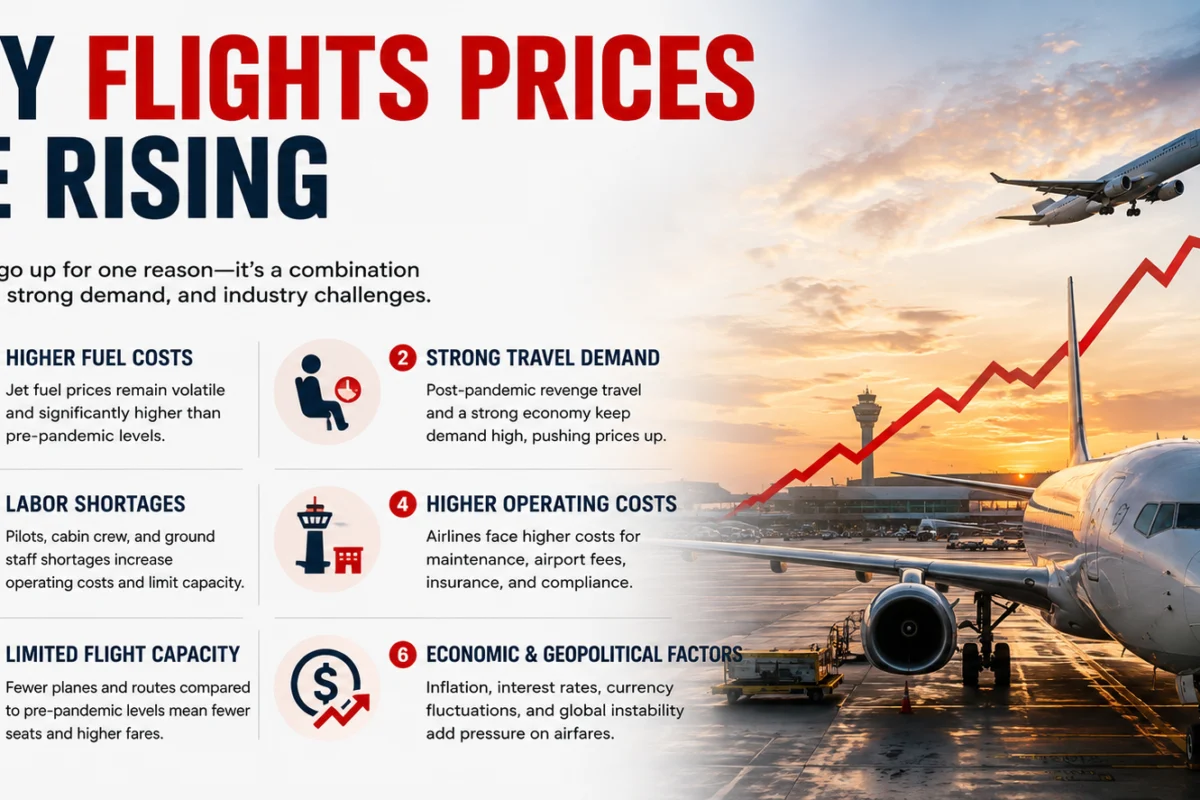
Why Flights Prices Are Rising :-You open a booking app, type in your usual route, and the fare on the screen makes you blink twice. The same seat that cost a modest amount a couple of years ago now costs noticeably more. It is not your imagination, and you are not alone. Travellers in India, the UK, the US and almost everywhere else are asking the same thing: why flights prices are rising when we were promised a cheaper, more connected world?
The honest answer is that there is no single villain. Airfares are the result of dozens of moving parts, including fuel, labour, aircraft supply, airport charges, taxes, demand and airline strategy, all pushing in the same direction at the same time. In this article I will walk through each of them in plain language. By the end you will understand why flights prices are rising, and more importantly, what you can do to keep your travel budget under control.
The Short Answer to Why Flights Prices Are Rising
If you only have thirty seconds, here it is. Airlines are running with fewer planes than they need, paying more for almost everything, and serving passengers who are eager to fly. When supply is tight and demand is strong, prices climb. That one sentence sums up why flights prices are rising across most markets. Everything below simply unpacks it.
1. Fuel Costs and Volatile Oil Markets
Fuel is usually the biggest single expense for an airline, often taking a quarter or more of operating costs. When crude oil prices swing upward, jet fuel follows, and airlines have very little room to absorb the shock. Some carriers hedge, meaning they lock in fuel prices months in advance, but hedging only delays the pain. Sooner or later the higher cost shows up in the fare on your screen.
What makes fuel tricky is its link to geopolitics. Conflicts, sanctions, production decisions by major oil exporters and even refinery outages can push jet fuel sharply higher within weeks. Refining capacity for jet fuel specifically has been tight in several regions, so aviation fuel can get expensive even when crude looks calm. If you want the first and most obvious answer to why flights prices are rising, fuel is it. But it is far from the whole story.
2. Fewer Aircraft, Longer Waiting Lists
During the pandemic, airlines parked planes, retired older jets early and paused orders. Manufacturers cut production and let skilled workers go. When travel roared back, the industry discovered that building aircraft takes far longer than cancelling orders. Supply chains for engines, seats and parts are still stretched, and delivery dates keep slipping.
Airlines therefore keep older aircraft flying longer, which raises maintenance bills, and they cannot add seats as fast as passengers want them. Engine inspections have also grounded some jets for long stretches, shrinking capacity further. A limited number of seats chased by a large number of travellers is a textbook recipe for higher prices. It is a major reason why flights prices are rising even on routes that were once budget-friendly. Until deliveries catch up with demand, this pressure is unlikely to disappear.
3. Labour Costs and the Pilot Shortage
Flying is a people-heavy business: pilots, cabin crew, engineers, ground handlers, air traffic staff, security officers. During the downturn many experienced workers left the industry, retired early or moved to other careers. When airlines needed to rebuild, they had to compete for talent, which meant better salaries, sign-on bonuses and improved working conditions.
Pilot training is long and expensive, and there is a limit to how quickly new pilots can be certified. Strikes and wage negotiations in several countries have added to the bill. These are fair demands from people who kept the industry alive, but the money has to come from somewhere. Anyone trying to understand why flights prices are rising must accept that higher labour costs are now a permanent part of the equation, not a temporary blip.
4. The Post-Pandemic Demand Surge
After long periods of restrictions, people wanted to travel again. Families reunited, professionals returned to in-person meetings, and holidaymakers who had postponed trips for years finally booked them. The trend was nicknamed “revenge travel”, and although the phrase has cooled, the appetite behind it has not. Growing middle-class populations in fast-developing economies are also flying for the first time, adding fresh demand every year.
Airlines noticed that passengers were willing to pay more, and they adjusted fares accordingly. When planes run nearly full, there is little reason to discount. Strong demand is one of the clearest, if least discussed, parts of why flights prices are rising. Airlines charge what the market will bear, and right now the market is bearing quite a lot.
5. Airport Charges, Taxes and Fees
Every ticket includes far more than the airline’s own costs. Airports charge landing fees, aircraft parking fees, passenger service fees and security charges. Governments add departure taxes, environmental levies and, in some countries, VAT or GST on the fare. Many airports have been upgraded or expanded, and the bill for that construction is passed to airlines and, eventually, to passengers.
Some of the biggest hubs are also slot constrained, meaning there is a fixed number of take-off and landing times. Scarce slots become valuable, and that value is reflected in what airlines charge. When you break down a fare, the tax and fee portion is often surprisingly large. That is one more layer in the story of why flights prices are rising, and one that airlines themselves have little control over.
6. Capacity Discipline and Airline Strategy
Before the pandemic, many airlines expanded aggressively, sometimes flying half-empty planes just to win market share. After nearly going under, most carriers changed their thinking. Profit came first. Today airlines are far more careful about adding flights, cutting unprofitable routes and keeping planes as full as possible.
This approach, known as capacity discipline, protects the airline’s finances, but it also means fewer bargain seats. Discount carriers that once sparked fare wars now focus on margins too. The result is a healthier industry and a more expensive experience for the traveller. When people ask why flights prices are rising, they often forget that airlines deliberately chose fewer seats and higher yields as their new business model.
7. Dynamic Pricing and Smart Algorithms
Airline fares are not fixed. They are set by revenue management systems that analyse booking patterns, competitor prices, seasonality, events, weather and even how often a route is searched. The moment demand for a flight picks up, the algorithm removes the cheapest fare buckets and moves to the next price level.
Modern software is extremely good at finding the maximum a passenger might be willing to pay, and prices can change many times a day. Two people sitting side by side may have paid very different amounts. This precision does not create demand, but it makes sure airlines capture as much of it as possible. It is a quiet contributor to why flights prices are rising in a way that feels random to consumers.
8. Environmental Rules and Sustainable Fuel
Aviation is under growing pressure to cut emissions. Many regions now require airlines to blend a share of sustainable aviation fuel into their supply, and that fuel costs significantly more than conventional jet fuel. Carbon pricing schemes and offset requirements add further costs on certain routes, especially within Europe.
Airlines are also investing in newer, more efficient aircraft and better emissions monitoring. These investments matter for the long-term future of flying, but they are expensive, and the cost will not stay on airline balance sheets forever. It is fair to say that the green transition is a growing part of why flights prices are rising, and its influence will likely increase over the next decade.
9. Consolidation and Reduced Competition
Over the last twenty years, the airline industry has consolidated through mergers, acquisitions and alliances. In many countries, two or three carriers now control most domestic traffic. Fewer competitors means less pressure to cut fares. When a low-cost airline collapses or shrinks, the remaining players often raise prices on the routes it once served.
Codeshares and joint ventures also let airlines coordinate schedules and share revenue. That can be good for connectivity, but it reduces price competition. Reduced competition is an important, if slightly technical, part of why flights prices are rising on corridors served by only one or two direct services.
10. Currency Swings and Global Events
Airlines pay for many things in US dollars: fuel, aircraft leases, spare parts and maintenance. When a local currency weakens against the dollar, those costs climb, and fares in the local currency follow. Travellers from countries with weaker currencies feel this the most.
Global events add further uncertainty. Airspace closures force planes onto longer routes, burning more fuel and adding crew hours. Extreme weather, technology outages and political tensions cause delays and cancellations that cost airlines heavily, and insurance premiums rise accordingly. Airlines build a buffer into their pricing to protect themselves, which is another practical piece of the puzzle of why flights prices are rising around the world.
11. Unbundling and Add-On Fees
Some travellers say the base fares don’t look that high, and sometimes they are right. But then come the extras: checked baggage, seat selection, meals, priority boarding, even printing a boarding pass at the airport with certain carriers. Airlines have unbundled the ticket, so a cheap base fare grows into a much bigger total by the time you finish checking out.
This strategy lets airlines advertise attractive prices while earning more per passenger. Ancillary revenue has become a major profit pillar. Comparing only the headline fare is misleading, and the real total is what you should check before booking. It is one more reason why flights prices are rising by more than the search results alone suggest.
Why Flights Prices Are Rising in India Specifically
India’s aviation market is one of the fastest growing in the world, and that growth brings its own pressures. Domestic demand has surged, but aircraft supply has not kept pace. Several carriers have had part of their fleets grounded because of engine problems, and the collapse of a major low-cost airline a few years ago removed capacity from the market. Airport user charges at busy metros are higher than many travellers realise, and state-level taxes on aviation fuel make jet fuel costlier than in many other countries.
Festival seasons, wedding months and school holidays create huge spikes. A ticket from Delhi to Mumbai or Goa can cost double or triple on peak dates. If you have ever wondered why flights prices are rising so sharply just before Diwali or during summer holidays, this mix of tight capacity, high taxes and seasonal demand is the answer. International routes from India are affected too, as airlines flying to the Gulf, Europe or Southeast Asia deal with longer routings around restricted airspace.
Is This the New Normal?
Probably, at least partly. Some pressures are temporary. Fuel prices can fall, aircraft deliveries will eventually recover, and supply chains will heal. But others are structural. Higher wages, environmental costs, airline discipline and consolidation are unlikely to reverse. Many analysts expect fares to stay above pre-pandemic levels in real terms for the foreseeable future, even if they ease from their peaks.
That does not mean flying will become a luxury again. New airlines, more efficient aircraft and fresh routes can take the edge off. But travellers should adjust their expectations. Understanding why flights prices are rising helps you plan sensibly instead of waiting for a return to old prices that may never come.
How to Beat Rising Airfares
Now that you know why flights prices are rising, let’s talk about practical ways to protect your wallet. You cannot change the industry, but you can change how you book.
- Book at the right time. Not too early, not last minute. For domestic trips, a few weeks ahead is usually the sweet spot. For international travel, aim for a couple of months.
- Stay flexible with dates. Mid-week flights and off-peak days are often much cheaper than Fridays, Sundays and holiday weekends.
- Set fare alerts. Let the price come to you instead of checking manually every day.
- Compare nearby airports. A short train or cab ride to a different airport can save a surprising amount.
- Look at two one-way tickets. Sometimes mixing airlines beats a return fare.
- Travel light. Skipping checked baggage removes one of the biggest add-on fees.
- Use points and card offers. Loyalty programmes, credit card benefits and festival sales can cut the final price.
Small habits like these will not reverse why flights prices are rising, but together they can take a meaningful bite out of your bill.
Common Myths About Why Flights Prices Are Rising
“Airlines are just greedy.” Historically, airlines have had thin and unstable margins, and many went bankrupt in past downturns. Higher prices today are largely a response to genuine cost increases and a determination not to repeat old mistakes.
“Clearing cookies lowers the fare.” There is little solid evidence for this. Prices move mainly because of seat availability, timing and demand, not because a website recognises you.
“Tuesday is always the cheapest day to book.” This used to be a popular tip, but modern pricing systems update constantly, so no single day is reliably best.
Separating fact from fiction matters when discussing why flights prices are rising, because believing a myth can lead you to waste time chasing a trick that doesn’t work.
Final Thoughts
Airfares are not climbing because of one decision or one company. They are climbing because fuel, labour, aircraft, taxes, technology, regulation and demand are all pulling upward together. Once you see that bigger picture, the question of why flights prices are rising feels less mysterious and more like a straightforward story of supply, cost and strategy.
The good news is that informed travellers still have plenty of power. Flexible dates, smart tools and a little planning can keep flying affordable even in an expensive era. So the next time a friend or family member asks you why flights prices are rising, you will have a clear, honest answer ready, along with a few tips to help them save on their next trip.


Join the conversation