

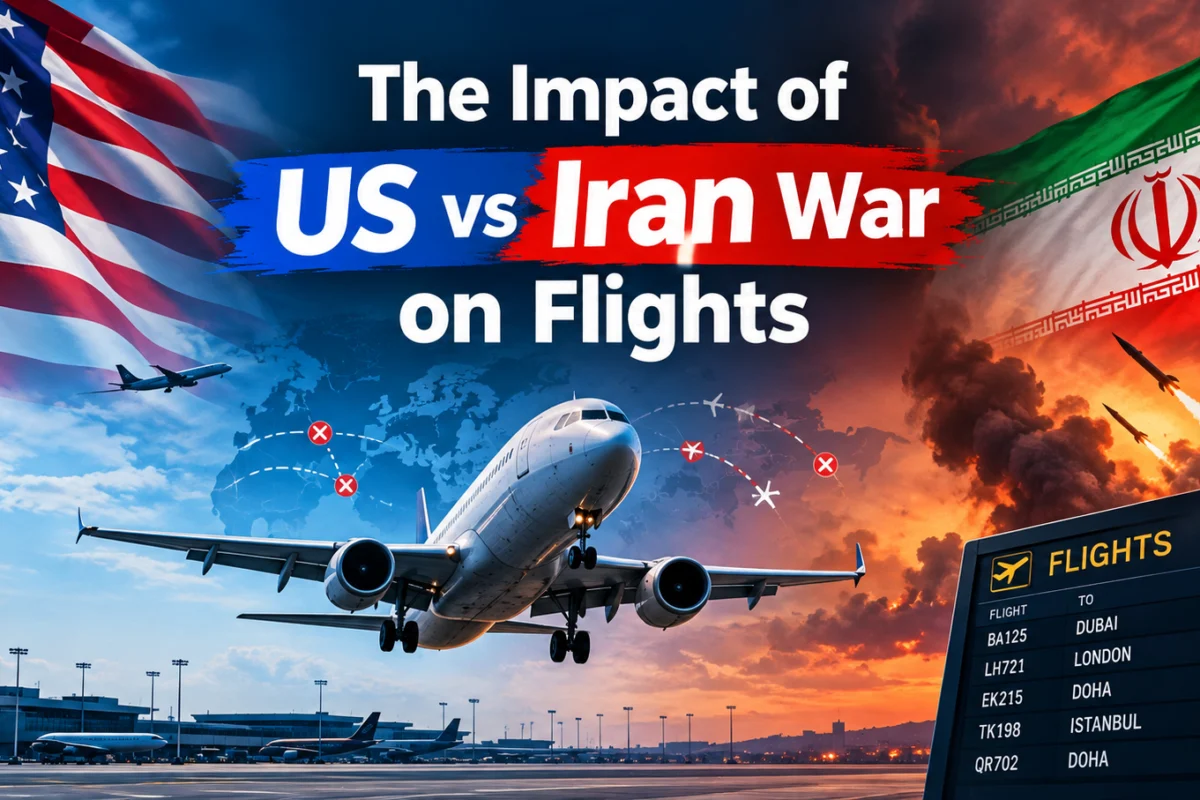
The Impact of US vs Iran War on Flights Few events reshape global travel as quickly or as dramatically as a military conflict breaking out along one of the world’s busiest flight corridors. Since late February 2026, the impact of US vs Iran war on flights has been one of the defining travel stories of the year, grounding tens of thousands of services, stranding over a million passengers, and permanently altering how airlines plan routes across the Middle East. This guide walks through exactly what’s happened, why it matters so much for global aviation, and what travellers need to know if their journey touches this increasingly complicated part of the world.
How the Conflict Began and Why Aviation Was Hit So Hard
The 2026 Iran war started on 28 February 2026, following coordinated US and Israeli strikes on Iran. Within days, at least eight states — including Iran, Israel, Iraq, Jordan, Qatar, Bahrain, Kuwait, and the United Arab Emirates — declared their airspace closed. The immediate impact of US vs Iran war on flights was staggering in scale: around 3,000 flights were cancelled in the opening days of the conflict alone, with that figure eventually climbing past 20,000, and later still past 30,000, as the disruption spread and deepened over the following weeks.
Understanding why this specific conflict has had such an outsized impact of US vs Iran war on flights requires understanding the geography involved. The Middle East has become an increasingly critical route for flights connecting Europe and Asia, largely because Russian and Ukrainian airspace has already been closed to most international airlines since the war in Eastern Europe. With that northern corridor unavailable, carriers had increasingly relied on Gulf airspace as their primary alternative — which meant that when this second major corridor also closed, airlines were left with dramatically fewer viable paths between two of the world’s largest aviation markets.
Which Airports and Routes Were Hit First
The early impact of US vs Iran war on flights fell hardest on some of the world’s busiest aviation hubs. Dubai International Airport, one of the busiest airports on the planet, saw flights to and from it suspended entirely as airspace closures took hold. Tel Aviv and Doha were similarly affected, and more than 40 flights were forced to divert in the early hours after the initial strikes, scrambling to find alternative routings with little warning.
Individual airlines felt the impact of US vs Iran war on flights in strikingly different ways depending on their specific route networks. Qatar Airways and Kuwait Airways both temporarily suspended flights entirely. Turkish Airlines cancelled services to several Middle Eastern destinations. Kuwait’s aviation authority halted all flights to Iran until further notice. Even Russian carriers, despite their own airspace already being closed to much of the world, suspended their own flights to both Iran and Israel. In percentage terms, airlines cancelled roughly half of their scheduled flights to Qatar and Israel, and around 28% of their flights to Kuwait, giving a genuine sense of just how widespread the disruption became almost overnight.
The Human Cost: Stranded Passengers and Repatriation Efforts
Beyond the raw statistics, the impact of US vs Iran war on flights has been measured in real human terms. More than a million people around the world found themselves stranded because of the airspace closures that grounded so many flights in such a short space of time. Aviation data firm Cirium, which has tracked the disruption closely throughout the conflict, described it as having an unusually long and geographically widespread impact on travel compared with most previous regional conflicts.
Numerous governments organised repatriation flights for their own stranded citizens as the crisis unfolded, a direct reflection of just how severe the impact of US vs Iran war on flights had become for ordinary travellers caught in the middle of a conflict entirely outside their control. Some particularly striking cases emerged during the crisis, including the evacuation of newborn babies from an Iranian hospital that had been damaged in the strikes, underlining the genuinely serious human stakes sitting behind the aviation statistics.
The Ripple Effect Beyond the Middle East
One of the more surprising elements of the impact of US vs Iran war on flights has been how far the disruption spread beyond the immediate conflict zone. Just three days into the conflict, the United States moved to close airspace throughout the Caribbean as a precautionary measure, stranding travellers who had booked holiday trips to resorts and home rentals thousands of miles from the actual fighting. This kind of far-reaching, seemingly unrelated disruption illustrates just how interconnected modern global aviation networks really are, and how a conflict in one region can create genuine chaos in destinations that have no direct connection to the underlying dispute.
Despite this widespread disruption, United Airlines CEO Scott Kirby noted that overall travel demand had remained broadly resilient since the conflict broke out, even as airlines absorbed the operational and financial shock of the impact of US vs Iran war on flights across their networks.
A Conflict That Refused to Stay Resolved
Perhaps the most challenging aspect of the impact of US vs Iran war on flights has been its sheer unpredictability. Airspace over several key Gulf states — including Doha, Bahrain, and Kuwait — closed and reopened multiple times between February and July 2026 as the security situation shifted, forcing airlines to constantly reassess their routing decisions on short notice rather than plan around a single, stable closure.
A ceasefire that had briefly stabilised the situation effectively broke down in July 2026, with renewed military action and attacks reported around the Strait of Hormuz, one of the world’s most strategically important waterways and a critical corridor for both shipping and aviation. This pattern of closure, tentative reopening, and renewed closure has made the impact of US vs Iran war on flights genuinely difficult for airlines to plan around, since route networks that made sense one month could become unviable again within weeks.
The Latest Development: Aviation Sanctions Reshape Iranian Travel
As of September 2026, the impact of US vs Iran war on flights has entered a new phase, driven less by direct military airspace closures and more by an expanding sanctions regime targeting Iran’s aviation sector specifically. US sanctions have begun shutting Iranian domestic airlines out of much of the world’s airspace, with airports and companies providing Iranian-operated aircraft with fuel, landing services, or ticket sales now facing the risk of secondary US sanctions that could cut them off from the US financial system entirely.
The practical impact of US vs Iran war on flights under this sanctions regime has been significant for ordinary Iranian travellers. Baghdad Airport has been declared off-limits to Iranian carriers, though flights to Najaf Airport, an important route for Shia Muslim pilgrims travelling between Iraq and Iran’s holy cities, continued operating as of late September. Turkish Airlines has suspended its Iran flights until at least March 2027, while Qatar Airways, Emirates, and Lufthansa have all similarly suspended their own operations to the country. Georgia and Azerbaijan have also moved to suspend Iranian flights in response to the mounting US pressure.
This latest chapter in the impact of US vs Iran war on flights has effectively pushed many Iranian travellers toward overland routes instead, as international airlines increasingly avoid the country altogether rather than risk falling foul of secondary sanctions. Iran, for its part, has warned neighbouring countries enforcing the US sanctions that their own airports could face retaliatory disruption, adding yet another layer of uncertainty to an already deeply unstable regional aviation picture.
What This Means for Fuel Costs and Airline Finances
The impact of US vs Iran war on flights extends well beyond cancellations and diversions into the underlying economics of running an airline. Airspace closures across the Middle East have disrupted a corridor that was already critical for connecting Europe, Asia, and Africa, forcing widespread rerouting that adds genuine time and cost to affected flights. Longer flight times mean higher fuel consumption, and jet fuel prices have surged as a direct consequence of the conflict, creating immediate margin pressure for airlines already operating on famously thin profit margins even in normal circumstances.
Network reliability has weakened considerably as a knock-on effect too, since airlines flying longer, rerouted paths have less operational buffer to absorb ordinary weather delays or technical issues on top of the conflict-driven disruption. This combination of higher costs and reduced reliability represents one of the more structural, longer-term dimensions of the impact of US vs Iran war on flights, likely to outlast the conflict itself in terms of how airlines plan their networks going forward.
Practical Advice for Travellers Affected by the Conflict
Given how volatile this situation has remained throughout 2026, understanding the practical impact of US vs Iran war on flights matters enormously for anyone travelling through or near the affected region. Checking your specific airline’s current route map and any active advisories before departure is essential, given how frequently airspace status has changed throughout the year. Organisations like OPSGROUP, which run the Safe Airspace conflict zone database, provide regularly updated briefings on which specific Flight Information Regions remain closed or restricted at any given time, and consulting this kind of resource is far more reliable than assuming a route that was open last month remains open today.
Travel insurance becomes genuinely essential for anyone whose journey touches this region, given how directly the impact of US vs Iran war on flights has affected ordinary travellers with no connection to the conflict itself. It’s worth specifically checking that any policy you’re considering covers conflict-related cancellations and rerouting, since not every standard travel insurance policy automatically includes this kind of coverage as standard. Building genuine flexibility into any itinerary touching the Gulf region, Iran, or nearby airspace is also sensible for the foreseeable future, given how unpredictably the situation has continued to evolve even months after the conflict first began.
Longer-Term Consequences for Global Aviation
Beyond the immediate disruption, the impact of US vs Iran war on flights is likely to reshape aviation planning for years to come. With both Russian-Ukrainian airspace and now large parts of Middle Eastern airspace becoming genuinely unreliable for international carriers, airlines are increasingly having to plan around the assumption that major overland corridors between Europe and Asia can close with very little warning. This is already influencing longer-term fleet and route planning decisions across the industry, as carriers weigh the value of aircraft capable of flying longer alternative routes against the ongoing operational cost of doing so.
The broader travel industry has felt the impact of US vs Iran war on flights too, with one estimate putting the global travel sector’s total exposure at around $11.7 trillion given how central air connectivity is to tourism, business travel, and international trade more broadly. Whatever the eventual resolution of the underlying conflict, the scale of disruption seen throughout 2026 has already demonstrated just how quickly a regional military crisis can cascade into a genuinely global aviation and travel emergency.
Insurance and Documentation Considerations
Given the scale of disruption already covered, it’s worth going a little deeper on the practical side of things for anyone with a booking that touches the region. Standard travel insurance policies vary considerably in how they treat conflict-related disruption, and this is an area worth checking carefully rather than assuming automatic coverage. Some policies explicitly exclude cancellations arising from war or armed conflict, treating it differently from a standard weather delay or mechanical cancellation, while others include specific “war risk” provisions that may cover rerouting costs, extended hotel stays, or even full trip cancellation if your destination or transit country becomes genuinely unsafe to reach. Reading the small print before booking any travel touching the wider Gulf region has become a far more important habit than it would have been before this conflict began, precisely because the impact of US vs Iran war on flights has shown how quickly an itinerary that looked completely routine can become genuinely complicated.
How Airlines Have Adapted Their Networks
Airlines haven’t simply absorbed this disruption passively — many have actively restructured parts of their networks in response. Some carriers have shifted connecting traffic away from Gulf hubs toward alternative routings through Central Asia or further south around the Arabian Peninsula, accepting longer flight times in exchange for greater operational predictability. Others have temporarily reduced frequency on affected routes rather than cancelling them outright, allowing them to maintain a presence in key markets while limiting their exposure to the ongoing disruption. A smaller number of carriers, particularly regional airlines with limited network flexibility, have found themselves with few viable alternatives and have simply absorbed extended periods of suspended service on certain routes until the security situation stabilises enough to resume.
This kind of network-level adaptation matters for travellers too, since it means the specific routing offered on a given itinerary today may look meaningfully different from what was available before the conflict began, even for carriers that have continued operating throughout. It’s genuinely worth double-checking the actual routing of any booking touching this region, rather than assuming a familiar airline and familiar-sounding route will follow the same path it did in previous years.
Monitoring the Situation Going Forward
The Impact of US vs Iran War on Flights :-Given how many times the security picture has shifted throughout 2026, staying informed about the ongoing impact of US vs Iran war on flights requires more than a single check at the time of booking. Aviation risk databases like Safe Airspace publish regularly updated briefings specifically tracking which Flight Information Regions remain closed, restricted, or newly reopened, and checking these sources close to your actual departure date, rather than relying on information from weeks earlier, is genuinely worthwhile given how quickly the situation has continued to change. Airlines themselves typically post updated route and safety advisories directly on their own websites too, and it’s sensible to check these alongside independent aviation risk sources rather than relying on either one exclusively.
The impact of US vs Iran war on flights has been one of the most significant aviation disruptions of the decade, reshaping travel patterns across three continents since the conflict began in February 2026. From the initial wave of over 20,000 cancelled flights and a million stranded passengers, through months of airspace closing and reopening around the Gulf, to the current sanctions-driven reshaping of Iranian aviation specifically, this has been a genuinely fluid and evolving situation rather than a single, contained event.
For travellers with any journey touching this region, staying genuinely informed through reliable, regularly updated sources remains the single most important thing you can do. The impact of US vs Iran war on flights isn’t over, and given how many times the situation has shifted throughout 2026 alone, it’s sensible to assume it could continue evolving for some time yet. Building flexibility, securing appropriate travel insurance, and checking current airspace advisories before any trip touching the Middle East remain the most practical ways to protect yourself against a situation that continues to affect ordinary travellers with little warning.

Join the conversation