

The reality is more complicated.
There is no single seat that can be guaranteed to be the safest in every possible aircraft emergency. The outcome of an incident depends on factors such as where an impact occurs, the type of emergency, whether an evacuation is required and how quickly passengers can reach a usable exit.
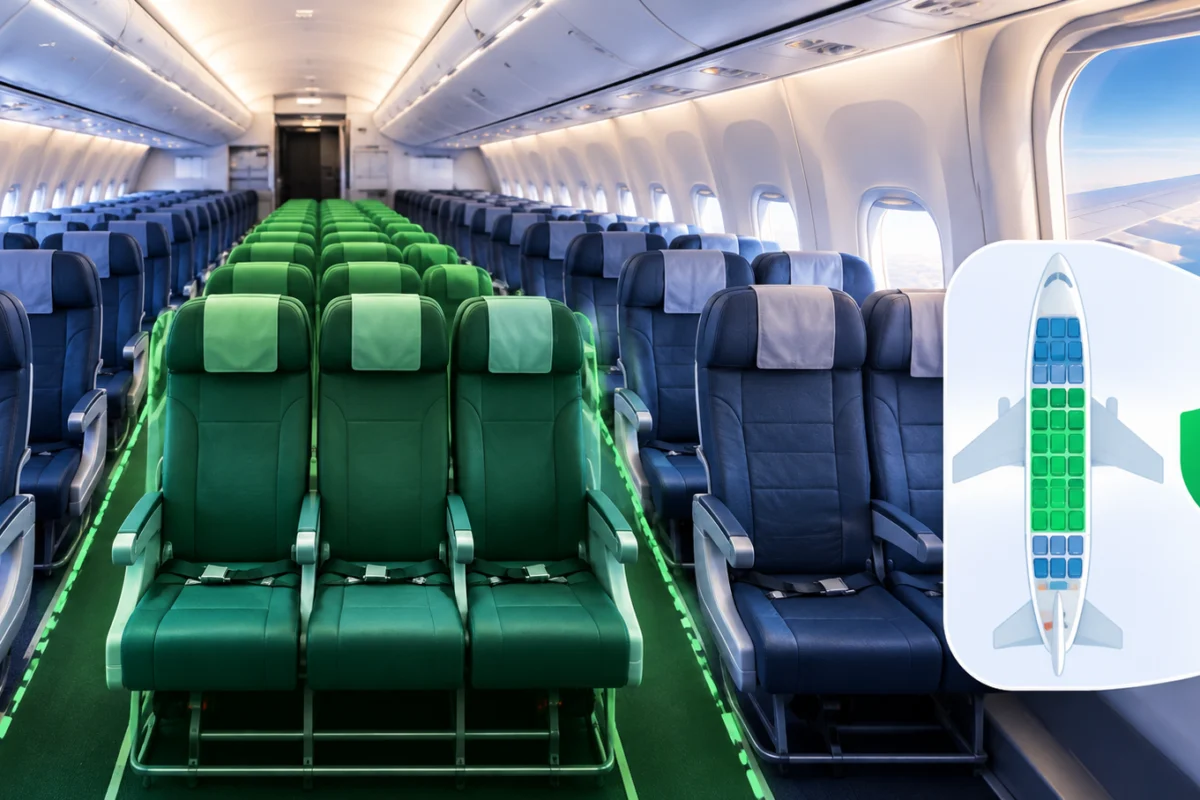
However, historical accident data has identified some seating positions with better survival outcomes in particular groups of accidents. A frequently cited analysis found that seats in the rear third of an aircraft had a lower fatality rate than seats in the middle or front sections, while rear-middle seats had the lowest fatality rate in that analysis.
So, if you are trying to find the safest seating on a plane, what should you actually look for?
This guide explains the evidence, the advantages and disadvantages of different cabin sections, and the practical safety factors that matter when selecting your seat.
Is There Really a Safest Seat on a Plane?
The short answer is: not universally.
Different aircraft accidents happen in very different ways. An impact at the front of an aircraft can produce different outcomes from an accident involving the rear. A fire may make proximity to a usable exit more important, while another type of accident may make seat location less relevant altogether.
That is why it would be misleading to tell passengers that one specific seat is always the safest seating on a plane.
Historical research can still provide useful information.
One widely discussed analysis of aircraft accident data found that passengers sitting in the rear third of the aircraft had a lower fatality rate than those in the middle or front sections. Within that dataset, middle seats in the rear section recorded the lowest fatality rate.
But these statistics should not be treated as a guarantee for future flights.
Modern commercial aviation is highly regulated, and aircraft are designed with emergency evacuation requirements in mind. The FAA states that transport aircraft must be capable of rapid evacuation under its certification requirements.
For everyday travellers, understanding evacuation procedures and following crew instructions can be more useful than obsessing over one particular seat.
What Seat Has Historically Had the Best Survival Rate?
If you are specifically researching the safest seating on a plane, the rear-middle area is often mentioned.
A historical analysis of aircraft accident data found a fatality rate of 28% for middle seats in the rear section, compared with higher rates for several other seating positions in the dataset. The analysis covered a relatively small subset of accidents for which both survival data and seating charts were available, so it should not be interpreted as a universal rule.
Why might a rear-middle seat have advantages?
A middle seat can have passengers on either side, potentially providing some additional physical buffering in certain impacts. The rear section may also be farther from an impact affecting the front of an aircraft.
However, there is an important limitation.
Aircraft accidents are not predictable enough for a single seat position to guarantee a better outcome. In some scenarios, being close to a usable emergency exit could be more important than whether your seat is at the front or rear.
Therefore, the rear-middle seat can be considered a historically favourable option, rather than a guaranteed safest seat.
Is the Back of the Plane Safer?
The back of the aircraft is frequently discussed when people search for the safest seating on a plane.
Historical data has suggested that passengers in the rear section have sometimes experienced better survival outcomes than passengers closer to the front. One analysis reported a 32% fatality rate for the rear third, compared with 39% for the middle third and 38% for the front third.
There are possible reasons for this.
In some forward-impact scenarios, the front portion of an aircraft can experience the initial forces before the rear section. However, this does not mean that every accident follows the same pattern.
The rear of an aircraft can also have disadvantages.
Depending on the aircraft layout, passengers at the very back may be farther from certain exits. If an exit is blocked by fire, smoke or structural damage, simply sitting near the rear does not automatically make evacuation easier.
So if you prefer the rear section, consider combining seat location with exit accessibility.
Are Middle Seats Safer Than Window or Aisle Seats?
The middle seat is often considered when discussing the safest seating on a plane.
The reasoning is fairly straightforward: a passenger sitting in the middle has another passenger on either side, which may provide some degree of physical buffering during certain types of impacts.
Historical data has supported this idea in some accident analyses. Rear-middle seats performed particularly well in the frequently cited dataset.
However, middle seats are not automatically safer in every situation.
An aisle seat provides easier access to the aisle and may make movement towards an emergency exit more convenient. A window seat can provide a more enclosed seating position and may be preferred by travellers who want to remain away from the aisle.
During an evacuation, however, getting to a usable exit quickly is critical.
That means the safest seating on a plane may depend not only on the seat itself but also on how easily you can reach an exit.
Is an Aisle Seat Safer?
An aisle seat has one obvious advantage: access.
You can usually move into the aisle without asking another passenger to get up, which may be useful if you need to evacuate quickly.
However, that does not automatically make the aisle seat the safest seating on a plane.
An aisle passenger may be more exposed to people or objects moving through the cabin. Historical accident data has also shown that some aisle positions performed worse than rear-middle seats in certain datasets.
The biggest advantage of an aisle seat is therefore mobility, not a guaranteed reduction in injury risk.
If you choose an aisle seat, pay attention to the emergency exits around you and count the rows to them.
Is a Window Seat Safer?
Window seats are popular because they offer a view and allow passengers to avoid people walking through the aisle.
From a safety perspective, however, there is no strong basis for saying that a window seat is universally the safest seating on a plane.
Its biggest practical disadvantage during an emergency is that you may need to move past other passengers before reaching the aisle.
Its advantage is that you are positioned away from the main aisle.
As with other seat types, the circumstances of an emergency determine which factors matter most.
What About Exit Row Seats?
Exit-row seats are often assumed to be the safest seating on a plane because they are close to an emergency exit.
There is a genuine advantage: proximity to an exit can reduce the distance you need to travel during an evacuation.
However, sitting in an exit row comes with responsibilities.
Passengers seated there must be physically capable and willing to perform emergency actions if required. The FAA specifically states that passengers in emergency or exit rows must be capable of carrying out those actions and should familiarise themselves with the relevant procedures.
Therefore, an exit-row seat should not simply be selected because it sounds safer.
You should understand the responsibilities associated with that seat and follow the instructions provided by the cabin crew.
Is Sitting Near an Emergency Exit Better?
Safest Seating on a Plane :Being close to an emergency exit can be an important safety consideration.
The FAA recommends that passengers identify the nearest exits both in front of and behind their seat and count the rows between their seat and those exits. Importantly, the nearest usable exit may be behind you.
This is one of the most practical things you can do regardless of where you sit.
Imagine that smoke makes the cabin difficult to see.
Counting the rows beforehand can help you navigate towards an exit even if visibility becomes poor.
For this reason, when choosing the safest seating on a plane, proximity to an exit can sometimes be more useful than simply choosing the front, middle or rear of the aircraft.
Does the Front of the Plane Have a Safety Advantage?
The front of the aircraft is generally popular for reasons unrelated to safety.
Passengers may prefer it because they can leave the aircraft sooner after landing or because the cabin can feel quieter depending on the aircraft layout.
But historical accident data does not establish the front as the safest seating on a plane.
One frequently cited analysis found a higher fatality rate in the front third than in the rear third of the aircraft.
That does not mean sitting at the front is dangerous.
Commercial aviation is designed around multiple safety systems, and millions of passengers fly safely every year.
Seat position is only one factor in an extremely complex set of circumstances.
What Is More Important Than Choosing the Safest Seat?
This is perhaps the most important point in the entire article.
If you want the safest seating on a plane, choosing a seat is only one part of passenger safety.
Your behaviour can matter considerably during an emergency.
The FAA recommends paying attention to the safety briefing, reviewing the safety card and locating the nearest exits.
Before take-off:
- Listen to the cabin crew.
- Read the safety card.
- Locate exits.
- Count the rows to nearby exits.
- Keep your seat belt fastened when required.
- Know how to adjust your seat belt.
- Follow crew instructions.
These steps are useful regardless of whether you sit at the front, middle or rear.
Why You Should Always Count the Rows to an Exit
If you remember only one practical tip from this article, make it this one.
After taking your seat, identify the nearest exit in front of you and the nearest exit behind you.
Then count the rows.
For example, if you are five rows from the exit behind you, remember that number.
The reason is simple.
In an emergency involving smoke or darkness, visibility may be reduced. You may not be able to see the exit clearly.
Knowing that it is, for example, five rows behind you gives you a mental reference point.
The FAA specifically recommends counting the rows between your seat and the nearest front and rear exits.
This can be more valuable than worrying about whether your seat is theoretically the safest seating on a plane.
Does the Aircraft Type Affect Seat Safety?
Yes.
Different aircraft have different cabin layouts, exit positions and seating configurations.
A seat that is near an exit on one aircraft may be several rows away from an exit on another.
This is another reason why there is no universal answer to the question of the safest seating on a plane.
Instead of memorising a particular row number, look at the aircraft-specific safety information provided during your journey.
The FAA’s guidance also emphasises using the aircraft’s safety card and following the instructions provided by the crew.
What Should You Do During an Emergency Evacuation?
Safest Seating on a Plane:If the crew orders an evacuation, follow their instructions immediately.
Do not stop to collect your suitcase, handbag or other belongings.
The FAA explicitly advises passengers to leave carry-on bags behind during an emergency evacuation because they can slow down other passengers, block aisles and interfere with evacuation slides.
Move towards the nearest safe exit as directed.
If the nearest exit is blocked or unsafe, follow crew instructions and use another available exit.
This is why knowing the exits around you is so important, regardless of whether you believe you have selected the safest seating on a plane.
Does Turbulence Change Which Seat Is Safest?
Turbulence is another reason travellers think about seat location.
The middle section around the wings generally experiences less up-and-down movement than the rear of the aircraft because it is closer to the aircraft’s centre of gravity.
That can make the middle area feel more stable during turbulence.
However, turbulence safety is different from crash survival.
If turbulence is your main concern, keeping your seat belt fastened whenever you are seated is much more important than trying to identify the safest seating on a plane.
Always follow crew instructions during turbulence.
Should You Choose the Rear-Middle Seat?
If your only priority is historical accident data, the rear-middle area is a reasonable option to consider.
It has been identified as having the lowest fatality rate in one frequently cited historical analysis.
But you should not assume that booking a rear-middle seat guarantees a safer flight.
Consider the location of emergency exits as well.
A rear-middle seat that is several rows away from a usable exit may not provide the same evacuation advantage as a seat located close to an exit.
The best practical approach is to combine historical information with basic passenger-safety principles.
Safest Seating on a Plane: Front vs Middle vs Rear
Here is a simple comparison:
| Cabin position | Potential advantage | Potential disadvantage |
|---|---|---|
| Front | Convenient for leaving after landing | Historical data does not show it as the strongest option |
| Middle | Often closer to central exits and generally stable during turbulence | Can be around wing/fuel areas |
| Rear | Historically better survival outcomes in some datasets | May be farther from some exits |
| Rear-middle | Best historical outcome in frequently cited analysis | Not guaranteed to be safest in every accident |
| Exit row | Close to an emergency exit | Requires passengers to be capable of assisting during an evacuation |
The important takeaway is that there is no seat that guarantees survival.
How to Choose a Seat for Maximum Practical Safety
If you want a simple method for choosing the safest seating on a plane, consider these steps.
1. Look at the Aircraft Layout
Check where the exits are located.
2. Consider the Rear Section
If historical accident data is important to you, the rear section can be considered.
3. Look at Exit Accessibility
Choose a seat that allows you to identify a nearby usable exit.
4. Consider Your Own Needs
If you have mobility limitations, choose a seat that allows you to travel comfortably and safely.
5. Keep Your Seat Belt Fastened
Seat belts remain one of the most important basic safety measures during flight.
6. Listen to the Crew
Do not ignore the safety briefing simply because you have flown before.
Common Myths About the Safest Plane Seat
Myth 1: The Back Is Always Safe
Not necessarily.
Historical data may favour the rear in certain accidents, but no section is guaranteed to be safer in every scenario.
Myth 2: The Exit Row Is Always Safest
Not necessarily.
Being close to an exit can be useful during an evacuation, but the exit must be usable and the passenger must be able to perform the required actions.
Myth 3: The Front Is Dangerous
No.
Commercial aircraft are designed with extensive safety requirements. A front seat should not be described as inherently dangerous.
Myth 4: Window Seats Are Always Safer
There is no universal evidence that a window seat is always safer than an aisle or middle seat.
Myth 5: Seat Selection Is the Most Important Safety Factor
Not necessarily.
Knowing your exits, listening to the crew, wearing your seat belt and following evacuation instructions are all extremely important.
Frequently Asked Questions
What is the safest seating on a plane?
There is no universally safest seat for every type of emergency. Historical accident analysis has found that rear-middle seats had the lowest fatality rate in a particular dataset, but the circumstances of an accident can change which seats have an advantage.
Is the back of a plane safer?
Safest Seating on a Plane :Some historical accident data suggests that passengers in the rear section have had better survival outcomes than passengers in the front or middle sections. However, this is not a guarantee and should not be interpreted as meaning every rear seat is safer.
Is the middle seat the safest?
Safest Seating on a Plane :The middle seat has historically performed well in some accident data, particularly in the rear section. One analysis found rear-middle seats had the lowest fatality rate among the seating positions studied.
Are exit row seats safer?
Safest Seating on a Plane :Exit-row seats provide quick access to an emergency exit, which can be useful during an evacuation. However, passengers sitting there must be capable and willing to perform emergency actions if required.
Is the aisle seat safer than the window seat?
Safest Seating on a Plane :Neither can be described as universally safer. The aisle provides easier access to the cabin, while a window seat keeps you away from aisle traffic. The circumstances of an emergency determine which advantages matter.
Should I sit at the back if I am nervous about flying?
Safest Seating on a Plane :You may choose a rear seat if historical safety statistics make you feel more comfortable, but remember that commercial aviation has extensive safety procedures across the cabin. Knowing the emergency exits and following crew instructions are practical steps that every passenger can take.
Which seat is best for turbulence?
Safest Seating on a Plane :The middle section around the wings generally experiences less movement than the rear because it is closer to the aircraft’s centre of gravity.
Does sitting near an exit improve survival?
Safest Seating on a Plane :Being close to a usable exit can reduce the distance you need to travel during an evacuation. However, the exit must be accessible and safe to use. The FAA recommends passengers identify exits in both directions from their seat.
What should I do during an aircraft evacuation?
Final Thoughts
If you are searching for the safest seating on a plane, the most accurate answer is that there is no single seat that guarantees the best outcome in every possible emergency.
Historical accident data has identified the rear section, particularly rear-middle seats, as having favourable survival outcomes in certain datasets.
But seat location is only part of the picture.


Join the conversation