

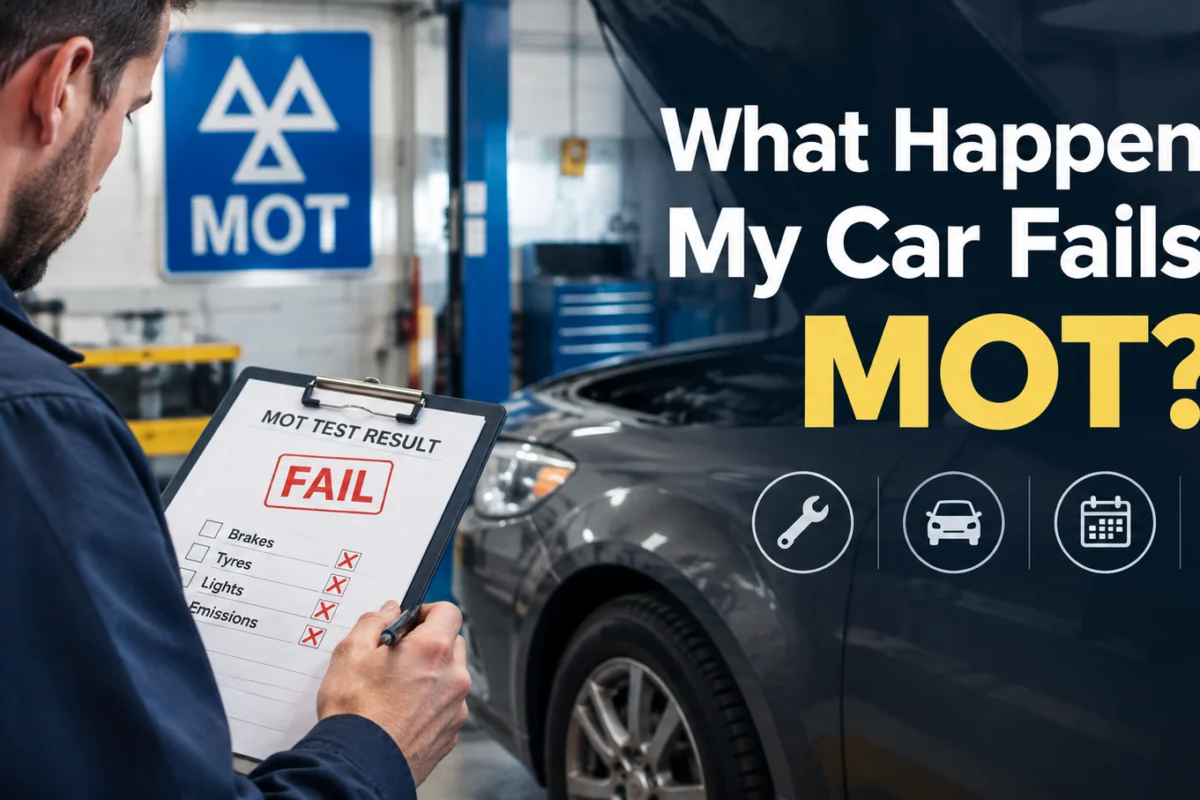
what happens if my car fails its MOT :-There are few sinking feelings quite like watching a mechanic walk over, clipboard in hand, with that particular look on their face. Then the questions start: can I still drive it? How much will this cost? Am I breaking the law right now? If you’ve ever wondered what happens if my car fails its MOT, you’re in very good company — roughly three in ten cars fail their test first time around in the UK, which works out at millions of drivers every single year.
The good news is that a failure is rarely the disaster it feels like in the moment. In most cases it’s a bulb, a wiper blade, or a tyre that’s crept just under the legal limit. This guide walks through exactly what happens if my car fails its MOT, step by step, so you know your rights, your costs, and your options before you even set foot in the garage.
The First Thing That Happens: You Get a VT30
When a car fails, the tester doesn’t just shrug and hand your keys back. They issue a formal document called a VT30 — a “Refusal of an MOT Test Certificate”. This is the single most important piece of paper in the whole process, and the first concrete answer to what happens if my car fails its MOT.
The VT30 lists every single reason your vehicle didn’t meet the required safety standards, categorised by severity. Keep it somewhere safe. You’ll need it when you go back for a retest, because it tells the tester precisely which items need re-checking rather than forcing them to start the whole inspection from scratch. Losing it can genuinely cost you money.
A lot of drivers asking what happens if my car fails its MOT assume the VT30 is just a receipt. It isn’t. It’s also worth reading properly rather than stuffing it into the glovebox. The wording can look intimidating, but most of it is standardised DVSA language describing ordinary wear and tear. If something confuses you, ask the tester to explain it.
Understanding the Three Fault Categories
Since May 2018, every fault found during an MOT falls into one of three buckets. It’s worth learning these properly, because almost every practical question about what happens if my car fails its MOT traces back to which bucket your defects landed in, and the categorisation is the key to understanding what happens if my car fails its MOT in your specific situation.
Minor faults don’t cause a failure at all. They’re logged on your certificate as something to keep an eye on, similar to an advisory. You’ve passed, but the tester is flagging something that will probably need attention before too long.
Major faults cause a failure. The car has a defect that could affect its safety, affect other road users, or have an environmental impact. It needs fixing, but it isn’t classed as an immediate danger.
Dangerous faults also cause a failure, and they’re far more serious. A dangerous defect means the car is unroadworthy and must not be driven — full stop. No exceptions, no “just to the garage down the road”.
That distinction between major and dangerous is the single biggest factor in what happens if my car fails its MOT, because it directly determines whether you can drive away from the test centre or need to arrange recovery.
Can You Legally Drive Away After a Fail?
This is the question that causes the most confusion when people ask what happens if my car fails its MOT, and getting it wrong can be expensive. Here’s how it actually breaks down.
If the fail was dangerous: you cannot drive the car at all. Not to another garage, not home, not around the corner. Even moving it to a different workshop for repairs would be illegal, and you’d need to arrange recovery or have the work done where it sits.
If the fail was major and your previous MOT certificate is still valid: you can legally drive the car away from the test centre. This is one of the more forgiving aspects of what happens if my car fails its MOT. However — and this is important — the vehicle still has to meet basic roadworthiness standards at all times. A serious brake problem you know about could still get you pulled over and prosecuted even if the paperwork technically permits you to drive.
If your previous MOT has already expired: your options narrow considerably. You can only drive to a pre-booked MOT appointment or to a garage for repairs, and only if the vehicle is genuinely in a safe condition. Driving anywhere else without a valid certificate can land you with a fine of up to £1,000, and potentially prosecution.
This is why timing matters so much. You can book your MOT up to a month before the current certificate expires and still keep the same renewal date. That single bit of planning gives you weeks of breathing room to sort out any faults rather than being stranded off the road, and it dramatically changes what happens if my car fails its MOT from a crisis into an inconvenience.
The Retest Rules and What They Cost
Once you know the answer to what happens if my car fails its MOT in terms of driving, the next question is money. Retest fees follow DVSA rules that apply consistently across the UK, and there are essentially four scenarios.
Leave the car at the same test centre, repaired and retested within 10 working days — free. If you let the garage that tested your car do the repairs, and the vehicle never leaves the premises, you won’t pay a retest fee at all. This is the cheapest and simplest route.
Take it away, fix it, and return by the end of the next working day — free partial retest. If you drive the car elsewhere for repairs and bring it back to the original test centre by close of business the following working day, the partial retest is free of charge. This applies only to certain failure items, though, and only if the faults weren’t dangerous. It’s designed for straightforward fixes — a blown bulb, a split wiper blade, that sort of thing.
Repair elsewhere and return within 10 working days — reduced fee. Get it fixed by a different garage and bring it back to the same test centre within ten business days, and you’ll typically pay a partial retest fee, often around half the standard MOT price.
Return after 10 working days, or go to a different centre entirely — full fee. At this point the tester has to carry out the complete MOT again from scratch, and you pay the full price.
The maximum statutory fee for a standard car MOT is £54.85, which means even a partial retest caps out at around £27.43. So while nobody enjoys paying twice, the retest itself is rarely the expensive part of what happens if my car fails its MOT — it’s the repairs that hurt.
What It Actually Costs to Fix
Here’s the reassuring bit. When people worry about what happens if my car fails its MOT, they usually imagine catastrophic engine work. The data tells a very different story.
Analysis of DVSA testing records shows the top failure categories are remarkably mundane. Lamps, reflectors and electrical equipment consistently top the list, accounting for roughly a quarter to a third of all failures depending on the year measured. Suspension comes next, then brakes, tyres, and driver visibility issues like cracked windscreens and worn wipers. Between them, those five categories cover the overwhelming majority of failure items.
In cost terms, that’s actually encouraging, and it reframes what happens if my car fails its MOT from a financial emergency into a manageable bill. A replacement bulb runs somewhere between £3 and £15. Wiper blades are roughly £10 to £25 for a pair. A tyre typically costs £50 to £80 each. Brake pads run around £100 to £200 per axle. Suspension work climbs higher, and corrosion or structural issues are where bills get genuinely serious — but those are a minority of cases.
The takeaway is that what happens if my car fails its MOT most often involves inexpensive, visible, checkable items. Tyre tread below the legal limit alone accounts for a significant chunk of all failure items across two decades of DVSA records, and a blown number plate bulb fails more cars than most owners would ever guess.
What If You Think the Failure Was Unfair?
Occasionally a driver genuinely believes a tester got it wrong — a misunderstanding about a modification, perhaps, or a judgement call you disagree with. You do have a formal route, and it’s a legitimate part of understanding what happens if my car fails its MOT.
You can appeal by completing a “Complain about an MOT” form and sending it to the DVSA within 14 working days of the test. Critically, you must not repair or modify the car before the appeal is heard — doing so cancels the process entirely, because there’s no longer anything for the DVSA examiner to assess.
If you go down this route, you pay the maximum MOT fee for your vehicle type to the DVSA examiner before the appeal retest begins. Pass, and that fee is refunded in full. Fail again, and you’re out the money and back where you started, still needing the repairs.
Appeals can and do succeed, but they’re something of a gamble, and they’re rarely the first answer to what happens if my car fails its MOT. In many cases, a calm conversation with the test centre manager resolves things faster and cheaper. Most disputes come down to miscommunication rather than genuine error.
What Happens to Your Road Tax
what happens if my car fails its MOT A detail that catches people out: you cannot renew your vehicle tax without a valid MOT pass certificate. So if your MOT has lapsed and your car has failed, you’re facing two overlapping legal problems rather than one.
This is a genuinely important piece of what happens if my car fails its MOT, because an untaxed vehicle on a public road carries its own penalties entirely separate from the MOT issue. If your tax renewal date is approaching and you’ve just failed, getting the retest sorted quickly becomes a priority rather than something to put off until payday.
A Realistic Timeline
Let’s walk through what happens if my car fails its MOT in practical, day-by-day terms, because the abstract rules can be hard to map onto real life.
Day one: You fail and receive your VT30. The tester explains which category each fault falls into and quotes for repairs. You decide whether to have the work done there or take the car elsewhere.
Days one to ten: This is your window. If the garage does the work in-house, you’ll usually have the car back within a few days and pay nothing for the retest. If you’re sourcing parts yourself or shopping around for a cheaper quote, keep that ten-working-day deadline firmly in mind — it’s the difference between a reduced retest fee and a full one.
Beyond ten working days: You’re now looking at a fresh, full MOT at full price. Parts delays are the usual culprit, particularly on older or less common vehicles. If a part will take weeks to arrive, raise it with the garage early rather than discovering the deadline has quietly passed.
The other thing worth flagging about what happens if my car fails its MOT is that a retest failure simply restarts the process. If the car fails again, it still can’t legally be driven on the roads, another retest needs booking, and any outstanding work has to be completed. There’s no limit on how many times you can retest, but each round costs time and money.
How to Avoid the Whole Situation Next Time
Since a large share of failures come down to things you could spot from your driveway, a pre-MOT check is genuinely one of the highest-value twenty minutes you can spend on a car. Understanding what happens if my car fails its MOT is useful; not failing in the first place is better.
Here’s the pre-test checklist that addresses the majority of common failure reasons, and the best insurance against ever needing to worry about what happens if my car fails its MOT again.
Check every light. Headlights, sidelights, brake lights, indicators, hazards, fog lights, reversing lights and — the one everyone forgets — number plate lamps. Get someone to stand behind the car while you press the brake pedal. Bulbs are a couple of pounds and take minutes to swap on most vehicles.
Check your tyres. The legal minimum tread depth is 1.6mm across the central three-quarters of the tyre, around the full circumference. The classic 20p test works well: insert a coin into the tread groove, and if you can see the outer band of the coin, your tread is likely too low. Also look for cuts, bulges and uneven wear, which fail you regardless of tread depth.
Test wipers and washers. Split or streaking blades fail cars routinely, as does an empty or blocked washer system. Both are trivial to fix and trivially annoying to fail on.
Look at your windscreen. Chips or cracks in the driver’s line of sight are a failure item. Many are repairable cheaply, and some insurance policies cover chip repair without affecting your premium.
Check your dashboard. Illuminated warning lights for ABS, airbags or engine management will fail the test. If one’s been glowing away for months, get it diagnosed before the MOT rather than after.
Listen to the car. Knocking over bumps, a spongy brake pedal, or a pull to one side under braking are all signs of suspension or brake wear. These are the items you’re least likely to catch yourself, which is why a professional pre-MOT inspection a week or two beforehand can be money well spent.
Frequently Asked Questions
A few quick answers to the questions that come up most often alongside what happens if my car fails its MOT.
Can I be fined just for failing? No. Failing itself isn’t an offence. The penalties come from driving a vehicle without a valid MOT, or driving one with dangerous defects — which is a different thing entirely from simply receiving a VT30.
Does a failure show up on my car’s public MOT history? Yes. The DVSA’s online MOT history service records passes, failures and advisories, and it’s publicly searchable by registration number — worth knowing if you’re planning to sell.
Will my insurance be invalid? Driving without a valid MOT can complicate a claim, and many policies require your vehicle to be roadworthy and legally compliant. If your certificate has expired, keep the car off the road except for the permitted journeys.
Is a retest ever completely free? Yes, in two situations: if the car stays at the original test centre and is repaired and retested within ten working days, or if you take it away and return it by the end of the next working day for eligible items.
The Bottom Line
Failing is stressful, but it’s ordinary. Around three in ten cars fail their first test, the vast majority for cheap, fixable reasons, and the system has plenty of built-in flexibility to get you back on the road without paying twice.
The short version of what happens if my car fails its MOT is this: you get a VT30 listing the faults, your ability to drive depends entirely on whether those faults were classed as major or dangerous and whether your old certificate is still valid, and you have ten working days to get repairs done and return to the same test centre for a discounted or free retest.
Know your fault categories, keep that VT30 safe, book your test early enough to leave repair time, and spend twenty minutes on the basic checks before you hand over the keys. Do those four things and what happens if my car fails its MOT becomes a fairly minor footnote in your motoring year rather than the expensive ordeal it can otherwise turn into.



Join the conversation