

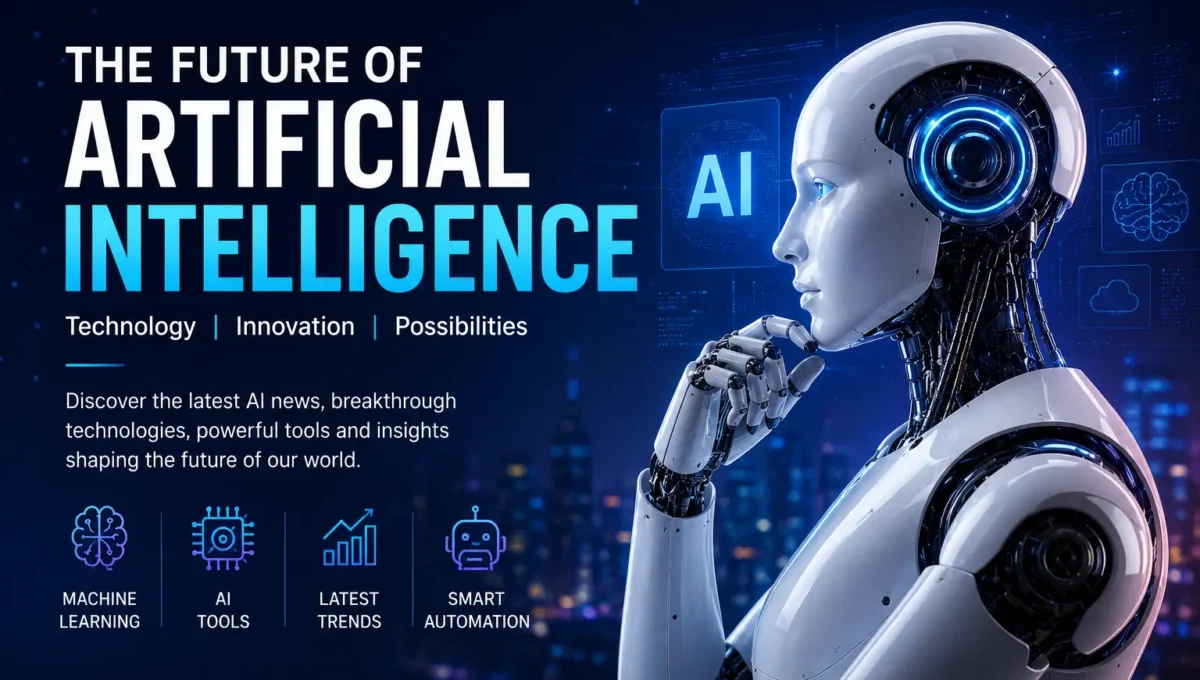
Artificial Intelligence: The Future of Technology and Everyday Life
Artificial Intelligence, commonly known as AI, has become one of the most important technologies of the modern world. From smartphones and search engines to healthcare, education, business and entertainment, AI is changing the way people live and work. What was once considered a futuristic concept is now becoming an essential part of everyday life.
AI refers to technology that enables machines and computer systems to perform tasks that usually require human intelligence. These tasks can include understanding language, recognising images, analysing information, solving problems, making predictions and generating content.
As Artificial Intelligence continues to develop, it is creating new opportunities for individuals, businesses and industries around the world. At the same time, it is also raising important questions about privacy, jobs, security and the responsible use of technology.
What Is Artificial Intelligence?
Artificial Intelligence is a branch of computer science focused on developing systems that can learn, analyse and make decisions. Unlike traditional software, which follows a fixed set of instructions, many modern AI systems can process large amounts of information and identify patterns.
For example, an AI-powered system may analyse thousands of documents within seconds, recognise objects in photographs or provide personalised recommendations based on user behaviour.
Artificial Intelligence is not limited to robots. AI technology is already present in many digital services that people use every day. Search engines, voice assistants, navigation applications, online shopping platforms and social media services all use different forms of AI.
The rapid development of AI has also made advanced technology more accessible. Today, businesses and individuals can use AI tools to write content, create images, analyse data, improve customer service and automate repetitive tasks.
How Does AI Work?
AI systems work by processing information and identifying patterns. Many modern AI technologies use machine learning, which allows computer systems to improve their performance based on data.
For example, if an AI system is trained to identify different types of animals, it may analyse thousands or even millions of images. Over time, the system learns to recognise patterns and characteristics associated with each animal.
Some important areas of Artificial Intelligence include:
Machine Learning
Machine learning allows computer systems to learn from data without requiring every possible instruction to be manually programmed.
It is widely used for recommendations, fraud detection, data analysis and prediction systems.
Natural Language Processing
Natural Language Processing, often called NLP, helps computers understand and generate human language.
AI chatbots, translation tools and virtual assistants use NLP to communicate with users.
Computer Vision
Computer vision enables AI systems to understand and analyse visual information.
This technology is used in facial recognition, image analysis, autonomous vehicles and medical imaging.
Generative AI
Generative AI can create new content such as text, images, music, videos and computer code.
The growth of generative AI has made Artificial Intelligence more visible to the general public and has introduced new ways of creating digital content.
How AI Is Changing Everyday Life
Artificial Intelligence is becoming increasingly integrated into everyday activities. Many people use AI-powered technology without even realising it.
When a streaming platform recommends a film, an online store suggests a product or a navigation app finds the fastest route, AI may be working in the background.
AI is helping create more personalised digital experiences. Instead of providing the same information to every user, technology can analyse preferences and behaviour to provide more relevant recommendations.
However, the growing use of AI also means that users should understand how their data is collected and used. Responsible technology development will continue to be an important part of the AI industry.
Artificial Intelligence in Business
Businesses across different industries are using AI to improve efficiency and make better decisions.
AI can help companies analyse customer information, automate repetitive work and identify important trends. This allows employees to spend more time on strategic and creative tasks.
Some common uses of AI in business include:
- Customer service chatbots
- Data analysis
- Content creation
- Marketing automation
- Fraud detection
- Sales forecasting
- Personalised recommendations
- Cybersecurity
Small businesses can also benefit from Artificial Intelligence. Many AI tools are now designed for individuals and smaller organisations, making advanced technology more accessible.
AI is not necessarily replacing every human role. In many situations, it is helping people work more efficiently by reducing repetitive and time-consuming tasks.
AI and the Future of Work
The impact of Artificial Intelligence on employment is one of the most discussed topics in technology.
AI is changing the nature of many jobs. Some tasks can now be automated, while new roles are being created in areas such as AI development, data science, cybersecurity and digital technology.
The future workplace is likely to require a combination of human and technological skills.
Creativity, communication, critical thinking and problem-solving will remain valuable because many complex situations require human understanding and judgement.
Learning how to use AI tools may also become an important skill. Instead of competing directly with technology, many professionals will use AI to improve their productivity and performance.
The key challenge will be ensuring that workers have access to education and training as technology continues to evolve.
Artificial Intelligence in Healthcare
Healthcare is another area where AI has the potential to create significant improvements.
AI systems can analyse medical data, assist researchers and help healthcare professionals identify patterns that may be difficult to detect manually.
For example, AI technology can assist with:
- Medical image analysis
- Research and drug development
- Patient data analysis
- Administrative automation
- Disease prediction
- Personalised healthcare
AI should not simply be viewed as a replacement for healthcare professionals. Instead, it can provide additional tools and information that help doctors and researchers make informed decisions.
The responsible use of medical data and patient privacy will remain essential as AI becomes more widely used in healthcare.
AI in Education
Artificial Intelligence is also changing the way people learn.
AI-powered learning platforms can provide personalised educational experiences based on a student’s strengths and weaknesses. Instead of following exactly the same learning path, students may receive recommendations and support based on their individual needs.
AI can also help teachers and educational institutions automate administrative tasks and create learning materials.
However, technology should support education rather than completely replace human teachers. Teachers provide guidance, motivation and personal understanding that technology cannot fully replicate.
The future of education may involve a combination of traditional teaching methods and AI-powered learning tools.
The Benefits of Artificial Intelligence
Artificial Intelligence offers several potential benefits for society and businesses.
One of the biggest advantages is efficiency. AI systems can process large amounts of information quickly and perform repetitive tasks without becoming tired.
AI can also help identify patterns and trends that may be difficult for humans to detect.
Some major benefits include:
- Increased productivity
- Faster data analysis
- Improved automation
- Personalised user experiences
- Better decision-making
- Support for scientific research
- Improved accessibility
- New business opportunities
AI technology can also help solve complex challenges in areas such as climate research, healthcare, transportation and scientific discovery.
Challenges and Concerns Around AI
Although AI offers significant opportunities, it also creates important challenges.
Privacy is one of the major concerns. AI systems often require large amounts of information, and companies must handle user data responsibly.
Another challenge is bias. If an AI system is trained using incomplete or biased information, its results may also be unfair or inaccurate.
Misinformation is another growing concern, particularly as generative AI makes it easier to create realistic digital content.
Cybersecurity, transparency and accountability will also become increasingly important.
Governments, technology companies and researchers will need to work together to develop responsible standards for Artificial Intelligence.
The Future of Artificial Intelligence
The future of AI is likely to bring even more advanced technology and new applications.
Artificial Intelligence may continue to transform industries, improve scientific research and change the way people interact with technology.
However, the future of AI should not only focus on creating more powerful systems. It should also focus on developing technology that is safe, transparent and beneficial for society.
The most successful use of AI may involve collaboration between humans and machines.
Humans can provide creativity, empathy, ethics and judgement, while AI can process information and automate complex tasks at incredible speed.
Explore the Latest AI News and Insights
Artificial Intelligence is developing rapidly, and staying informed has never been more important. New AI tools, technologies and innovations are constantly changing the digital world.
Whether you are interested in AI tools, machine learning, automation, generative AI or the future of technology, this category brings together the latest information and insights.
Explore Artificial Intelligence news, guides and updates to understand how this powerful technology is shaping the present and the future.
AI is no longer simply a technology of tomorrow. It is already transforming the world today, and its influence will continue to grow in the years ahead.
