

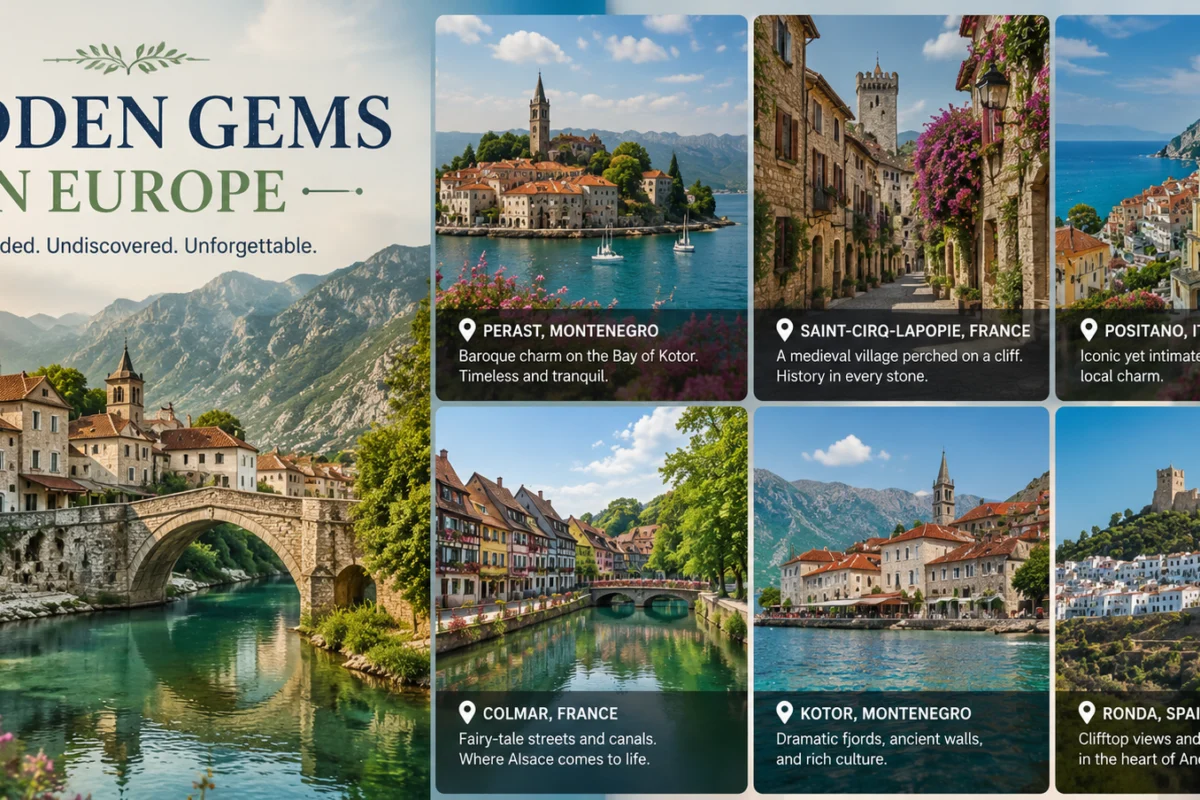
Hidden gems in Europe :-Europe has a visibility problem. A handful of famous cities absorb most of the visitors, and the result is queues at the Colosseum, selfie sticks on the Charles Bridge, and hotel prices that make your eyes water. Meanwhile, a few hours away by train or budget flight, there are towns, valleys, and islands that are every bit as beautiful and nearly empty. This guide is about those places. If you’ve already ticked off Paris, Rome, and Barcelona, or you simply prefer cobbled lanes without a crowd, these hidden gems in Europe are where your next trip should begin.
What Makes a Place a Genuine Hidden Gem?
The phrase gets overused, so it’s worth being clear. Real hidden gems in Europe usually have a few things in common. They’re far enough from the big tourist circuits that most visitors never reach them, yet they have enough infrastructure, such as decent hotels, restaurants, and transport, that you won’t be roughing it. They have something distinctive, whether that’s an unspoiled old town, a dramatic landscape, or a food tradition you can’t find elsewhere. And they tend to reward slower travel, because the best moments happen when you wander rather than tick off sights.
One honest caveat: the moment a place gets labelled a secret, it stops being one. A few spots below are already creeping onto bucket lists. Go soon, go respectfully, and spend money in local businesses.
Hidden Gems in Europe: The Balkans
The Balkans have quietly become one of the most exciting regions on the continent, with astonishing scenery, warm hospitality, and prices that still feel gentle compared with Western Europe.
Berat and Gjirokastër, Albania. Berat is nicknamed the town of a thousand windows, thanks to the white Ottoman houses stacked up its hillside. Gjirokastër, a short journey south, is a stone-roofed UNESCO-listed town crowned by a vast fortress. Both are walkable, atmospheric, and wonderfully affordable. Albania’s coast, including the beaches around Ksamil and Himarë, adds a Mediterranean finish.
Ohrid, North Macedonia. Lake Ohrid is one of Europe’s oldest and deepest lakes, and the town on its shore has a tangle of lanes, medieval churches, and a hilltop fortress with lake views. It’s relaxed, inexpensive, and rarely crowded outside high summer.
Perast and Lake Skadar, Montenegro. Kotor draws the cruise ships, but the neighbouring village of Perast is quieter, with baroque palaces and two tiny islands you can reach by boat. Lake Skadar National Park offers birdwatching and kayaking for those who like nature.
Mostar’s surroundings and Jajce, Bosnia and Herzegovina. While Mostar has become busier, nearby villages such as Počitelj, and the town of Jajce with its waterfall in the middle of town, still feel refreshingly uncrowded.
Hidden Gems in Europe: Italy Beyond the Headlines
Italy is so famous that its lesser-known corners get overlooked, but they’re where much of the magic lives.
Lecce, Puglia. Often called the Florence of the south, Lecce’s honey-coloured baroque buildings glow at sunset, and the surrounding countryside is dotted with whitewashed villages and olive groves. The food, from orecchiette to pasticciotto pastries, is superb.
Trieste. Perched on the border with Slovenia, Trieste feels like a Central European coffee-house city that happens to be Italian. Grand Habsburg buildings, a huge seafront piazza, and a serious coffee culture make it a rewarding city break.
Procida. The smallest and most colourful of the islands in the Bay of Naples is a pastel-painted fishing community that feels worlds away from Capri’s glitz.
Matera. Famous for its ancient cave dwellings, Matera is no longer a total secret, but visiting off-season or early in the morning still delivers a deeply atmospheric experience.
Hidden Gems in Europe: Spain and Portugal
The Iberian Peninsula is huge, and most visitors stick to a short list of cities and beaches.
Galicia, Spain. Spain’s green north-west corner has dramatic coastlines, excellent seafood, and the pilgrimage city of Santiago de Compostela. It’s cooler and quieter than the south, perfect for walking and eating.
Albarracín and Cuenca, Spain. Albarracín is a rose-coloured medieval village in Aragon, with winding streets and dramatic walls on a rocky outcrop. Cuenca is famed for its hanging houses clinging to a gorge. Both are easy to reach from Madrid or Valencia.
The Alentejo, Portugal. This sun-baked region of cork forests, vineyards, and whitewashed hilltop villages like Monsaraz is slow-paced and beautifully rural. It’s among the best-value places for wine and food in Europe.
The Azores, Portugal. These volcanic islands in the Atlantic offer crater lakes, hot springs, whale watching, and hiking, all at a gentle pace and without the crowds of mainland resorts.
Hidden Gems in Europe: France and Germany
Albi, France. A red-brick cathedral city in the south-west, Albi is home to the extraordinary Sainte-Cécile Cathedral and a museum dedicated to Toulouse-Lautrec. It’s elegant and easy to explore on foot.
The Lot Valley, France. With medieval villages perched above a winding river, plus excellent wine and food, this region is a quieter alternative to the Dordogne.
Bamberg, Germany. A Bavarian town of canals, half-timbered houses, and smoked beer, Bamberg is a UNESCO World Heritage Site with a fraction of the tourists you’d meet in Munich.
Görlitz, Germany. On the Polish border, Görlitz boasts thousands of beautifully preserved historic buildings, which is why it has served as a film location for many period dramas.
Hidden Gems in Europe: Central and Eastern Europe
This region is packed with charming towns that deliver big on atmosphere and small on price.
Olomouc, Czechia. Often called a smaller Prague without the crowds, Olomouc has a lovely historic centre, a baroque column listed by UNESCO, and a lively student scene.
Toruń, Poland. The birthplace of Copernicus, Toruń has a Gothic old town, a riverside setting, and a reputation for gingerbread. It’s a delightful, compact city break.
Košice, Slovakia. Slovakia’s second city has a beautiful pedestrian old town, elegant squares, and a growing creative scene.
Eger, Hungary. Known for its Ottoman history, baroque architecture, and the famous Bull’s Blood red wine, Eger rewards visitors who enjoy wandering and tasting.
Sibiu and Sighișoara, Romania. Transylvania’s medieval towns are striking, with colourful houses, fortified churches, and lively squares. Beyond the towns, villages with fortified churches and rolling hills offer a glimpse of rural traditions.
Plovdiv and Veliko Tarnovo, Bulgaria. Plovdiv, one of Europe’s oldest continuously inhabited cities, mixes Roman ruins with a vibrant arts district. Veliko Tarnovo clings dramatically to a river gorge.
Hidden Gems in Europe: The Baltics and the North
Kuldīga, Latvia. This small, pretty town sits beside the Venta Rapid, often described as Europe’s widest waterfall, and has old wooden houses and a long brick bridge. It’s calm, charming, and very affordable.
Tartu, Estonia. Estonia’s university city is youthful, creative, and relaxed, with a lovely riverside setting and a growing café scene.
Kaunas, Lithuania. Often overshadowed by Vilnius, Kaunas has excellent interwar architecture, museums, and a pleasant old town.
Bornholm, Denmark. A sunny island in the Baltic, Bornholm combines sandy beaches, round churches, smoked herring, and cycling routes through quiet countryside.
The Faroe Islands and Lofoten. For dramatic scenery, few places beat these remote North Atlantic landscapes. Expect cliffs, fjords, tiny villages, and weather that changes every few minutes.
Hidden Gems in Europe: Greece and the Islands
Pelion. This forested peninsula in central Greece combines mountain villages with beaches on the Aegean, making it perfect for hikers and food lovers.
Zagori. In north-west Greece, stone villages and dramatic gorges give a taste of a Greece few visitors see.
Folegandros and Naxos’ villages. Smaller Cyclades islands offer whitewashed hilltop towns, tavernas, and beaches without the crowds of Santorini or Mykonos.
Monemvasia and Nafplio. These Peloponnese towns blend medieval streets, sea views, and relaxed charm.
Hidden Gems in Europe for Foodies
Some of the best meals on the continent are served far from the tourist trail. Among the most delicious hidden gems in Europe are towns where regional cooking has barely changed in generations. In Lecce, you’ll find simple southern Italian dishes built around local olive oil and fresh vegetables. In Galicia, the seafood is so good that locals plan whole days around lunch. Eger’s wine cellars let you taste local reds straight from the barrel, while Transylvanian kitchens serve hearty stews and homemade preserves. Eat where menus are short and handwritten, and don’t be afraid to ask what’s cooking today.
Hidden Gems in Europe for Hikers and Nature Lovers
If you prefer mountains to museums, there are plenty of quieter options. The Pelion peninsula in Greece combines old cobbled mule paths with views over the Aegean. Albania’s northern Accursed Mountains offer rugged trails and traditional guesthouses, and the Azores deliver crater lakes and coastal walks. Slovenia’s Soča Valley has emerald-green rivers and excellent paths for beginners and experts alike. These hidden gems in Europe suit travellers who value fresh air, big views, and a very small crowd, and many can be explored without a car if you pick your base carefully.
Hidden Gems in Europe on a Budget
Not every great trip needs a big budget. Many hidden gems in Europe are noticeably cheaper than their famous neighbours, especially in the Balkans, Eastern Europe, and rural Portugal. Meals, local transport, and guesthouse rooms cost far less than in Paris or Amsterdam, which means your money stretches much further. To save even more, travel outside peak summer, use regional trains and buses, and stay in family-run guesthouses rather than chain hotels. A week in places like Berat, Olomouc, or the Alentejo can cost a fraction of a city break in a major capital.
Hidden Gems in Europe by Train
You don’t need a car to reach a surprising number of these places. Europe’s rail network is excellent, and many lesser-known towns sit on scenic routes. Bamberg and Görlitz are straightforward by train in Germany, while Olomouc, Košice, and Toruń are all well connected within their countries. Trieste is easy to reach from Venice, and trains in Portugal link Lisbon to many smaller towns. Choosing hidden gems in Europe that you can reach by rail keeps your trip low-carbon and relaxed, and it lets you watch the landscape instead of the road.
Hidden Gems in Europe for Couples and Families
Romantic travellers will love Lecce’s candlelit lanes, Perast’s seaside terraces, and the stone villages of the Lot Valley. Families will find hidden gems in Europe that suit children too: Bornholm’s sandy beaches and cycling routes, the Azores’ friendly whale-watching boats, and Ohrid’s calm lakeside swimming spots all work well. Look for places with gentle pacing, plenty of outdoor space, and restaurants that welcome children, and you’ll find that quieter destinations are often easier with kids than crowded ones.
How to Find Your Own Hidden Gems in Europe
You don’t need a list to discover places that feel special. A few simple habits help.
Take the train or bus to the second city. Instead of the capital, look at regional centres, particularly university towns, which tend to have good food, lively streets, and lower prices.
Look at smaller airports. Budget airlines fly to regional airports across the continent, and these often open up areas you’d never consider.
Stay a few nights, not one. Day-trippers see the headline sights and leave. Staying overnight lets you experience quiet mornings and empty evenings.
Ask locals. A café owner or hotel host will often point you to a restaurant, viewpoint, or walking route that no guidebook mentions.
Go in the shoulder season. April, May, September, and October often offer the best combination of weather and quiet.
Hidden Gems in Europe for Solo Travel in December
December is one of the most atmospheric months to explore Europe, and it’s particularly rewarding if you’re travelling alone. If you’re looking for solo travel destinations in December, the lesser-known towns on this list are ideal, because they’re compact, safe, and full of winter charm without festive crowds.
For Christmas markets with a quieter feel, try Olomouc, Görlitz, Bamberg, or Sibiu. These towns hold lovely seasonal markets, with mulled wine, handmade gifts, and local food, yet they’re far calmer than the big-name markets in Vienna or Strasbourg. Eating alone at a market stall feels entirely natural, and it’s easy to strike up conversations at shared tables.
If you’d rather escape the cold, consider winter sun. Madeira is famous for its December lights and its New Year fireworks, while the Canary Islands offer mild days and relaxed resorts. Both are good picks among solo travel destinations in December for people who want warmth with minimal planning.
Another idea for solo travel destinations in December is a quiet, restorative break somewhere like Galicia, the Alentejo, or Trieste, where cosy cafés and walks along the coast provide a gentle rhythm. A few practical tips help. Book accommodation with a social space if you want company, check opening times around December 24 to 26, and keep a day free either side of your trip for travel disruption.
Three Sample Itineraries
If you’d like a ready-made starting point, here are three simple ways to string hidden gems in Europe into a single trip.
Seven days in the Balkans: Fly into Tirana, spend two nights in Berat, two in Gjirokastër, then finish with a few days on the Albanian coast around Ksamil.
Five days in Central Europe: Start in Dresden or Prague, then take trains to Görlitz and Olomouc, with an overnight in each. Compact, walkable, and easy on the budget.
Ten days of Iberian slow travel: Fly to Lisbon, head into the Alentejo for a few nights among vineyards and hilltop villages, then add a short flight to the Azores for hiking and hot springs.
Treat these as templates rather than rules, and swap in whichever places appeal most.
Practical Tips for Visiting Europe’s Lesser-Known Places
Before you go, a bit of preparation makes a difference. Check entry rules, because European border processes are changing. The EU’s Entry/Exit System has been rolling out since late 2025, and the new ETIAS travel authorisation for UK visitors is expected to launch later in 2026, with a transition period before it becomes fully mandatory. Always confirm current requirements on official government websites before you travel.
Take out proper travel insurance, carry some local cash for small villages where card payments may not work, and learn a few phrases in the local language. Public transport in rural areas can be infrequent, so check timetables in advance or consider hiring a car for a few days. And be a considerate visitor: avoid disturbing residents, follow local customs, and spend your money locally.
Protecting Hidden Gems in Europe
There’s an important responsibility that comes with seeking out hidden gems in Europe. Overtourism has damaged many beloved places, and small towns can be quickly overwhelmed. You can help by staying in locally owned guesthouses, eating at family-run restaurants, travelling outside peak times, and leaving no trace in natural areas. Don’t geotag fragile spots carelessly on social media, and respect rules about drones, photography, and access.
The Bottom Line
The beauty of Europe is that its depth is almost endless. Beyond the famous skylines and crowded squares lie villages, valleys, islands, and cities that offer the same history, food, and scenery at a slower pace and a gentler price. Whether you head to Albania’s stone towns, Lecce’s baroque lanes, a Transylvanian fortified church, or a Baltic island, these hidden gems in Europe reward curiosity and patience. Pick one that appeals, book a few nights, and wander without a plan. The best discoveries usually happen when you stop following the crowd.


Join the conversation