

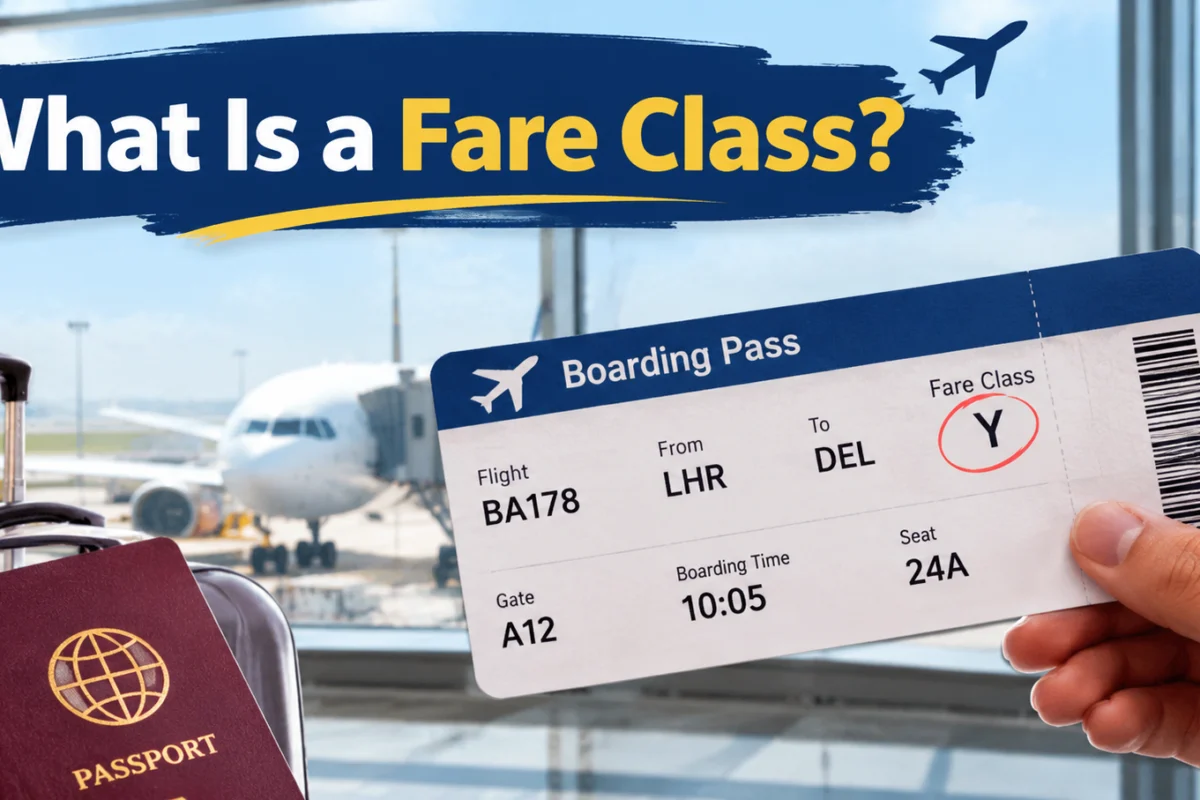
What Is a Fare Class ? Two passengers sit side by side in the same economy cabin on the same flight. One paid a little over the odds for a ticket they can change, cancel, and upgrade. The other grabbed a bargain fare that earns hardly any miles and can’t be altered without a hefty fee. They’re sitting in identical seats, yet their tickets are very different products. The reason is a small letter printed somewhere on your booking, and it’s the answer to a question many travellers never think to ask: what is a fare class? This guide decodes it in plain English, so you can pick the right ticket rather than just the cheapest one.
What Is a Fare Class? The Short Answer
So, what is a fare class in the simplest terms? It’s a single-letter code that tells an airline exactly which price bucket and set of rules apply to your ticket. You’ll also hear it called a booking class, booking code, fare bucket, or, in the trade, a Reservation Booking Designator (RBD). Whatever the name, it’s the same idea: a label that sorts tickets for the same seat into different prices and conditions.
A handy way to remember it is this: the cabin is the seat comfort, and the fare class is the conditions. The cabin tells you whether you’re in economy, premium economy, business, or first. The fare class tells you how flexible your ticket is, how many miles it earns, and what you’ll pay if your plans change.
Fare Class vs Cabin Class: Not the Same Thing
One of the biggest sources of confusion is mixing up cabin class with fare class. If you’ve ever wondered what is a fare class compared with a cabin, here’s the difference.
Cabin class (sometimes called class of service) is the physical product: the seat, the legroom, the meal, the lounge. The main cabins are economy, premium economy, business, and first.
Fare class is the pricing and rules bucket within, or sometimes across, those cabins. Several fare classes can sit inside a single cabin. Economy alone might have a dozen different codes, each with its own price, restrictions, and mileage earning.
That’s why two people in the same cabin can have very different tickets. The seat is the same, but the booking code behind it isn’t.
What Do the Letters Actually Mean?
Airlines use letters to represent each bucket. Some are widely recognised. Y usually means full-fare, fully flexible economy, and it’s the closest thing to a universal code. J and C are commonly used for business class, while F is typically first class. Premium economy codes vary more from airline to airline, so it’s worth checking directly. Other letters, such as B, M, H, K, L, Q, T, and V, commonly represent progressively cheaper economy fares, though the exact order differs.
Here’s the important caveat. Each airline decides its own system, and the letters don’t follow a fixed alphabetical order of price. A K on one airline might be cheaper than an M, while on another airline the reverse could be true. Some letters are reserved for special purposes, such as award tickets bought with miles or discounted staff travel. So when someone asks what is a fare class letter worth, the honest answer is that it depends on the airline.
How Fare Classes Work Behind the Scenes
To understand why prices move around, it helps to know how airlines sell seats. For each flight, an airline has a limited number of seats in each fare class. These pools are sometimes called fare buckets or inventory.
When demand is low, the airline opens many of the cheaper buckets for sale. As the flight fills up, the lowest-priced buckets close one by one, and the cheapest remaining fare rises. That’s why you can see a ticket at one price in the morning and a higher price by the afternoon. You haven’t imagined it. The cheap bucket simply ran out of seats.
This system, known as revenue management, is how airlines try to fill planes while squeezing the most income from each flight. Understanding what is a fare class and how buckets work explains why last-minute tickets tend to cost more and why early booking often saves money.
What Your Fare Class Controls
The letter on your ticket affects a surprising number of things.
Price. Obviously, each bucket sits at a different price point.
Changes and refunds. The fare class and the rules attached to it decide whether your ticket is refundable, changeable for a fee, or locked in. Lower buckets are usually the most restrictive.
Baggage. Some fares include checked bags while others don’t, and the difference can be significant on long-haul or budget routes.
Advance purchase rules. Cheaper fares often require booking weeks ahead and may have minimum or maximum stay conditions.
Miles and status credits. Loyalty programmes often award different amounts depending on your booking code. Deep-discount buckets may earn only a fraction of the miles flown, or even none on certain partner airlines.
Upgrade eligibility. Many upgrade systems, whether paid for or using miles, only apply to certain fare classes.
Seat selection and extras. Cheaper fares may charge for seat selection, priority boarding, or lounge access.
When travellers ask what is a fare class worth, this list is the answer. It’s a bundle of rules and perks, not just a price tag.
Fare Basis Codes: The Longer String
If the fare class is the headline, the fare basis code is the fine print. A fare basis code is a longer string of letters and numbers on your ticket, and the first letter usually (though not always) matches your booking class. The rest of the code can show details such as the season, day of the week, ticket type, and special conditions.
You don’t need to memorise how to decode every character, but knowing it exists helps. When you want precise details about what is a fare class doing for your specific ticket, the fare basis code points to the actual rules. If you can’t interpret it, the airline’s fare rules page or customer service team can explain it.
Fare Families: The Marketing Version
Airlines know that a screen full of single letters is confusing, so most now sell fares in branded bundles called fare families. You’ve probably seen options with names like Basic, Standard, Flex, or Premium. Each branded fare rolls up to one or more underlying booking codes.
A basic fare might map to a low bucket, with no free bag, limited changes, and few miles. A flexible fare might map to a higher bucket, with free changes, more baggage, and better mileage earning. So in practice, what is a fare class when you’re shopping online? It’s the code hiding behind the colourful fare family label.
How to Find Your Fare Class
Many travellers never see their booking code because airlines don’t always display it prominently. Here’s where to look.
During booking, some airline websites show the fare class letter alongside the fare details. After booking, check your confirmation email and e-ticket receipt, where the booking class is often listed next to each flight segment. In the manage-booking section of the airline’s website or app, look at the fare details for each leg. And on your fare basis code, the first character is usually your booking class.
If you booked through a travel agent or an online travel agency, ask them to tell you the booking class for each segment. It takes one email and can prevent nasty surprises with miles or upgrades later.
Fare Classes and Frequent Flyer Miles
This is one of the places where understanding what is a fare class pays off most. Many loyalty programmes award miles based on the booking code, not just the distance flown or the cabin you sit in.
It’s entirely possible to buy a business-class ticket on a very low business fare class and earn fewer miles than you expected, or none at all, on a partner airline’s programme. Likewise, some deeply discounted economy fares earn only a small percentage of the distance flown.
Before booking, particularly on flights operated by partner airlines, check the earning chart for your programme. Look up the exact booking code, not just the cabin. If you’re chasing elite status, this one check can make the difference between earning and missing out.
Fare Classes and Upgrades
Upgrade rules are often tied to fare class too. Some airlines only allow upgrades from certain higher economy buckets, while the cheapest fares may be excluded altogether. Instant upgrade offers, bidding systems, and mileage upgrades all have their own rules.
If upgrading is a goal, check the upgrade conditions before you buy. A slightly more expensive fare class that qualifies for upgrades might be better value than the cheapest ticket that doesn’t. This is a practical example of what is a fare class doing for your wallet, rather than just appearing on a receipt.
Fare Classes and Codeshare Flights
On codeshare flights, where one airline sells seats on another airline’s plane, the fare class belongs to the airline that sold the ticket. That affects mileage earning, baggage allowance, and rebooking options. If you’re booked on a partner flight, always confirm which airline’s rules apply, and keep your booking code handy. It’s another reason to understand what is a fare class before you book a partner flight.
What Is a Fare Class on Budget Airlines?
Low-cost carriers handle things a little differently. Many focus on bundles of extras rather than a long ladder of lettered buckets, so you’ll see options like a basic fare, a fare with a bag, or a flexible fare with seat selection included. Behind the scenes they still price by demand, with cheaper seats selling first. So when budget travellers ask what is a fare class on a no-frills airline, the practical answer is to look closely at what each bundle includes. Bags, seat choice, and change rights are where the real cost differences hide.
What Is a Fare Class for Business and First Class Tickets?
Premium cabins have fare classes too, and the gap between them can be large. A full-fare business ticket usually offers the most flexibility, with generous change and refund conditions and strong mileage earning. A discounted business fare in the same cabin can be much stricter, with limited changes and reduced miles. If you’re paying thousands for a long-haul seat, knowing what is a fare class on your specific ticket matters even more, because it determines how much of that price buys you flexibility rather than just a lie-flat bed.
What Is a Fare Class When You Book Through a Travel Agent?
Agents and online travel agencies sell the same fare classes that airlines do, but the details aren’t always obvious on the booking screen. If you book this way, ask for the booking class and fare rules for every flight segment, and check the ticketing deadline so your fare doesn’t expire. A good agent will happily explain what is a fare class on your itinerary and which alternatives are available, and they can often compare fare families faster than you can click through airline websites.
Fare Classes and Cancelling Your Trip
Your booking code is what decides your fate when plans change. A fully flexible fare might allow a refund, a mid-range fare might permit changes for a fee, and the cheapest fare might offer nothing beyond reclaiming certain unused taxes and airport charges, which many travellers don’t realise they can ask for. If there’s any chance you’ll need to cancel, a few minutes spent working out what is a fare class on each option can save far more than the small premium for flexibility.
Common Mistakes People Make With Fare Classes
When people ask what is a fare class, they rarely hear about the mistakes, but a few errors come up again and again.
Buying purely on price. The cheapest fare is rarely the cheapest if your plans might change. A modest extra payment for flexibility can save far more later.
Ignoring baggage rules. A bargain fare without a checked bag can cost more than a standard fare once you add luggage.
Assuming all economy tickets are equal. They aren’t. Two economy fares on the same flight can differ in refund rights, miles earning, and upgrade options.
Not checking mileage earning. Many travellers discover too late that their ticket earns little or nothing.
Forgetting fare rules for changes. Some tickets can’t be changed at all, while others allow changes for a fee. Read the conditions before you pay.
Myths About Fare Classes
Plenty of half-truths surround what is a fare class, so here are the biggest ones.
Myth: Cabin and fare class are the same. They aren’t. The cabin is the seat, and the fare class is the rules.
Myth: Every airline uses the same letters. Y is nearly universal for full-fare economy, but most other codes vary.
Myth: A higher letter always means a higher price. Letters don’t follow a fixed price order, so check each airline’s system.
Myth: You can’t find your fare class. You usually can, in your booking details, e-ticket, or fare basis code.
How to Choose the Right Fare
Once you know what is a fare class, here’s a quick framework for picking a fare with confidence.
- Decide how certain your plans are. If there’s any doubt, a flexible fare may be worth the extra cost.
- Check what’s included. Look at bags, seat selection, and refundability, not just the headline price.
- Think about miles. If you collect points, check the earning rate for your booking code.
- Consider upgrades. If you hope to upgrade, confirm that your fare class is eligible.
- Compare fare families side by side. Airlines usually show the differences in a simple table.
- Keep a record. Save your fare basis code and booking class for future reference.
Frequently Asked Questions
What is a fare class in one sentence? It’s a code, usually a single letter, that tells the airline which price bucket and set of rules apply to your ticket.
Is fare class the same as booking class? Yes. Booking class, booking code, fare bucket, and RBD all refer to essentially the same thing.
Why do two passengers in the same cabin pay different prices? Because they booked into different fare classes, which have different prices and conditions.
Can I change my fare class after booking? Sometimes, usually by paying the fare difference and any change fee. The rules depend on your ticket.
Does fare class affect safety or service in the cabin? No. Everyone in the same cabin gets the same seat, crew, and safety standards. The difference is in the ticket’s rules and perks.
The Bottom Line
By now, the answer to what is a fare class should be clear: it’s the small code behind your ticket that determines price, flexibility, miles, and upgrades, even when everyone is sitting in the same seats. You don’t need to become an expert in airline jargon. You just need to check three things before you buy: what’s included, how flexible the ticket is, and how many miles it earns.
Next time you compare fares, look beyond the headline price and ask what is a fare class doing for you on this ticket. A few minutes of reading the conditions can save you real money and frustration, and it might just turn an ordinary booking into a much better deal.
Are you also looking for :- cheap flights to australia?


Join the conversation