

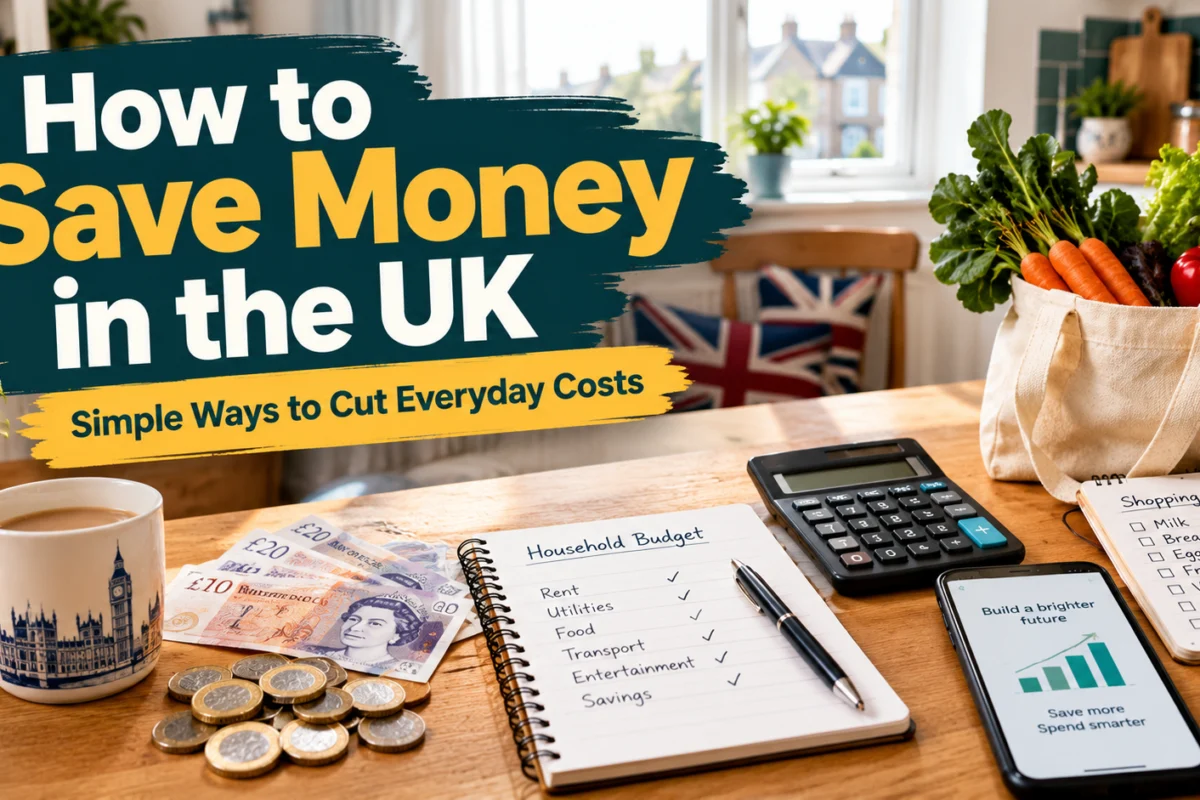
How to Save Money UK : If you’ve opened your banking app lately and wondered where the month went, you’re definitely not alone. Rent, energy, food and transport have all crept up, and for many people the pay packet just doesn’t stretch the way it used to. The good news? Learning how to save money UK households can actually stick to doesn’t mean living on beans on toast or giving up every little pleasure. It simply means making a handful of smart changes and letting them quietly add up.
In this guide, we’ll walk through realistic ways to trim your spending, from household bills to supermarket shopping, and then show you where to put the money you free up. Whether you’re a student in Leeds, a young family in Birmingham or a retiree in Cornwall, these money saving tips UK readers swear by can be adapted to your own situation. Let’s get into it.
Why Saving Money Feels So Hard Right Now
The cost of living UK families face has changed a lot over the past few years. Food prices jumped, energy bills stayed stubbornly high compared with a decade ago, and housing costs keep climbing in almost every region. Wages have risen too, but for plenty of people they haven’t kept pace.
That’s why so many of us feel like we’re doing everything right and still ending the month with nothing left. If that sounds familiar, please don’t blame yourself. The aim isn’t perfection. It’s finding the small leaks in your finances and fixing them one at a time.
Step One: Find Out Where Your Money Actually Goes
The first rule of how to save money UK experts always repeat is simple: you can’t fix what you can’t see. Most of us have a rough idea of our big bills but wildly underestimate the small stuff, like the daily coffee, the takeaway on a tired Friday or the app subscription we forgot to cancel.
Grab your last three months of bank statements, or use your banking app’s spending breakdown, and sort every transaction into three buckets:
- Essentials: rent or mortgage, council tax, energy, water, food, transport to work
- Wants: eating out, streaming, hobbies, holidays, clothes
- Savings and debt: anything you put aside or use to repay what you owe
Seeing it laid out in black and white can be uncomfortable, but it’s also the moment things start to change. You’ll almost always spot at least £30 to £50 a month you didn’t realise was slipping away.
Build a Budget You’ll Actually Follow
Budgeting UK style doesn’t need to be complicated. You don’t need a fancy spreadsheet or a degree in maths. A popular starting point is the 50/30/20 rule: roughly half your take-home pay on essentials, thirty per cent on wants and twenty per cent on savings or debt repayment.
Of course, that split won’t suit everyone. If you live in London or the South East, your housing costs might swallow far more than 50 per cent. That’s fine. Adjust the percentages until they reflect your real life, then stick with them for a few months.
A few things make a budget easier to keep:
- Pay yourself first. Set up a standing order for payday so your savings leave your account before you can spend them.
- Use separate pots. Many banks let you create “pots” or “spaces” for bills, fun money and savings, which makes overspending far harder.
- Review monthly. Ten minutes on the first Sunday of the month is enough to see what worked and what didn’t.
Cut Your Energy Bills Without Sitting in the Cold
Energy is one of the biggest areas where you can save on energy bills without noticing a real difference in comfort. A big part of how to save money UK wide comes down to heating and power, because those costs hit every household, every month.
Try these quick wins:
- Turn the thermostat down by one degree. It’s barely noticeable, but it can trim your heating bill by around 10 per cent.
- Bleed your radiators and keep furniture away from them so the heat actually circulates.
- Draught-proof windows and doors. Cheap strips and a letterbox brush pay for themselves within a winter.
- Wash at 30 degrees and run full loads only.
- Switch off standby. TVs, consoles and chargers quietly sip electricity all day.
- Take shorter showers. Cutting even a minute or two saves both water and heating costs.
It’s also worth submitting regular meter readings so you’re billed on real usage rather than estimates. If you’re on a fixed deal, check when it ends, as many people slide onto a more expensive tariff without realising. And if you’re struggling, ask your supplier about hardship support or check whether you qualify for government help with heating costs.
Slash Your Grocery Bill
Food is where many families can make the quickest progress. Cheap supermarket shopping UK style doesn’t mean buying rubbish. It means being smart about where, when and how you shop. If you want to know how to save money UK families rely on every week, start at the supermarket.
Here’s what works:
- Plan your meals before you shop and write a list. Stick to it. Impulse buys are where budgets go to die.
- Never shop hungry. Everything looks like a good idea at 5pm on an empty stomach.
- Try the budget supermarkets. Aldi and Lidl often undercut the big names on basics, and their own-label products are usually perfectly good.
- Buy own-brand. Most of the time, you’re paying extra just for the logo.
- Use the yellow stickers. Reduced items in the evening can be frozen the same day.
- Cook in batches. Making a big chilli or curry and freezing portions saves money and stops you ordering takeaway on a bad day.
- Waste less. The average UK household throws away a surprising amount of edible food each year. Freeze bread, use leftover veg in soups and check dates before binning.
Apps like Too Good To Go let you grab surplus food from local shops and cafés at a fraction of the price, and loyalty schemes can quietly knock pounds off your weekly shop if you use them consistently.
Switch and Save on Broadband, Mobile and Insurance
Loyalty rarely pays when it comes to contracts. Companies save their best deals for new customers, which means staying put often costs you more. If you’re serious about how to save money UK consumers can control, make a yearly “switch day” where you review every recurring contract.
Broadband and mobile: When your contract ends, haggle or switch. Calling and saying you’re thinking of leaving often triggers a better offer. SIM-only deals are usually far cheaper than phone contracts, particularly if you already own a handset.
Car and home insurance: Compare quotes using comparison sites around 3 weeks before renewal, then ask your current insurer to match the best price. Paying annually instead of monthly can also cut the total cost, since monthly payments usually carry interest.
Council tax: Check you’re in the right band, and see whether you qualify for a discount. Single occupants, for example, can usually claim a 25 per cent reduction.
Spend Less on Getting Around
Transport quietly drains household budgets, but there’s plenty of room to cut your costs without giving up your independence. When people ask how to save money UK commuters can do straight away, the answer is usually railcards and smarter planning.
- Get a railcard. The 16-25, 26-30, Two Together and Senior railcards all give around a third off most fares, and they pay for themselves quickly if you travel even occasionally.
- Book trains in advance and use split ticketing, where buying two tickets for one journey can sometimes be cheaper than a single through-ticket.
- Walk or cycle short trips. The cash savings are real, and it’s good for your health too.
- Keep your car healthy. Correctly inflated tyres and regular servicing improve fuel economy.
- Shop around for fuel using price comparison apps, and avoid motorway services where prices are highest.
- Consider car sharing for the daily commute. Splitting fuel and parking costs halves the pain.
Put Your Savings Somewhere They Actually Grow
Saving is only half the story. If your cash is sitting in a current account earning nothing, inflation is slowly eating it. This is where understanding how to save money UK savers can protect and grow becomes really valuable.
Easy-access and fixed-rate accounts. A high-interest savings account pays far more than a standard current account. Compare rates regularly, because the best deals change often. If you won’t need the money for a year or more, a fixed-rate bond may pay even better.
Cash ISAs. You can put up to £20,000 a year into ISAs, and the interest is completely tax-free. Even if you’re not a higher-rate taxpayer, that protection is worth having as your pot grows.
Lifetime ISA. If you’re aged 18 to 39 and saving for your first home or retirement, the government adds a 25 per cent bonus to what you pay in, up to £4,000 a year. That’s free money, but check the withdrawal rules before you commit.
Premium Bonds. Run by NS&I, these don’t pay interest. Instead, you’re entered into monthly prize draws. They’re backed by the Treasury, so your money is safe, though your winnings aren’t guaranteed.
Emergency fund first. Before chasing returns, aim to build three to six months of essential spending in an easy-access account. It stops one broken boiler from turning into a credit card problem.
Trim the Subscriptions and Little Luxuries
Subscriptions are sneaky. Ten pounds here and eight pounds there doesn’t feel like much, but a handful of streaming services, a gym you never visit and a few apps can easily cost £60 a month or more.
Do an audit. List every subscription, ask yourself whether you’ve used it in the last month and cancel anything that gets a “no”. You can always resubscribe later. Better still, rotate streaming services: watch what you want on one platform, cancel, and move to the next.
For days out and entertainment, look for free options. Many UK museums and galleries are free to enter, libraries lend books, audiobooks and even films, and local parks and walking trails cost nothing at all. Eating out? Use lunchtime menus and loyalty apps, or make dinner at home the “treat” with a good bottle and nice ingredients.
Buy Second-Hand and Look After What You Own
Buying new isn’t always the smartest move. Vinted, eBay, Facebook Marketplace and charity shops are full of good-quality clothes, furniture and electronics at a fraction of the price. Selling things you no longer need is a bonus. A clear-out can easily put a few hundred pounds in your pocket.
Looking after what you already have matters too. Mend a seam instead of replacing a jacket, descale the kettle, clean the washing machine filter. Small acts of maintenance stretch the life of your belongings and keep replacement costs down.
Earn a Little Extra on the Side
Sometimes the answer to how to save money UK life demands isn’t only cutting, it’s also earning. A side income doesn’t need to be huge to make a difference. Selling unwanted items, doing a few freelance hours, dog walking, tutoring or taking on weekend shifts can all create breathing room.
You can earn up to £1,000 from trading or side work tax-free under the trading allowance, so it’s worth knowing the rules. Just remember to keep records and declare income if you go over the limit.
Common Money Mistakes to Avoid
Even with the best intentions, a few habits can undo your progress:
- Saving what’s left over. There’s rarely anything left. Save first, spend the rest.
- Ignoring high-interest debt. Credit card and overdraft interest can wipe out any savings gain. Tackle the most expensive debt first.
- Buying “bargains” you don’t need. A sale isn’t a saving if you weren’t going to buy it anyway.
- Not checking bank charges. Review fees and consider switching if you’re paying for an account with features you never use.
- Giving up too fast. One overspend doesn’t ruin the month. Reset and carry on.
How to Save Money Fast When You Need a Quick Boost
Sometimes you need results this month, not next year. If you’re wondering how to save money fast, try a short, focused “savings sprint”:
- Cancel every subscription you don’t use today.
- Do a no-spend weekend, then a no-spend week.
- Sell five things you haven’t touched in six months.
- Cook every meal at home for two weeks and track the difference.
- Call your broadband and mobile providers and ask for a better deal.
Run all five and it’s realistic to free up £100 to £200 within a month. It’s not a forever lifestyle, but it’s a brilliant way to build momentum and prove to yourself that change is possible.
Frequently Asked Questions
What is the easiest way to save money in the UK?
Start with a simple budget and automate a small transfer into savings every payday. Even £20 a week becomes over £1,000 in a year, and automation means you never have to rely on willpower.
How much should I save each month?
A common guideline is around 20 per cent of your take-home pay, but anything is better than nothing. If 20 per cent isn’t realistic right now, start at 5 per cent and increase it whenever your income rises.
How to save money UK families can manage on a low income?
Focus on the essentials first. Check you’re claiming every benefit, discount and support scheme you’re entitled to, use a free benefits calculator, and make the most of local community resources like food banks, warm banks and charity-run schemes when needed. Small, steady steps matter far more than big, unrealistic targets.
Are savings accounts safe in the UK?
Yes, deposits with FCA-authorised banks and building societies are protected by the Financial Services Compensation Scheme (FSCS) up to £85,000 per person, per institution. Always check the provider is authorised before depositing.
Is it worth using a cash ISA?
If you want your interest completely tax-free, yes. Compare it against standard savings accounts, as sometimes the Personal Savings Allowance already covers your interest anyway.
Final Thoughts
There’s no magic trick behind how to save money UK households need to hit their goals. It’s a mix of awareness, small habit changes and putting your cash somewhere sensible. Track your spending, trim the bills, shop smarter, switch providers and let a good savings account do some of the heavy lifting.
Pick two or three tips from this guide and try them this week. Then add a couple more next month. Before you know it, you’ll feel more in control, with a growing buffer between you and the next unexpected bill. Your future self will thank you.


Join the conversation