

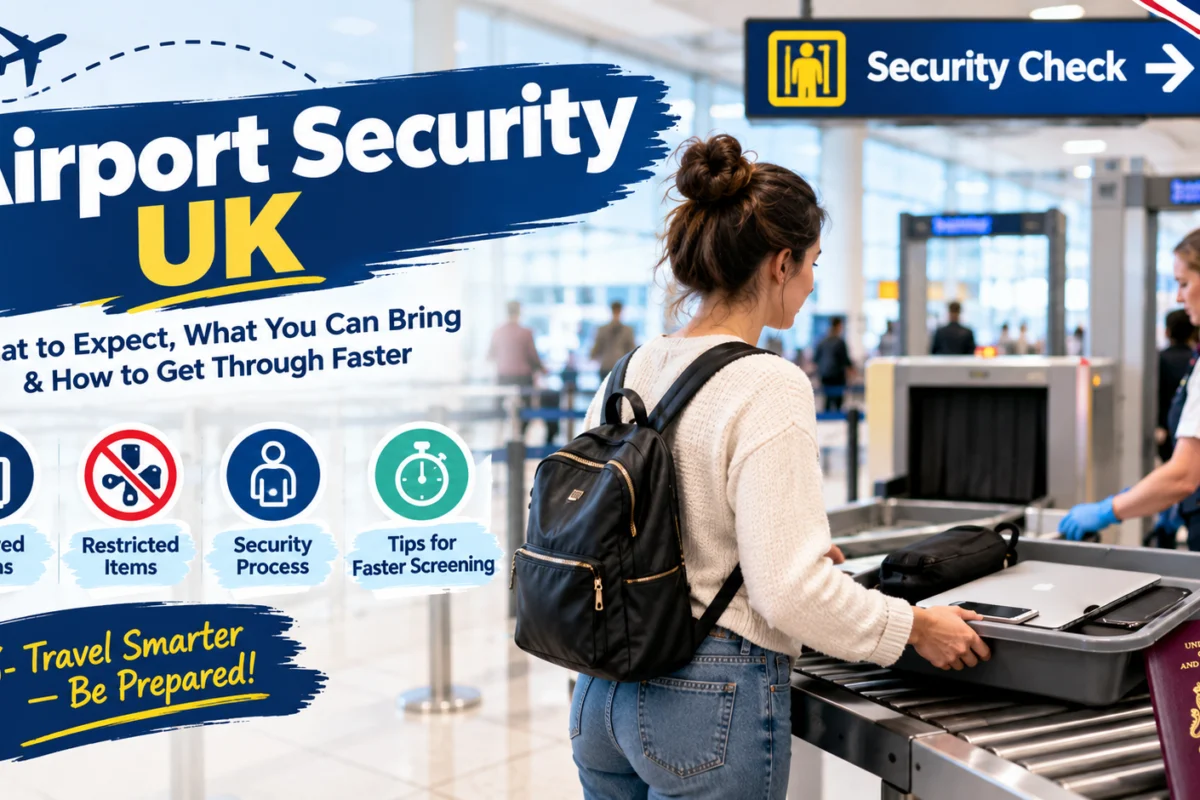
Few parts of a trip cause as much quiet dread as the security queue. You’ve checked in, you’re wearing the wrong shoes, there’s a toddler on one hip and a stern sign is reminding you about liquids. Somewhere behind you, someone is sighing very loudly.
The good news is that things are getting easier. New scanners, clearer rules and a little preparation can turn a stressful shuffle into a smooth five-minute job. This guide to UK Airport Security travel explains what actually happens at the checkpoint, what you can pack, what’s changed recently and how to avoid the mistakes that slow people down.
Whether you’re flying from Heathrow, Manchester, Glasgow or a small regional airport, the basics are similar. The details, however, can differ from airport to airport, so we’ll point out where to double-check.
If you’re looking for reliable and affordable travel options, explore Cheap Flights from UK to USA and find the best deals for your next journey.
How Airport Security UK Travel Works, Step by Step
Knowing what to expect makes the whole process less intimidating. Here’s the typical journey for airport security UK travel from the moment you arrive.
- Check in and drop your hold bag. Do this online or at the airport, depending on your airline.
- Show your boarding pass at the entrance to the security area. Many airports use automatic gates that scan the barcode.
- Prepare your belongings. Remove coats, jackets and anything bulky from your pockets. Depending on the airport’s equipment, you may also need to take out liquids and electronics.
- Place items in the trays. Use a separate tray for your bag, one for your coat and one for anything metal.
- Walk through the scanner. This will be a metal detector or a body scanner, depending on the airport.
- Collect your belongings and repack away from the conveyor belt, so you don’t hold up the people behind you.
- Possible extra checks. Some passengers are chosen at random for a hand search or an explosives trace test. This is routine and nothing to worry about.
The whole thing often takes less than ten minutes at quiet times, though it can stretch much longer during school holidays and early-morning peaks.
What’s Changing: New CT Scanners and the 100ml Liquid Rule
The biggest shift in airport security UK travel for nearly two decades is the arrival of CT scanners. These machines create a 3D image of what’s inside your bag, which lets security staff see far more detail than older X-ray machines. As a result, passengers at airports with the new equipment can often leave laptops, tablets and liquids inside their hand luggage.
That has also led to a relaxing of the famous 100ml liquid rule at some airports. At the time of writing, several major airports, including Heathrow, Birmingham and Edinburgh, have been reported to allow containers of up to two litres through security. Other airports, however, still enforce the 100ml limit, and recent reports suggest a fair number still publish that rule. Even where the 100ml cap applies, some of those airports now let you keep liquids in your bag during screening.
The key takeaway: the rules now depend on the airport. Don’t assume the relaxed rules at one airport apply at another. That matters especially for:
- Return journeys from different airports
- Connecting flights with security checks at each stop
- Trips abroad where the destination airport may still use the old rules
If you want to be safe, pack liquids in containers of 100ml or less in a clear, resealable bag, which works everywhere. Check your departure airport’s website a few days before you fly, as policies are still changing.
What You Can and Can’t Pack in Hand Luggage
Hand luggage restrictions UK airports apply are set by government rules, with additional limits from individual airlines. When it comes to airport security UK travel rules for cabin bags, the main principle is simple: anything that could be used as a weapon or cause danger is banned.
Usually not allowed in hand luggage:
- Knives and sharp blades, apart from some small items such as plastic or round-bladed butter knives
- Scissors with blades longer than 6cm
- Firearms, ammunition and realistic replicas
- Fireworks, flares and other explosives
- Flammable items such as lighter fuel, matches in large quantities and certain aerosols
- Tools and sports equipment that could be used as weapons, such as hammers, crowbars and baseball bats
- Large containers of liquid, where your airport still enforces the 100ml limit
Usually allowed:
- Liquids in small containers, or larger ones where your airport allows it
- Phones, laptops, tablets and e-readers
- Baby food and milk in reasonable quantities
- Medicines you need during the flight
- Sealed duty-free purchases in the correct tamper-evident bag
The official GOV.UK list is the best place to check anything unusual. If an item isn’t on the list, ask the airport or your airline before you fly, because security officers always have the final say.
Batteries, Power Banks and Vapes
Lithium batteries need extra care. Power banks and spare batteries are normally required to go in your hand luggage, not your hold bag, because of fire risk. Many airlines have recently tightened rules on how you can use power banks on board, so read your airline’s policy.
Vapes and e-cigarettes must also travel in your cabin bag rather than the hold, and e-liquids count as liquids, so they follow the same limits as any other. Protect devices from accidental activation by switching them off and keeping them in a case.
Electronics: Laptops, Tablets and Chargers
At airports with the older scanners, you’ll usually need to take laptops and larger electronics out of your bag and put them in a separate tray. Airports with the latest CT scanners typically let you leave them inside. This is another reason to check the rules for your specific airport.
A few sensible habits help whichever system you meet:
- Keep your devices easy to reach.
- Pack cables and chargers neatly, so they don’t look tangled on the scanner.
- Charge your phone and any device you might need to switch on, as staff can occasionally ask you to power them up.
- Keep your passport and boarding pass in a pocket or small pouch, not buried in your bag.
Medicines, Baby Items and Special Foods
If you’re travelling with medication, bring only what you need for the trip and keep it in your hand luggage in its original packaging, ideally with the pharmacy label showing. Airport security UK travel rules allow essential medicines in the quantities you need for your journey, even liquids above the usual limit, but you may be asked to show them. A copy of your prescription or a letter from your GP can help, especially for controlled drugs, injectables or anything unusual.
Parents can carry baby milk, sterilised water and baby food in the amounts needed for the journey. Staff may ask you to taste some of it, or test it, so don’t be alarmed. Special dietary foods needed for medical reasons are also permitted, but it’s worth carrying evidence if the quantity is large.
Duty-Free Shopping and Sealed Bags
Duty-free goods bought at the airport come in a sealed security bag called a STEB, which allows you to carry liquids onto your flight and through transfers. Keep the receipt visible inside the bag and don’t open it until you’ve reached your final destination, or you may have to surrender the liquids at a connecting airport’s security.
What to Wear for a Smoother Security Check
Your outfit can make a noticeable difference. A few simple choices speed everything up:
- Slip-on shoes that are quick to remove if requested
- A belt without a large metal buckle, or put it in your bag
- Minimal jewellery, which can set off the metal detector
- Layers you can remove quickly, such as a jacket or hoodie
- Pockets that stay empty, so everything goes into your bag before you reach the trays
What to Expect From Body Scanners and Searches
Most UK airports use body scanners that look for hidden objects without showing a realistic image of your body. If the machine flags something, you may be asked to go through again or have a pat-down search. You can ask for the search to be carried out in private and by an officer of the same sex.
You may also be asked to remove items such as religious or ceremonial headwear for inspection, or to have them checked in a private area. Staff are trained to treat everyone respectfully, so if you have a concern, calmly tell them and ask for a private space.
Airport Security UK Travel With Children
Travelling with little ones adds extra things to think about. When it comes to airport security UK travel with a family, a bit of planning goes a long way:
- Pushchairs and car seats usually need to be scanned, so be ready to fold them.
- Babies and toddlers may be carried through the scanner by a parent, and staff will guide you.
- Children’s shoes and coats often come off too, so dress them in easy layers.
- Snacks and drinks are fine, but liquids must fit the airport’s rules.
- Comfort items such as soft toys can usually stay with your child but may be checked.
Many airports have dedicated family lanes, which can be calmer and quicker. If you can, give children a simple explanation beforehand, such as “we walk through the arch and then collect our bags”, to reduce nerves.
Assistance for Disabled and Vulnerable Passengers
Airport security UK travel should be accessible to everyone, and airports and airlines are required to provide help. If you need support, tell your airline or booking provider at least 48 hours before you fly so the right assistance is ready. Many airports offer a Sunflower lanyard scheme for people with hidden disabilities, which discreetly signals that you may need extra time or support.
If you use a wheelchair, mobility aid, hearing aid or medical device, staff can screen you in ways that suit your situation, including private searches. People with pacemakers or implants should carry their medical card and tell security staff before screening.
How Early Should You Arrive?
There’s no single right answer, but a safe rule is to arrive two to three hours before a short-haul flight and three hours or more for long-haul, especially at big airports. Airlines usually publish their own check-in and bag-drop deadlines, and missing them can mean being refused travel, even if you’ve arrived at the airport in time.
Arrive earlier during school holidays, bank holiday weekends, major events or very early morning departures. For airport security UK travel in busy periods, extra time is the cheapest insurance you can buy. And remember that once you’re through security, you can relax in the terminal rather than sprint to the gate.
Is Fast Track Security Worth It?
Many UK airports offer a paid fast track lane, and some allow you to book a security slot in advance. These can shorten your wait significantly at peak times. Prices vary, so compare them with your total trip cost.
It’s usually worth it if you’re travelling with children, have a tight connection or simply hate queueing. If you’re travelling at a quiet time, you may find you don’t need it. Some premium tickets and airline status levels also include priority security, so check before paying extra.
Connecting Flights and Multi-Airport Trips
Rules for airport security UK travel are one thing, but your journey might involve several airports with different systems. If you’re connecting abroad, you may need to go through security again, and the rules at the other airport could be stricter than at home. Liquids bought in the UK may need to be in a sealed duty-free bag for transfers, or you could have to surrender them.
The safest approach is to pack to the strictest standard on your route. That means clear, 100ml-or-smaller liquids and easy-to-remove electronics. Check your return airport’s rules as well, since the airport you fly home from may not follow the same policy as the one you left.
Common Mistakes That Cause Delays
These slip-ups cause most of the hold-ups at the checkpoint:
- Packing a full-size toiletry without checking the airport’s liquid rules
- Forgetting about items in pockets, such as keys, coins and phones
- Leaving a water bottle full, which usually needs to be emptied before security
- Packing sharp objects, such as nail scissors with long blades, penknives or cooking tools
- Burying your boarding pass in a bag
- Ignoring airline cabin bag limits, which are separate from security rules
- Failing to separate electronics where the airport still requires it
- Making jokes about bombs or weapons. These are taken seriously, and can lead to a refused flight or police involvement.
What Happens If You Pack a Prohibited Item?
If security finds something that isn’t allowed, you’ll usually be asked to hand it over or throw it away, and in some cases you might be asked to go back and put it into your hold luggage if you still have time. Dangerous or illegal items can lead to further questions, and in serious cases, police action. It’s far easier to check the list at home than to explain yourself at the checkpoint.
Quick Airport Security UK Travel Checklist
Run through this list the night before you fly:
- Passport or photo ID, boarding pass and any required travel documents
- Liquids in 100ml containers in a clear bag, unless you’ve confirmed otherwise
- Laptops and tablets easy to reach
- Power banks and spare batteries in your hand luggage
- Medicines in original packaging, with a prescription copy if needed
- No sharp items, tools or prohibited goods
- Empty water bottle to refill after security
- Easy-to-remove shoes and jacket
- Airport and airline rules checked within the last few days
Frequently Asked Questions
What are the main airport security UK travel rules for hand luggage?
You can generally take a cabin bag within your airline’s size limit, but sharp items, weapons, flammables and certain tools are banned. Liquids must follow your airport’s limit, either 100ml containers or up to two litres at airports with the newest scanners. Always check GOV.UK and your airline for the full list.
Has the 100ml liquid rule been scrapped in the UK?
Not everywhere. Some major airports have relaxed it thanks to CT scanners, but many still apply the 100ml limit. Check your departure airport’s website shortly before travelling.
Do I need to take my laptop out of my bag?
It depends on the airport. Airports with CT scanners usually let you leave electronics in your bag, while others still ask you to remove them. Follow the signs and staff instructions.
Can I take food through security?
Solid food is generally fine, but liquids and spreads such as yoghurt, jam or hummus may count as liquids. Some countries also restrict importing certain foods, so check your destination’s rules.
Can I take an empty water bottle through?
Yes. Take an empty reusable bottle through security and fill it at a water fountain or refill station once you’re through.
How long does security take at UK airports?
It can be as little as ten minutes in quiet periods, and 30 to 60 minutes or more in busy periods. Arriving early and packing sensibly keeps it smooth.
Can I get through security with a pacemaker or medical device?
Yes, but tell staff before screening and carry your medical card. They’ll arrange an alternative check if needed.
Final Thoughts
UK Airport Security travel doesn’t need to be stressful. Once you understand the process, pack with the rules in mind and allow yourself plenty of time, the checkpoint becomes a small hurdle rather than a big one. Remember that liquids and laptop rules now vary by airport, so spend two minutes checking your airport’s website before you head out.
Pack smart, dress for speed, keep your documents handy and stay calm. Do that, and you’ll be through the gates with time to spare for a coffee, some duty-free browsing and the best part of any trip: the moment the plane lifts off.

Join the conversation