

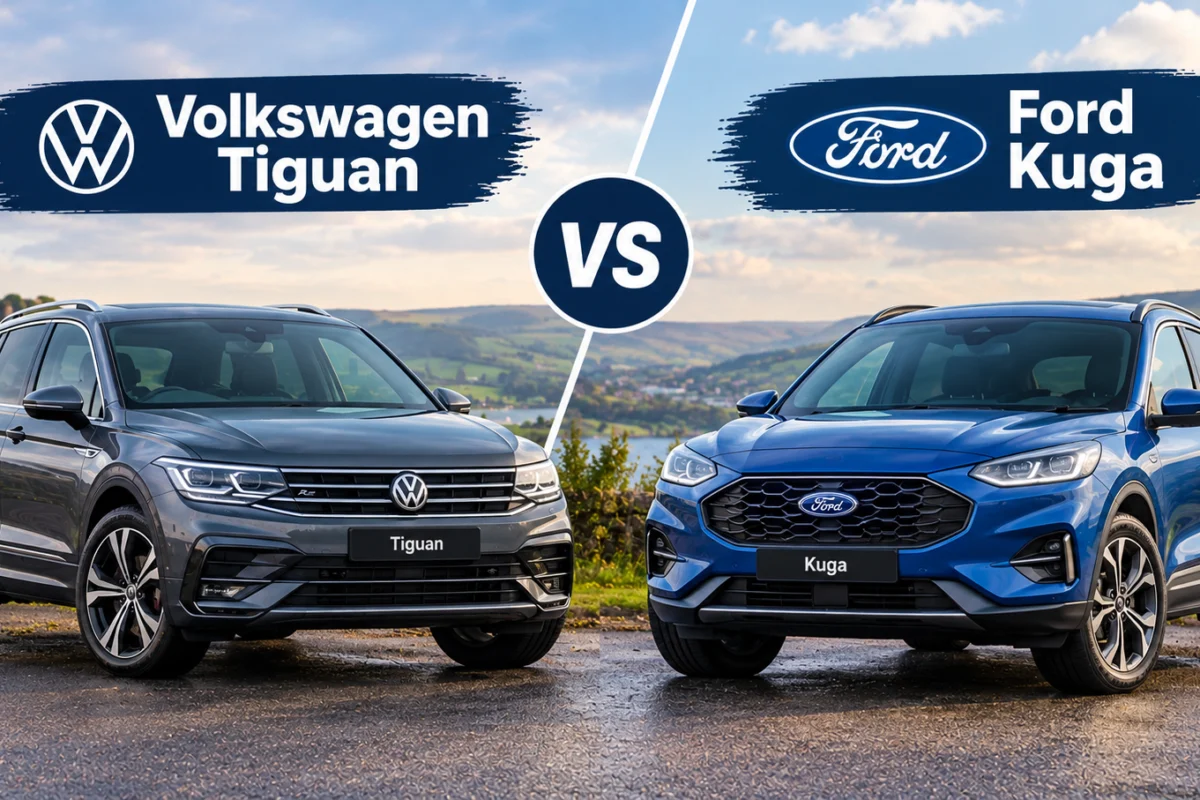
Volkswagen Tiguan vs Ford Kuga UK :-Walk into any UK dealership forecourt and you’ll notice the same two names keep cropping up in the compact family SUV segment: the Volkswagen Tiguan and the Ford Kuga. That’s exactly why the Volkswagen Tiguan vs Ford Kuga UK comparison keeps coming up whenever someone starts shortlisting a practical, mid-size crossover for the school run, the motorway commute, and the annual family holiday drive.
Both cars occupy almost identical territory on paper — similar dimensions, similar price brackets, similar petrol, hybrid and plug-in hybrid powertrain choices. But spend a weekend driving both and you’ll quickly discover they appeal to genuinely different types of buyer. One leans on German engineering credibility and interior polish. The other leans on driving dynamics and outright value. So when people search for Volkswagen Tiguan vs Ford Kuga UK breakdowns, what they’re really trying to work out is which of these two very different personalities suits their life better.
This guide walks through everything that actually matters — UK pricing, interior quality, technology, boot space, hybrid efficiency, driving feel, running costs, and resale value — so you’ll finish this article knowing exactly where you land in the Volkswagen Tiguan vs Ford Kuga UK debate.
UK Pricing: Value vs Premium Positioning
Let’s get straight into the number most people check first when weighing up the Volkswagen Tiguan vs Ford Kuga UK price gap.
The Ford Kuga starts from around £33,000 for the entry-level 150PS petrol Titanium model, making it noticeably cheaper to get into than the Tiguan at launch trim. Move up to the self-charging hybrid and prices climb to around £38,000, while the plug-in hybrid variants push past £39,000-£41,000 once you start adding ST-Line X trim and extra kit.
The Volkswagen Tiguan, meanwhile, starts from around £38,000-£38,300 for its entry petrol trim, positioning it firmly as the pricier option from the very first spec sheet. Once you move into eHybrid plug-in territory, Tiguan prices climb further still, often exceeding what an equivalent Kuga PHEV costs.
So in the Volkswagen Tiguan vs Ford Kuga UK pricing argument, Ford wins comfortably at the entry point, sometimes by as much as £5,000 for a broadly similar spec. If your budget is the deciding factor, the Kuga simply gets you into a compact SUV for meaningfully less money. But as with most car comparisons, the story doesn’t end at the price sticker.
Interior Quality and Build: German Precision vs Practical Familiarity
This is where the Volkswagen Tiguan vs Ford Kuga UK comparison shifts firmly in Volkswagen’s favour.
The Tiguan’s cabin has long been held up as one of the benchmarks in this class — clean, logically laid out, and finished with materials that genuinely feel like they belong in a car costing several thousand pounds more. Even the design of the climate controls and driving position adjustment range in the Tiguan has been praised for feeling more considered than most rivals.
The Ford Kuga’s interior, by comparison, has been criticised for feeling a little dated, with harder plastics in places and an infotainment layout that trades physical dials for touchscreen-only climate shortcuts — something reviewers have flagged as a step back for usability on the move. It’s a perfectly functional cabin, but it doesn’t quite match the sense of quality you get sitting inside a Tiguan.
If interior ambience and material quality genuinely matter to you, the Volkswagen Tiguan wins this part of the Volkswagen Tiguan vs Ford Kuga UK conversation outright.
Technology and Infotainment
Both cars have moved toward large central touchscreens as their primary control method, which brings its own trade-offs in the Volkswagen Tiguan vs Ford Kuga UK tech comparison.
The Ford Kuga now runs Ford’s SYNC 4 system through a 13.2-inch touchscreen, offering noticeably more processing power and a cleaner interface than the older SYNC 3 setup it replaces. It’s a big step forward for Ford, even if some physical controls have disappeared in the process.
The Volkswagen Tiguan pairs its own touchscreen with the ability to display sat-nav mapping directly in the driver’s instrument cluster — something the Kuga can’t currently match — giving it a slight edge for drivers who like keeping navigation information directly in their eyeline.
Neither system is perfect, and both have drawn criticism for shifting too many functions away from physical buttons, but the Tiguan generally comes out slightly ahead on configurability in most Volkswagen Tiguan vs Ford Kuga UK tech reviews.
Boot Space and Practicality
Practicality is often the single biggest factor for family buyers, so it deserves real attention in any Volkswagen Tiguan vs Ford Kuga UK write-up.
The standard Ford Kuga offers a generous 645 litres of boot space, dropping to 581 litres in plug-in hybrid form due to battery packaging under the boot floor. Both figures are competitive for the class, and the Kuga’s sliding rear bench allows buyers to prioritise either legroom or luggage space depending on the day’s needs.
The Volkswagen Tiguan eHybrid, meanwhile, offers an impressive 652 litres with the rear seats slid fully forward — slightly ahead of the equivalent Kuga PHEV — while the standard Tiguan range has traditionally offered a genuinely useful, regularly-shaped load bay that makes it easy to actually use every litre on paper.
Both cars also include an Isofix mounting point setup, though the Tiguan uniquely offers one on the front passenger seat too, letting families fit a child seat in three positions rather than two — a small but genuinely useful practical win in the Volkswagen Tiguan vs Ford Kuga UK comparison for anyone with young kids.
Hybrid and Plug-In Hybrid Efficiency
Electrified options are a major part of why buyers now cross-shop these two cars, and this is one of the more decisive sections of the Volkswagen Tiguan vs Ford Kuga UK comparison.
The Volkswagen Tiguan eHybrid uses a 25.7kWh battery (19.7kWh usable) to deliver an official all-electric range of up to 77 miles, with real-world testing in cold weather still returning a very usable 55 miles. It also supports 50kW DC rapid charging, taking the battery from 10-80% in around 26 minutes, plus 11kW AC charging for a full home charge in roughly two and a half hours.
The Ford Kuga PHEV, by contrast, offers a maximum electric-only range of around 42 miles — a solid figure, but well short of what the Tiguan eHybrid can manage. For UK buyers doing short daily commutes who want to run mostly on electric power during the week, the Tiguan’s plug-in hybrid clearly has the edge in this part of the Volkswagen Tiguan vs Ford Kuga UK matchup.
Driving Experience: Sporty vs Composed
Here’s where the Ford Kuga fights back hard in the Volkswagen Tiguan vs Ford Kuga UK debate.
Reviewers consistently praise the Kuga for genuinely enjoyable handling — it’s often described as one of the more fun compact SUVs to drive on a country lane, with sharper steering and a chassis that feels more engaged than most rivals in this segment. It’s not a hot hatch, but among family SUVs, it stands out for actually rewarding a keen driver.
The Volkswagen Tiguan takes a more composed, refined approach, prioritising comfort and a settled ride over outright driving thrills. It’s an easier car to relax in over a long motorway journey, but it doesn’t try to be exciting in the same way the Kuga does.
So if driving enjoyment is high on your list, the Ford Kuga arguably wins this part of the Volkswagen Tiguan vs Ford Kuga UK comparison, while the Tiguan focuses its energy on comfort and refinement instead.
Running Costs and Resale Value
Cost of ownership tends to favour Volkswagen slightly, and it’s worth factoring into any serious Volkswagen Tiguan vs Ford Kuga UK decision.
Historical depreciation studies have shown Volkswagens holding onto more of their original value than equivalent Fords, often by a few percentage points over a typical ownership period. The Tiguan’s stronger badge perception in the used market tends to support this trend, even though the Kuga’s cheaper up-front price partially offsets the gap in total cost of ownership.
Insurance groups are broadly comparable across equivalent trims, though the more complex PHEV powertrains in both cars — particularly the Tiguan eHybrid — tend to sit in slightly higher insurance bands than the standard petrol and hybrid versions.
Towing and Load Capability
If towing matters to you, this is a section of the Volkswagen Tiguan vs Ford Kuga UK comparison worth paying close attention to, since it’s one of the more overlooked factors in most Volkswagen Tiguan vs Ford Kuga UK reviews. For demanding, regular towing of heavier loads, the Volkswagen Tiguan is generally considered the stronger choice, with a more robust setup built around frequent trailer or caravan use. The Ford Kuga remains perfectly capable for occasional towing duties, but buyers who tow often and heavily tend to lean toward the Tiguan.
So, Volkswagen Tiguan or Ford Kuga — Which Should You Actually Buy?
If you’ve made it this far, you’ve probably already got a leaning in the Volkswagen Tiguan vs Ford Kuga UK debate, but here’s the breakdown made concrete.
Choose the Ford Kuga if:
- You want the lowest possible entry price in this class
- You genuinely enjoy driving and want sharper, more engaging handling
- You don’t need maximum plug-in electric range
- You want the latest, more powerful SYNC 4 infotainment system
Choose the Volkswagen Tiguan if:
- Interior quality and material feel matter more to you than saving a few thousand pounds
- You regularly do short commutes and want the longest possible electric-only range from a PHEV
- You tow frequently and want the more capable setup
- Resale value and badge strength matter to your long-term ownership plans
Final Verdict
There’s no single right answer in the Volkswagen Tiguan vs Ford Kuga UK debate, and that’s precisely what makes it such a genuinely close contest. The Ford Kuga is the smarter choice for buyers who want strong value, sharper driving dynamics, and the latest infotainment tech without paying a premium. The Volkswagen Tiguan, on the other hand, justifies its higher price with a genuinely nicer cabin, longer electric-only range in eHybrid form, stronger towing capability, and better long-term resale value.
If you’re chasing maximum value and a car that’s actually enjoyable on a back road, the Kuga is hard to argue with. But if you want a compact SUV that feels a notch more premium every time you get behind the wheel, and you’re willing to pay for it, the Tiguan remains one of the strongest all-rounders in the entire family SUV class.
Either way, the fact that these two cars keep getting cross-shopped so heavily says everything about how competitive the UK’s compact SUV segment has become — and whichever one you choose, you’re picking one of the two genuine class leaders.
Frequently Asked Questions
Is the Ford Kuga cheaper than the Volkswagen Tiguan in the UK? Yes. The Kuga starts from around £33,000, while the Tiguan starts from roughly £38,000, with the gap continuing across hybrid and PHEV trims.
Which has more boot space, the Tiguan or the Kuga? The Volkswagen Tiguan eHybrid offers 652 litres with seats slid forward, slightly ahead of the Ford Kuga PHEV’s 581 litres, while the standard Kuga offers 645 litres.
Which plug-in hybrid has better electric range? The Volkswagen Tiguan eHybrid offers up to 77 miles of electric-only range, well ahead of the Ford Kuga PHEV’s 42 miles.
Which is better to drive, the Kuga or the Tiguan? The Ford Kuga is generally considered more engaging and fun to drive, while the Volkswagen Tiguan prioritises comfort and refinement over outright driving excitement.
Which is the better choice overall in the Volkswagen Tiguan vs Ford Kuga UK comparison? It depends on priorities: the Kuga wins on price and driving enjoyment, while the Tiguan wins on interior quality, electric range, towing capability, and resale value.
Join the conversation