

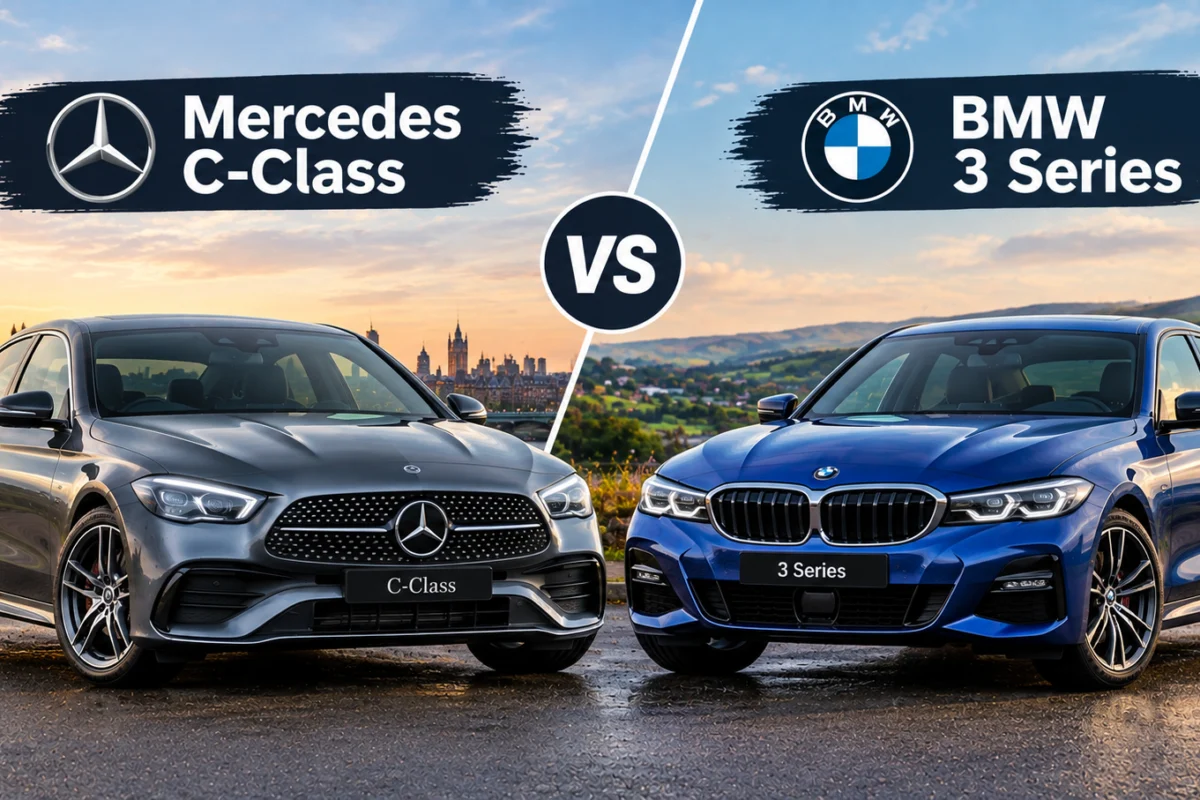
Mercedes C-Class vs BMW 3 Series UK :-Few rivalries in the UK car market run as deep as this one. For decades now, the Mercedes C-Class and BMW 3 Series have been squaring off for the same buyer: someone who wants a genuinely premium saloon, a badge that means something on the driveway, and a driving experience that feels a cut above the mainstream family car market. That’s exactly why the Mercedes C-Class vs BMW 3 Series UK comparison remains one of the most searched, most debated match-ups in the entire executive car segment.
Both cars sit in a near-identical price bracket, both offer estate versions, both come loaded with premium tech, and both have spent generations refining what a compact executive saloon should feel like — which is exactly why the Mercedes C-Class vs BMW 3 Series UK comparison never seems to get old. But drive them back to back and the differences become obvious fast. One leans into comfort, luxury, and cutting-edge infotainment. The other leans into sharper handling and that unmistakable “driver’s car” feel BMW has built its entire brand around. So when people search for Mercedes C-Class vs BMW 3 Series UK breakdowns, they’re really trying to work out which of these two very different flavours of premium suits them better.
This article walks through everything that actually matters in the Mercedes C-Class vs BMW 3 Series UK debate — pricing, interior tech, performance, comfort, running costs, hybrid options, and resale value — so by the end you’ll know exactly which side of this rivalry you land on.
UK Pricing: Where the Gap Actually Sits
Let’s start with the figure most buyers check first when weighing up the Mercedes C-Class vs BMW 3 Series UK price gap.
The BMW 3 Series remains the cheaper of the two at entry level, with UK pricing typically starting a little under £42,000 for the base petrol variant. The Mercedes C-Class, by comparison, starts from around £46,995 for its entry-level C 250 petrol in Urban Edition trim, putting it more than £5,000 above the equivalent BMW.
Move up the range and the gap tends to persist, with the C 300 petrol starting from around £49,145 and the C300e plug-in hybrid coming in at roughly £52,515. BMW’s equivalent 330i and 330e variants typically undercut these figures by a comparable margin.
So in the Mercedes C-Class vs BMW 3 Series UK pricing argument, BMW wins clearly on value at every trim level. If getting the most premium badge for your money is the priority, the 3 Series is the more sensible starting point. That said, the Mercedes doesn’t arrive at that higher price with nothing to show for it.
Interior Quality and Technology: MBUX vs iDrive
This is arguably the most talked-about section of any Mercedes C-Class vs BMW 3 Series UK comparison, because both brands have taken infotainment in genuinely different directions.
The Mercedes C-Class brings S-Class design language downstream for the first time in this generation, and it shows. The cabin feels noticeably more expensive than its price tag suggests, with the MBUX infotainment system standing out as one of the most visually striking systems in the class. Features like augmented reality navigation — which overlays turn-by-turn directions onto a live video feed of the road ahead — feel genuinely futuristic and give the Mercedes a real technological edge.
The BMW 3 Series counters with its long-refined iDrive system, which remains slightly more driver-focused in its layout, with physical controls that many owners still prefer over pure touchscreen interaction. It’s a more restrained, function-first approach compared to the Mercedes’ showier presentation.
If cutting-edge tech and cabin ambience matter most to you, the Mercedes tends to win this part of the Mercedes C-Class vs BMW 3 Series UK comparison, while BMW’s approach still appeals strongly to buyers who prefer physical controls over screen-based menus.
Performance and Driving Dynamics
Here’s where the BMW 3 Series has built its entire reputation, and it’s central to any honest Mercedes C-Class vs BMW 3 Series UK write-up, since performance is often the single biggest reason buyers pick one over the other.
In base four-cylinder form, both cars use closely matched 2.0-litre turbocharged petrol engines producing around 255 horsepower, but the BMW is consistently quicker off the line — the 330i sprints to 60mph in around 5.4 seconds, compared to roughly six seconds for the equivalent C 300. Higher up the range, the divergence grows further: BMW’s M340i uses the brilliant B58 straight-six engine to hit 60mph in just 4.1 seconds, a genuinely thrilling figure for a car this practical.
The Mercedes counters with its own six-cylinder options and AMG-badged variants that sharpen the handling considerably compared to the standard C-Class, but most reviewers still rate the BMW as the more engaging car to actually drive — sharper steering, a more communicative chassis, and that classic rear-wheel-drive balance BMW has spent decades perfecting.
So if driving enjoyment is the deciding factor in your Mercedes C-Class vs BMW 3 Series UK decision, the BMW remains the stronger choice for most buyers, even as the gap has narrowed generation after generation.
Comfort and Ride Quality
The Mercedes claws back significant ground here, and it’s a genuinely important part of the Mercedes C-Class vs BMW 3 Series UK comparison for buyers doing lots of motorway miles, since comfort tends to matter more than outright handling for everyday commuting.
The C-Class prioritises a smoother, more cosseting ride, with a cabin that feels calmer and more isolated from road imperfections — exactly the kind of experience you’d expect from a scaled-down S-Class. The BMW, by contrast, retains a firmer edge to its suspension tuning, particularly on larger alloy wheel options, which rewards keen drivers but can feel slightly less relaxing on longer journeys.
For buyers who value comfort and refinement over outright dynamism, the Mercedes tends to edge ahead in this section of the Mercedes C-Class vs BMW 3 Series UK debate.
Plug-In Hybrid Options and Running Costs
Both brands offer strong plug-in hybrid variants, and this is one of the more financially relevant parts of the Mercedes C-Class vs BMW 3 Series UK comparison for company car drivers, since running costs often matter more than list price over a typical ownership period.
Both the BMW 330e and Mercedes C300e currently attract the same low 3% Benefit-in-Kind rate in the UK, making either an attractive company car choice. However, the C300e’s greater electric-only range translates into lower pence-per-mile running costs for drivers who can charge regularly, giving Mercedes a genuine edge for anyone doing predominantly short commutes.
Insurance groups are broadly similar between the two, though BMW models typically insure at a slightly lower group than the directly equivalent Mercedes variant, which can shave a modest amount off annual premiums depending on your individual driver profile.
Resale Value and Long-Term Ownership
This is a section that often surprises people looking into the Mercedes C-Class vs BMW 3 Series UK debate for the first time, and it’s arguably underrated in most Mercedes C-Class vs BMW 3 Series UK guides.
Despite its higher purchase price, the Mercedes C-Class has recently ranked highest among premium brands for residual value in UK cap hpi research, meaning it tends to hold onto a larger percentage of its original price over a typical finance term. The BMW 3 Series remains competitive on depreciation too, and some independent five-year cost-of-ownership studies still favour BMW overall thanks to cheaper running costs offsetting the Mercedes’ stronger residuals.
In practice, the total cost of ownership between the two is closer than the initial price gap suggests, which is worth remembering before ruling either car out purely on sticker price in your own Mercedes C-Class vs BMW 3 Series UK comparison.
Estate Versions: Touring vs C-Class Estate
Family buyers cross-shopping the Mercedes C-Class vs BMW 3 Series UK range shouldn’t overlook the estate variants, which extend the same Mercedes C-Class vs BMW 3 Series UK trade-offs into a more practical body style. Both the BMW 3 Series Touring and the Mercedes C-Class Estate are genuinely attractive, practical alternatives to the saloon body style, offering similar driving characteristics to their saloon counterparts while adding meaningfully more luggage space for family life, making either estate a strong shout for buyers who need more practicality without stepping up into a full SUV.
So, Mercedes C-Class or BMW 3 Series — Which Should You Actually Buy?
If you’ve read this far, you probably already have a leaning in the Mercedes C-Class vs BMW 3 Series UK debate, but here’s the breakdown made concrete.
Choose the BMW 3 Series if:
- You want the lowest possible entry price for a premium German saloon
- Sharp handling and genuine driving engagement matter most to you
- You prefer physical controls over a fully screen-dominated cabin
- You want the strongest straight-line performance in six-cylinder form
Choose the Mercedes C-Class if:
- Cabin ambience, material quality, and cutting-edge tech matter more than saving money upfront
- You want the plug-in hybrid with the longest electric-only range
- Ride comfort on long motorway journeys is a bigger priority than outright dynamics
- Strong resale value matters to your long-term ownership plans
Final Verdict
There’s no single correct answer in the Mercedes C-Class vs BMW 3 Series UK debate, and that’s exactly what keeps this rivalry so interesting generation after generation. The BMW 3 Series remains the smarter choice for buyers who want the sharpest driving experience and the lowest entry price into premium German motoring. The Mercedes C-Class, meanwhile, justifies its higher price tag with a genuinely more luxurious cabin, more advanced infotainment, greater comfort, and a longer plug-in hybrid electric range.
If you see your car as something to be enjoyed from behind the wheel on a good road, the BMW is difficult to beat. But if you want your daily drive to feel like a scaled-down luxury flagship every time you get in, the Mercedes makes a genuinely compelling case for the extra outlay.
Either way, the fact that these two cars remain so closely matched after all these years says everything about how seriously both brands take this segment — and whichever one you choose, you’re picking one of the two genuine benchmarks of the premium saloon class.
Frequently Asked Questions
Is the BMW 3 Series cheaper than the Mercedes C-Class in the UK? Yes. The BMW 3 Series starts from just under £42,000, while the Mercedes C-Class starts from around £46,995, a gap of more than £5,000 at entry level.
Which plug-in hybrid has better electric range, the 330e or C300e? The Mercedes C300e offers a greater electric-only range than the BMW 330e, translating into lower pence-per-mile running costs for drivers who charge regularly.
Which is faster, the BMW 3 Series or the Mercedes C-Class? The BMW 330i is quicker to 60mph than the equivalent Mercedes C 300, and the gap widens further in six-cylinder form with the M340i.
Which holds its value better, the C-Class or the 3 Series? The Mercedes C-Class has recently ranked highest among premium brands for residual value in UK cap hpi research, though total ownership costs remain closely matched overall.
Which is the better choice overall in the Mercedes C-Class vs BMW 3 Series UK comparison? It depends on priorities: the BMW wins on price and driving dynamics, while the Mercedes wins on comfort, technology, electric range, and resale value.
Join the conversation