


Every year, millions of travellers pass through UK airports without giving much thought to the aircraft waiting at the gate. For most people, it is simply the plane that will take them to their destination. But for aviation enthusiasts, curious travellers and plane spotters, identifying an aircraft can make time at the airport much more interesting.
If you have ever looked through a terminal window and wondered whether you were watching an Airbus or a Boeing, you are certainly not alone. Modern passenger aircraft can look remarkably similar, particularly when viewed from a distance. However, once you know which details to look for, identifying the manufacturer becomes much easier.
The guide Airbus or Boeing? 5 Ways to Spot the Difference is designed for beginners who want to understand the most noticeable visual differences without getting buried in complicated aviation terminology.
From the nose and cockpit windows to the engines, tail and wingtips, there are several useful clues that can help you make a confident identification. You do not need specialist equipment or years of experience. A little observation and regular practice can make a surprisingly big difference.
Airbus or Boeing: Why Can They Look So Similar?
Before getting into Airbus or Boeing? 5 Ways to Spot the Difference, it is worth understanding why aircraft from the two manufacturers can be difficult to distinguish.
Most modern passenger aircraft follow similar aerodynamic principles. They generally have a cylindrical fuselage, swept wings, engines mounted beneath the wings and a vertical tail. These basic characteristics are necessary for efficient flight, so there is naturally a degree of visual similarity between different aircraft.
The problem becomes even more noticeable when you compare aircraft from similar size categories. From a terminal building or viewing area, a narrow-body aircraft seen several hundred metres away may initially look almost identical to another aircraft from a different manufacturer.
The viewing angle can also change what you see. An aircraft approaching the runway will reveal different clues from one taxiing away from you. Weather and lighting matter too, particularly in the UK, where cloudy conditions can make smaller details harder to distinguish.
That is why the best approach to Airbus or Boeing? 5 Ways to Spot the Difference is to avoid relying on a single feature. Instead, look at several parts of the aircraft and combine the clues.
1. Look at the Shape of the Nose
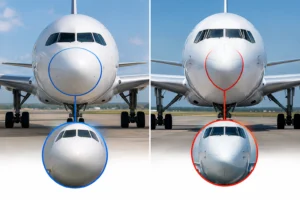
The nose is one of the first areas worth checking when trying to identify an aircraft.
When studying Airbus or Boeing? 5 Ways to Spot the Difference, beginners often find the front profile useful because the shape can provide an immediate visual clue. Depending on the specific model, Airbus aircraft can have a relatively rounded appearance around the nose, while several Boeing designs have a more pointed or angular-looking profile.
However, this is not a universal rule. Aircraft families have evolved over many years, and different models can have noticeably different nose designs. The viewing angle can also exaggerate or hide certain curves.
Pay particular attention to the area below and around the cockpit. The transition between the cockpit windows and the lower nose can sometimes help you distinguish one aircraft family from another.
A side-on view is particularly useful because you can see the complete profile rather than trying to judge the shape head-on.
Quick Spotting Tip
Do not make your final identification from the nose alone. Use it as your first clue, then check the cockpit windows, wings and tail before deciding.
For anyone learning Airbus or Boeing? 5 Ways to Spot the Difference, comparing two aircraft photographs side by side can be an excellent way to train your eye.
2. Check the Cockpit Windows
Once you have examined the nose, move your attention upwards towards the cockpit windows.
Cockpit-window design is another useful clue when learning Airbus or Boeing? 5 Ways to Spot the Difference. The shape, positioning and overall arrangement of the windows can vary between aircraft families.
Some Airbus aircraft have a distinctive cockpit appearance, while several Boeing designs have a different window arrangement that can become easier to recognise with practice.
At first, these differences may appear extremely subtle. You might look at an aircraft and see nothing more than a row of dark windows. After seeing the same aircraft types repeatedly, however, the cockpit area can become one of the quickest visual clues available.
This is particularly useful when an aircraft is still some distance away and the tail or registration cannot be seen clearly.
Quick Spotting Tip
If you are watching aircraft from a UK airport viewing area, binoculars can help you study cockpit-window shapes. You do not need professional equipment; even a basic pair can make distant details easier to see.
Remember that the cockpit windows should support your identification rather than determine it by themselves. The most reliable approach to Airbus or Boeing? 5 Ways to Spot the Difference is to combine several characteristics.
3. Examine the Engines and Their Position
The engines are probably one of the most obvious features of a modern passenger aircraft, but they can also be one of the most misleading when identifying the manufacturer.
This is an important point when following Airbus or Boeing? 5 Ways to Spot the Difference. Aircraft manufacturers do not necessarily use one single engine design across their entire range, and the same aircraft model can be available with different engine options.
For this reason, you should not look at an engine and immediately assume you know whether an aircraft is Airbus or Boeing.
Instead, examine the overall relationship between the engine and the wing. Look at the engine’s size, its position underneath the wing and how it appears from your viewing angle.
The shape of the engine intake can also provide useful information, particularly when you are close enough to see it clearly. From a distance, however, engine details can become difficult to distinguish.
Engine placement becomes much more useful when combined with the nose and wing design. This is one reason experienced spotters rarely depend on a single feature.
Quick Spotting Tip
Try watching an aircraft as it taxis away rather than only when it approaches. The rear three-quarter view can give you an interesting perspective of the engines, wings and tail at the same time.
If you are building your aircraft-identification skills, the engine area is another useful part of Airbus or Boeing? 5 Ways to Spot the Difference to practise.
4. Study the Tail and Rear Fuselage
The tail is often overlooked by beginners, but it can provide valuable information.
When working through Airbus or Boeing? 5 Ways to Spot the Difference, look at the vertical stabiliser, commonly referred to as the tail fin. Pay attention to its overall shape, angle and how it connects to the rear fuselage.
Different aircraft families can have noticeably different tail profiles. Some may appear more upright, while others have a more sharply swept appearance.
The shape of the rear fuselage can also help. Watch how the main body narrows as it approaches the tail. Although these details may seem minor, repeated observation makes them easier to recognise.
The tail can be particularly helpful when an aircraft is moving away from you. In that situation, the nose and cockpit are hidden, leaving the rear profile and wings as some of your strongest visual clues.
For beginners, Airbus or Boeing? 5 Ways to Spot the Difference becomes much easier once you learn to look at the aircraft from different angles instead of always viewing it from the side.
5. Compare the Wings and Wingtips
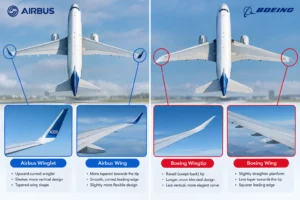
The wings are among the most useful areas to examine when learning Airbus or Boeing? 5 Ways to Spot the Difference.
Look beyond the overall wing shape and pay particular attention to the tips. Modern aircraft can use different types of wingtip devices designed to improve aerodynamic efficiency.
Depending on the aircraft model and generation, you may see curved wingtip extensions, upright fins or other aerodynamic structures. These can create a distinctive appearance when an aircraft is viewed against the sky.
However, it is important not to assume that every Airbus aircraft has exactly the same wingtip design or that every Boeing aircraft uses one particular style. Designs vary across models and generations.
The wingtip is therefore best treated as an important clue rather than an absolute rule.
For many beginners, this is one of the most enjoyable parts of Airbus or Boeing? 5 Ways to Spot the Difference because the wingtip can remain visible even when other details are difficult to see.
Airbus vs Boeing: Quick Comparison
| Feature | Airbus | Boeing |
|---|---|---|
| Nose | Often has a rounded appearance on many models | Several models have a more angular or pointed profile |
| Cockpit windows | Distinctive arrangement varies by aircraft family | Different shapes and positioning across model families |
| Engines | Size and appearance vary by model and engine option | Size and appearance vary by model and engine option |
| Tail | Shape varies across aircraft generations | Shape varies across aircraft generations |
| Wingtips | Different curved and blended designs are used | Different angled and blended designs are used |
| Overall appearance | Depends heavily on model and generation | Depends heavily on model and generation |
This table is only a general guide. Aircraft identification should always consider the specific model rather than assuming that every aircraft from one manufacturer looks the same.
How to Practise Aircraft Spotting at UK Airports
The UK is a great place to develop your aircraft-identification skills because busy airports provide plenty of opportunities to observe different aircraft.
You do not necessarily need to visit an official viewing area. Terminal windows can provide useful views of aircraft taxiing around the airport, while some airports have dedicated areas where enthusiasts can watch aircraft movements.
When practising Airbus or Boeing? 5 Ways to Spot the Difference, try to observe aircraft before checking what type they are. Make your own identification first and then use a reliable aircraft-tracking or airport-information service to see whether your guess was correct.
Why Viewing Angle Matters
One of the biggest mistakes beginners make when learning Airbus or Boeing? 5 Ways to Spot the Difference is assuming that every aircraft will look the same from every angle.
It will not.
A side view allows you to examine the nose and fuselage profile. A front view gives you a better opportunity to study the cockpit and engine arrangement. A rear view highlights the tail and wing shape.
The distance between you and the aircraft also changes what you can see. At close range, small details become obvious. From several kilometres away, you may only be able to identify the broad silhouette.
This is why experienced spotters learn to adapt their identification method depending on the situation.
Common Mistakes Beginners Make
Learning Airbus or Boeing? 5 Ways to Spot the Difference takes practice, and mistakes are completely normal.
Here are some common errors to avoid:
- Judging only by size: Aircraft can appear larger or smaller depending on their distance from you.
- Using only the nose: The nose is useful, but it is not enough for a reliable identification.
- Ignoring the wingtip: Wingtip design can provide valuable additional information.
- Assuming all aircraft from one manufacturer look identical: Both manufacturers have produced numerous aircraft families and generations.
The more features you compare, the more reliable your identification becomes.
A Simple Beginner’s Checklist
If you are completely new to aircraft spotting, use this checklist whenever you see a passenger aircraft:
- Look at the nose.
- Study the cockpit windows.
- Check the engines.
- Look at the wing shape.
- Examine the wingtips.
- Study the tail.
- Compare several features before deciding.
This simple process is at the heart of Airbus or Boeing? 5 Ways to Spot the Difference.
You can start with just two or three features and gradually add more as your confidence improves. There is no need to memorise every aircraft model immediately.
Airbus or Boeing: Which Is Easier to Recognise?
There is no universal answer to which manufacturer is easier to identify.
Some aircraft have distinctive characteristics that make them relatively easy to recognise, while others can be surprisingly difficult even for experienced enthusiasts.
Your viewing position also matters. Someone watching from the side of a runway may have a completely different set of clues available compared with someone sitting inside a terminal.
Weather is another factor. Bright conditions can make wingtip shapes easier to see, while low cloud or poor visibility can make even large aircraft difficult to identify.
The key lesson from Airbus or Boeing? 5 Ways to Spot the Difference is that identification becomes easier through repetition.
The more aircraft you see, the more quickly your brain starts recognising familiar shapes.
Tips for Plane Spotters in the UK
If aircraft spotting becomes a regular hobby, there are several simple ways to improve.
First, practise regularly. Even a short session at an airport can help you become more familiar with aircraft silhouettes.
Second, photograph aircraft where permitted and use your images for later comparison.
Third, focus on one feature at a time. Spend one session studying noses, another looking at cockpit windows and another concentrating on wingtip designs.
Fourth, try to identify an aircraft before checking its type. This turns every sighting into a small test.
Finally, do not worry about getting everything right immediately. Airbus or Boeing? 5 Ways to Spot the Difference is ultimately about developing your observation skills and enjoying aviation.
How Long Does It Take to Learn Aircraft Identification?
There is no fixed amount of time required.
Some people begin recognising common aircraft types after only a handful of spotting sessions. Others need considerably longer before the differences become obvious.
The important thing is consistency.
Spend a few minutes observing aircraft whenever you have the opportunity. Compare photographs and make notes about features you find distinctive.
Eventually, you may find yourself recognising an aircraft almost instantly without consciously going through the entire checklist.
That is when the techniques in Airbus or Boeing? 5 Ways to Spot the Difference start becoming second nature.
Final Thoughts: Airbus or Boeing? 5 Ways to Spot the Difference
Aircraft identification does not have to be a complicated hobby reserved for experienced aviation enthusiasts.
The next time you are sitting at a UK airport, looking through a terminal window or watching aircraft overhead, take a few seconds to examine what you can see.
Start with the nose. Check the cockpit windows. Look at the engines. Study the tail. Then pay close attention to the wings and wingtips.
These five areas give beginners a practical foundation for Airbus or Boeing? 5 Ways to Spot the Difference without requiring specialist aviation knowledge.
Most importantly, remember that no single visual clue is perfect. Aircraft models differ, generations change and viewing conditions can make identification harder. Combining several features will always give you a better chance of getting it right.
With a little practice, the aircraft that once looked like simply “a plane” can start to reveal its own distinctive characteristics.
That is what makes Airbus or Boeing? 5 Ways to Spot the Difference such an enjoyable skill to learn. It can turn an ordinary airport wait into an opportunity to observe, compare and discover more about the aircraft around you.
Frequently Asked Questions
How can I tell the difference between Airbus and Boeing?
Start by examining several features rather than relying on one. The nose, cockpit windows, engines, tail, wings and wingtips can all provide useful clues. Comparing multiple characteristics is the most reliable approach.
What is the easiest way to identify an aircraft?
For beginners, the nose and wingtip areas are useful starting points. However, combining several features will generally produce a more confident identification.
Can cockpit windows help identify an aircraft?
Yes. The shape and arrangement of cockpit windows can provide useful clues. However, they should be considered alongside other aircraft characteristics.
Are Airbus and Boeing wings different?
Wing designs vary considerably between individual aircraft models and generations. Wingtip shapes can sometimes be particularly useful when identifying an aircraft, but they should not be treated as an absolute rule.
Can you identify an aircraft by its engines?
Engines can help, but they should not be used alone. Different aircraft can use different engine options, so engine shape and position are best considered alongside the nose, wings and tail.
Is aircraft spotting difficult for beginners?
Not at all. You can begin with a simple checklist and gradually learn more aircraft features. Regular observation is usually more valuable than trying to memorise everything at once.
Where can I practise aircraft spotting in the UK?
You can practise from suitable airport viewing areas, permitted public locations and terminal windows where aircraft are visible. Always follow airport rules and local safety guidance.
Do I need binoculars to identify aircraft?
No. Binoculars can make small details easier to see, but beginners can learn a lot using the naked eye and photographs taken from appropriate public viewing locations.
Why do Airbus and Boeing aircraft look so similar?
Both manufacturers design aircraft around the same basic principles of aerodynamics, efficiency and passenger transport. As a result, many modern aircraft share similar overall shapes.
What should I look at first when spotting an aircraft?
Start with the nose and cockpit, then move your attention to the wings, wingtips, engines and tail. Comparing several areas will give you a stronger identification than relying on one feature.
Can I identify an aircraft from a distance?
Often, yes. Larger features such as the overall silhouette, wing shape and tail can remain visible from a distance. Smaller details become much harder to judge as the aircraft moves further away.
What is the most important lesson for new plane spotters?
Do not rush your identification. Take a moment to compare several features and accept that some aircraft will be difficult to distinguish. Accuracy improves naturally with practice.
Airbus or Boeing? 5 Ways to Spot the Difference is ultimately less about memorising technical specifications and more about learning to notice small visual details. Once you develop that habit, every trip to the airport can become a little more interesting.



Join the conversation