

Direct flight vs connecting flight Every time you open a flight booking site, you run into the same question: direct flight vs connecting flight — which one is really worth your money and your time? It sounds like a simple choice, but once you start comparing prices, layover times, luggage rules, and how tired you’ll feel at the other end, the direct flight vs connecting flight decision gets a lot more complicated. This guide breaks down everything you need to know so you can stop guessing and start booking smarter.
What Do We Actually Mean by Direct Flight vs Connecting Flight?
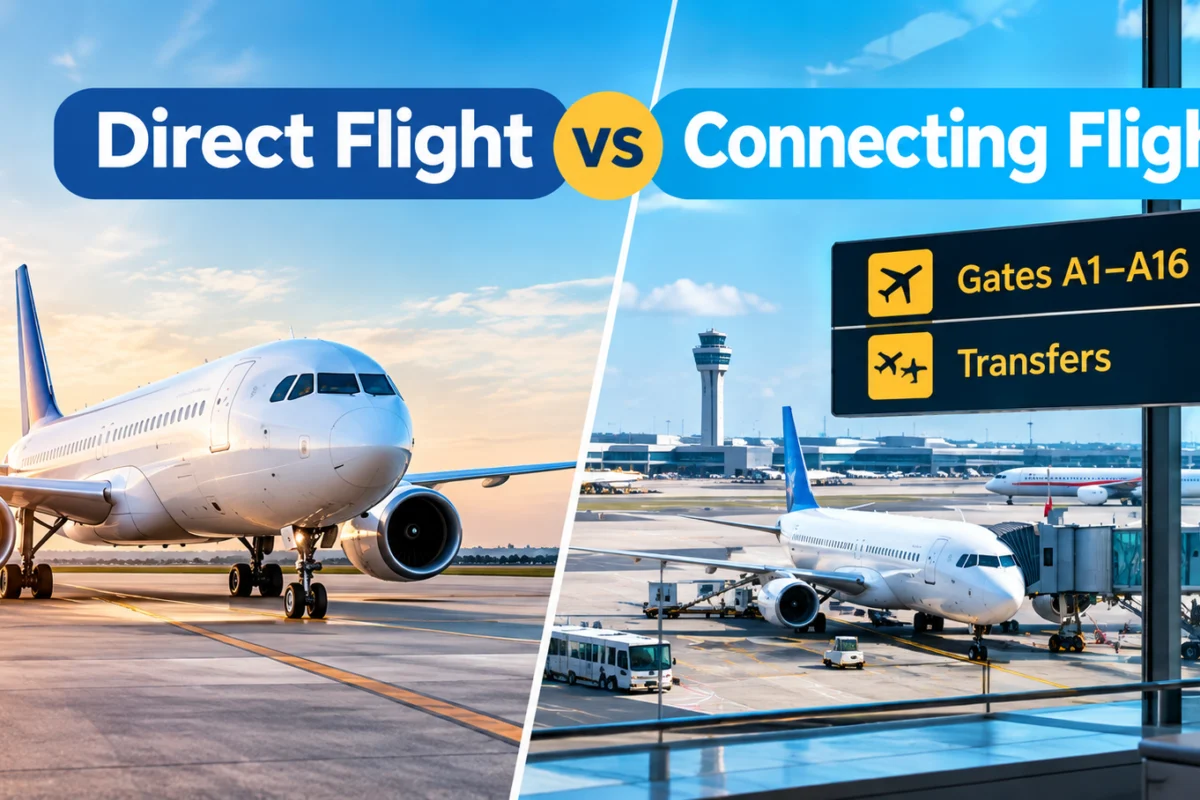
Before comparing costs and comfort, it helps to get the basics right. A direct flight takes you from your origin to your destination without changing planes, even if it technically stops somewhere along the way to refuel or pick up passengers. A connecting flight, on the other hand, requires you to land, deplane, and board a different aircraft to reach your final stop. This one distinction is the foundation of the entire direct flight vs connecting flight conversation, because everything else — price, risk, comfort — flows from it.
Airlines don’t always make this obvious at checkout. You might see “1 stop” listed for both a direct flight with a technical stop and an actual connecting flight, so it pays to read the fine print before you assume you know what you’re booking.
Price: The First Thing Most Travelers Check
Cost is usually where the direct flight vs connecting flight debate starts for most people. Connecting flights are frequently cheaper because airlines use them to fill seats on less popular routes through a hub. If your budget is tight and your schedule is flexible, a connecting flight can save you a meaningful amount, sometimes enough to justify a few extra hours of travel.
That said, price alone shouldn’t decide the direct flight vs connecting flight question. A cheap connecting ticket can turn expensive fast if you miss your next leg and need to rebook, pay for an extra night at a hotel, or lose a prepaid reservation at your destination. When you weigh direct flight vs connecting flight purely on the sticker price, you’re only seeing half the picture.
Travel Time and Convenience
This is where the direct flight vs connecting flight comparison becomes personal. If you value your time more than you value saving a bit of money, a direct flight almost always wins. There’s no layover to manage, no risk of a delayed connection, and no need to navigate an unfamiliar airport terminal with limited time.
Connecting flights add hours to your journey, and not just the layover itself. You need buffer time for boarding, deplaning, walking to a new gate, and occasionally clearing security again. On a short domestic trip, this difference might not matter much, but on a long international journey, the direct flight vs connecting flight gap in total travel time can stretch to half a day or more.
Risk of Delays and Missed Connections
One of the most underrated parts of the direct flight vs connecting flight discussion is risk. A direct flight has exactly one point of failure: your single flight. A connecting flight has at least two, plus the transfer window in between. If your first leg is delayed, even by 30 minutes, you could miss your connecting flight entirely.
Airlines do build in some buffer for this, and many will rebook you automatically if a delay is their fault. But weather, air traffic control issues, and mechanical problems don’t care about your itinerary. Anyone who has sprinted through an airport to make a tight connection understands why the direct flight vs connecting flight decision often comes down to how much stress you’re willing to accept for a lower fare.
Baggage Handling
Checked luggage is another practical factor in the direct flight vs connecting flight decision. On a direct flight, your bags are loaded once and unloaded once, which minimizes the number of times they can be misrouted or delayed. On a connecting flight, your luggage has to be transferred between aircraft, often within a tight window, which raises the odds of a bag not making it to your final destination on time.
If you’re traveling with connecting flights through a major international hub, airlines are usually well-practiced at fast transfers. But a short layover combined with a delayed first flight is a classic recipe for lost luggage. This is a real, if often overlooked, part of the direct flight vs connecting flight equation for anyone who checks bags rather than traveling carry-on only.
Comfort and Physical Fatigue
Long-haul travelers know that comfort matters as much as cost when weighing direct flight vs connecting flight options. A direct flight lets you settle in once, get through security once, and arrive with a single, predictable level of jet lag. A connecting flight means going through the boarding process twice, sitting in a different seat configuration, and possibly dealing with a layover in an airport with limited amenities.
For families with young children, older travelers, or anyone with mobility concerns, the direct flight vs connecting flight decision often tilts firmly toward direct, even at a higher price. The physical toll of an extra takeoff, landing, and terminal walk adds up quickly over a long trip.
When a Connecting Flight Actually Makes Sense
Despite all the downsides above, there are good reasons to choose a connecting flight over a direct one. If you’re traveling on a strict budget, a connecting flight vs connecting flight and stopping to compare direct flight vs connecting flight fares on the same route can reveal savings of hundreds of dollars. A layover can also be a chance to briefly visit a new city if your connection time is long enough, effectively giving you two destinations for the price of one ticket.
Connecting flights can also open up routes that simply don’t have a direct option. Smaller cities and less-traveled destinations often rely entirely on connecting service through a major hub, so in these cases the direct flight vs connecting flight comparison isn’t really a choice at all — a connection may be your only way to get there.
When a Direct Flight Is Worth the Extra Cost
On the other side, a direct flight earns its higher price when your schedule is tight, when you’re traveling for business and need to arrive fresh, or when you simply want to minimize the number of things that could go wrong. Anyone booking a same-day return trip, attending an important meeting, or traveling with a lot of luggage will usually find that the direct flight vs connecting flight math favors paying more for a nonstop route.
Direct flights are also the safer choice during peak travel seasons, when airports are more congested and the odds of a missed connection go up. If you’re flying during a holiday weekend, the direct flight vs connecting flight decision becomes less about comfort and more about avoiding a stressful, chaotic transfer.
Frequent Flyer Miles and Loyalty Programs
Loyalty programs quietly influence this choice more than most travelers realize. Airlines often reward nonstop routes with the same mileage earnings as a multi-leg itinerary, but the real benefit shows up in status qualification. Many programs count each takeoff and landing as a separate “segment,” so a two-stop itinerary can help you hit a segment-based status tier faster than a single nonstop hop. On the flip side, elite travelers with lounge access and priority rebooking often find that the hassle of an extra stop is far less painful, since they get fast-tracked through security, board first, and have a comfortable place to wait out a delay.
If you’re chasing status or trying to stretch a limited travel budget with points, it’s worth checking how your airline’s program treats connections before you book. A slightly longer itinerary booked with the right card or program can sometimes net you free upgrades, lounge passes, or bonus miles that a nonstop ticket wouldn’t unlock.
The Environmental Angle
Sustainability is becoming a bigger part of travel planning, and it’s worth a mention here too. Nonstop routes are generally more fuel-efficient per passenger mile than itineraries with a stop, because a large share of a flight’s fuel burn happens during takeoff and climb. Adding an extra takeoff and landing for a connection increases the total fuel used and the associated emissions for the same origin and destination, even though the ticket might be cheaper. Airlines are aware of this and some now display an estimated carbon footprint at checkout, which can be a useful, if imperfect, data point if sustainability factors into how you choose your itinerary.
A Quick Case Study
Picture two travelers booking the same week for a trip from the East Coast to Southeast Asia. The first books a nonstop overnight flight, pays a premium, and lands rested enough to start sightseeing the same afternoon. The second books an itinerary with a single stop in Europe, saves close to 30 percent on the fare, and uses the seven-hour layover to grab a quick meal outside the airport before continuing on. Neither choice is wrong — one traveler prioritized time and comfort, the other prioritized budget and was happy to trade a few extra hours for it. Working through a real scenario like this is often more useful than any general rule, because it forces you to weigh what actually matters for your own trip rather than following advice that assumes everyone travels the same way.
Common Myths Worth Clearing Up
A few misconceptions come up again and again when people plan their itinerary. One is the idea that a stop always means a cheaper fare — this is often true, but not always, especially on routes where a nonstop service is heavily discounted to compete with a budget carrier that only offers connections. Another myth is that longer layovers are automatically safer; in reality, an excessively long layover can mean more time sitting in a crowded terminal, more chances for your gate to change, and more opportunities for a schedule shuffle. Finally, many travelers assume checked bags always transfer automatically between airlines at a connection point, which isn’t guaranteed unless the airlines have an interline agreement — always confirm this before you assume your luggage will make it without you having to reclaim and recheck it yourself.
Questions Travelers Often Ask
Is it ever worth paying double for a nonstop ticket? If a missed connection would cost you a prepaid hotel, a cruise departure, or a non-refundable event ticket, paying more for a guaranteed single flight is often cheaper than the risk it removes.
How much layover time is actually safe? A general guideline is 60–90 minutes for domestic transfers and closer to 2–3 hours for international ones, with more buffer during winter months or busy holiday periods when delays are more common.
Does booking through one airline make connections safer? Yes, generally. A single-airline or alliance itinerary means the airline is responsible for getting you to your final destination and will typically rebook you for free if an earlier leg is delayed, which isn’t always guaranteed with separately booked tickets on different carriers.
How to Decide: A Simple Framework
Instead of treating direct flight vs connecting flight as one universal rule, try running your trip through a few quick questions:
- How much is the price difference in real numbers, not just percentages?
- How much buffer time do you have if something goes wrong?
- Are you traveling with checked bags, young kids, or anyone who needs extra time to move through an airport?
- Is this trip time-sensitive, like a wedding, interview, or connecting cruise departure?
- Does a direct option even exist on your route, or is a connection your only choice?
Answering these honestly will usually make the direct flight vs connecting flight decision obvious for your specific trip, even if the “right” answer is different every time you travel.
Tips for Booking Whichever You Choose
If you decide a connecting flight makes more sense, book a layover of at least 90 minutes domestically and closer to two hours internationally, especially if you’re changing terminals. Check whether your connecting flight vs connecting flight pairing is with the same airline or an alliance partner, since this usually means smoother rebooking if something goes wrong.
If you go with a direct flight, it’s still worth comparing departure times, since early morning or late-night direct flights are sometimes priced lower than midday ones. Either way, always compare the full direct flight vs connecting flight itinerary — not just the base fare — including baggage fees, seat selection costs, and how each airline handles delays.
Booking Strategy for Families and Groups
Traveling with a group changes the math in ways that are easy to overlook. A single delayed connection can turn into a logistical headache when you’re managing multiple boarding passes, strollers, car seats, and a mix of adults and kids who all need to move through security and reach the gate together. Airlines don’t always hold a flight for a large group the way they might for a lone traveler with elite status, so if any one person in your party is running behind, the entire group can end up missing the same connection. For families, it’s often worth padding the standard layover recommendation by an extra 30 to 45 minutes, and choosing a nonstop route whenever the price gap is reasonable, simply to reduce the number of moving parts on travel day.
Groups traveling for a shared event — a wedding, a reunion, a conference — face a similar calculation. If everyone needs to arrive by a fixed time, the certainty of a single flight is usually worth more than the savings from a itinerary with a stop, since one person’s missed connection can disrupt plans for the whole group rather than just themselves.
Final Thoughts
There’s no single correct answer to the direct flight vs connecting flight debate. A connecting flight can save you real money and occasionally add an interesting stopover to your trip, while a direct flight buys back your time, reduces risk, and keeps travel simple. The smartest approach is to treat direct flight vs connecting flight as a case-by-case decision based on your budget, your schedule, and how much uncertainty you’re comfortable carrying on travel day. Once you know what matters most for a specific trip, choosing between them becomes far easier than it first seems. The next time you’re staring at a search results page full of options, run through your budget, your timeline, and your tolerance for risk before you click “book,” and you’ll almost always end up with the itinerary that actually fits your trip instead of just the cheapest one on the screen.



Join the conversation