

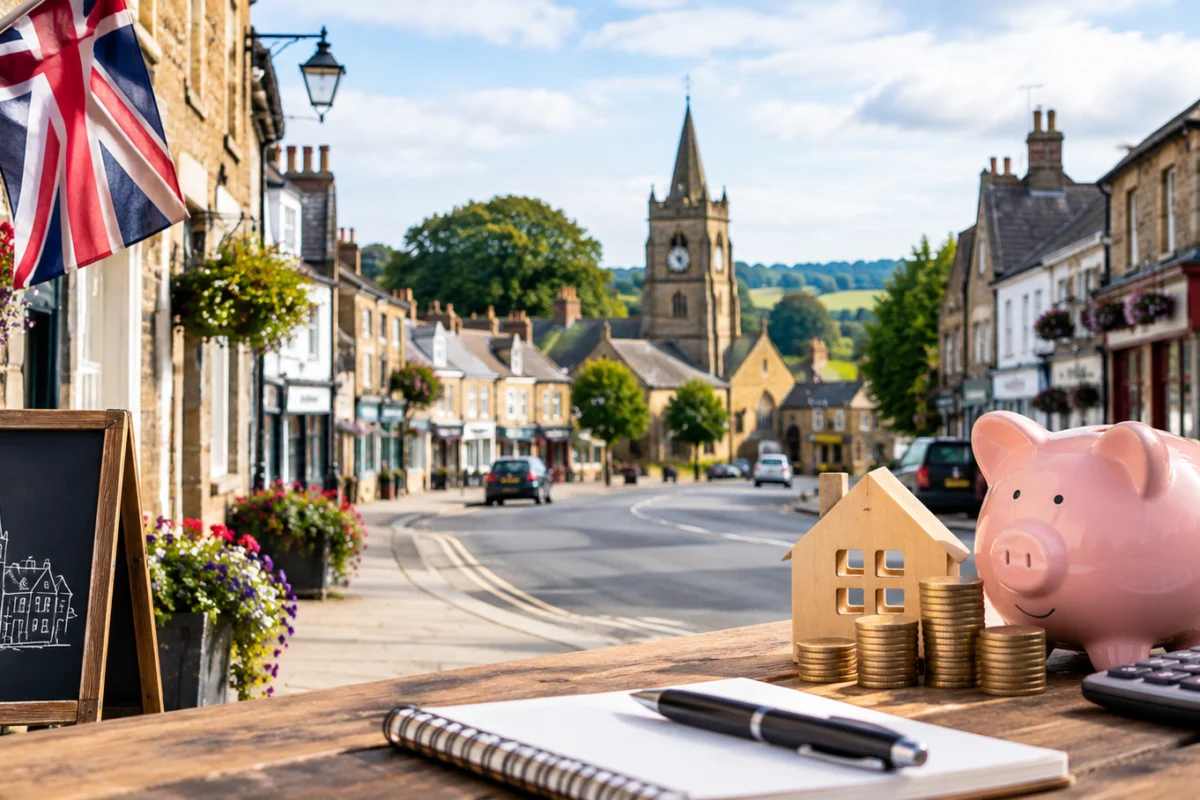
What Does Budget Mean for UK Small Towns?
Every year, the Chancellor stands up in Parliament, delivers a Budget speech full of numbers, and the headlines the next morning focus on income tax, pensions, and stock markets. But if you actually live in a small UK town — the kind with a high street, a couple of independent cafés, and a market square that’s seen better days — the question that matters most rarely makes the front page: what does the Budget mean for UK small towns, specifically?
It’s a fair question, and a genuinely confusing one. Budgets are written in the language of Westminster, not in the language of your local butcher wondering if he can afford next year’s rates bill. So let’s break it down properly — what’s actually changed, what it means for your local high street, and whether small towns are getting a fair deal.
First, What Actually Is “The Budget”?
Before diving into the small-town specifics, it helps to be clear on what “the Budget” actually refers to. In the UK, the Budget is the Chancellor of the Exchequer’s annual statement to Parliament, setting out the government’s plans for taxation, public spending, and borrowing for the year ahead. There’s typically a main Autumn Budget, sometimes accompanied by a smaller Spring Statement that updates forecasts without introducing major new policy.
Within that speech, the Chancellor announces changes that ripple down into almost every corner of daily life — from income tax thresholds and National Insurance to, crucially for our purposes here, business rates and regional funding pots aimed at places like small towns and high streets. So when people ask what the Budget means for their local area, they’re really asking how these top-level national decisions translate into something tangible on their own high street.
Why Small Towns Watch the Budget So Closely
Small towns don’t have the built-in resilience of big cities. When a major employer closes, or a chain store pulls out, there often isn’t another large business ready to fill the gap. A struggling high street in a small town can feel the effects far more sharply than a struggling street in a city with dozens of alternatives nearby.
That’s exactly why Budget announcements around business rates, high street funding, and local government support matter so much here. These aren’t abstract fiscal policies — they directly decide whether the local pub survives, whether an empty shopfront gets a new tenant, or whether the market stays open on a Saturday.
Business Rates: The Headline Change for Small Towns
If there’s one Budget measure that small town shopkeepers actually feel in their pocket, it’s business rates — and the most recent Autumn Budget made some genuinely significant changes here.
Chancellor Rachel Reeves announced a permanent reduction in business rates for retail, hospitality, and leisure properties, replacing the old system with a five-tier structure tied to a property’s rateable value. In practice, this means the small business RHL multiplier drops to 38.2p, while the standard RHL multiplier falls to 43p for the 2026–27 tax year. That’s roughly 5p below the national equivalent multiplier, and it’s described as the lowest rate since 1991.
For the independent café or bookshop on your local high street, this reduction is designed to ease one of the biggest recurring costs of running a physical premises. The government estimates that more than 750,000 retail, hospitality, and leisure properties across the UK stand to benefit.
Where does the money to fund this come from? Larger commercial properties — think distribution warehouses used by major online retailers — will now carry a higher multiplier if their rateable value sits above £500,000. It’s essentially a rebalancing exercise: bigger, mostly online-facing businesses subsidise the smaller, physical high street businesses that small towns depend on.
There’s also a cushion built in for anyone facing a sharp bill increase. A £4.3 billion transitional support package, spread across the next three years, is meant to prevent businesses from being hit with sudden, unmanageable jumps in their rates following the 2026 property revaluation.
What This Actually Means If You Run a Small Town Business
Numbers on a page are one thing — but what does this translate to if you’re the person actually paying the bill?
For a small independent shop, café, or pub with a modest rateable value, the lower multiplier should mean a genuinely smaller annual bill from April 2026 onward, compared with what you’d have paid under the old system. That’s a real, ongoing saving rather than a one-off grant, which matters for long-term planning.
However, it’s not universally good news for every business. Some legal and accountancy commentators have flagged that businesses with larger footprints, or those in high-value areas, could find themselves pushed into a higher tier even if they’re not large companies in any practical sense. A well-located shop with a high rateable value could, in theory, end up worse off rather than better off. It’s worth checking exactly where your premises falls in the new banding rather than assuming the changes automatically help you.
Beyond Business Rates: Direct Funding for High Streets
Business rates reform tends to dominate the conversation, but it’s not the only lever the government is pulling for small towns. A separate strand of Budget-adjacent policy focuses on direct funding for high street regeneration.
Earlier in the year, the government confirmed £301 million in funding for High Street Innovation Partnerships, aimed at supporting local communities to revive struggling town centres. Alongside this, a High Streets Strategy — backed by at least £150 million — was announced, with funding earmarked for improving neglected shopfronts, bringing empty units back into use, and prioritising areas that have felt the harshest impact of high street decline.
Then there’s the Pride in Place programme, a much larger long-term commitment worth up to £5.8 billion, designed to support around 300 communities over the next ten years. It builds on the earlier Long-Term Plan for Towns, rolling in both towns that were originally selected in 2023 and 2025, along with newer additions announced later.
The Pride in Place Impact Fund specifically makes awards of £1.5 million over two years to a set list of towns, with money directed toward three objectives: community spaces, public spaces, and high street or town centre revitalisation. Examples of what this can fund include improving infrastructure for regular markets, refurbishing public squares, and supporting projects that bring people back into town centres.
Not Every Small Town Gets a Slice
Here’s the part that tends to get left out of the celebratory press releases: not every small town qualifies for these regeneration funds. Pride in Place, for all its scale, is still targeted at a defined list of roughly 300 communities over a decade — which sounds generous until you consider just how many small towns exist across the UK that aren’t on that list.
This has become a genuine point of frustration in Parliament. Some MPs have raised concerns that towns previously supported by older funding streams, like the Levelling Up Fund and the UK Shared Prosperity Fund, have lost that support entirely, with the newer replacement schemes weighted more heavily toward city regions and areas of high deprivation rather than smaller or mid-sized towns.
Business groups have echoed similar frustrations about scale. With hundreds of thousands of independent high street retailers across the country, some analysts have pointed out that even headline sums like the £150 million high street fund work out to only a few hundred pounds per business once spread nationally — a genuinely modest amount against rising costs like energy, wages, and rents.
The Wider Financial Picture Small Towns Are Living Through
It’s worth zooming out slightly, because business rates and regeneration grants don’t exist in isolation — they sit alongside broader tax and cost pressures that small town households and businesses are dealing with at the same time.
The income tax personal allowance, higher-rate threshold, and additional-rate threshold have all been frozen — now extended until 2030–31, with the higher rate threshold frozen even further out to April 2031 in some announcements. This is what’s often called “fiscal drag”: as wages rise with inflation, more income gets pulled into higher tax brackets even though the tax rates themselves haven’t officially gone up. For small town workers and business owners alike, that means real take-home pay grows more slowly than it might otherwise.
At the same time, high street footfall has continued to struggle nationally, with data showing consistent year-on-year declines through much of the year, even as out-of-town retail parks saw modest growth. That backdrop matters, because it means the business rates relief and regeneration funding are arriving at a moment when town centres are already under real pressure from changing shopping habits, not just from tax policy.
So, Is the Budget Actually Good News for Small Towns?
The honest answer is: it’s mixed, and it depends heavily on which small town — and which business — you’re talking about.
If you run a modest-sized retail, hospitality, or leisure business, the lower business rates multiplier is a genuine, ongoing saving that should ease pressure on your bottom line from April 2026. Combined with the transitional relief package, most small businesses facing a revaluation increase should be protected from the sharpest shocks.
If your town happens to be one of the roughly 300 places included in the Pride in Place programme, or has successfully secured High Street Innovation Partnership funding, there’s meaningful capital investment heading your way for public spaces, market infrastructure, and empty shopfronts.
But if your town isn’t on either list, and your business sits just above the smaller rateable value bands, the practical benefit is far less obvious. Broader cost pressures — frozen tax thresholds, ongoing footfall declines, and general economic uncertainty — remain very much in play regardless of what any single Budget delivers.
What Small Town Businesses and Residents Can Do Now
Rather than waiting to see how policy plays out, there are a few practical steps worth taking if you want to make the most of what’s currently on offer:
- Check your business rates banding carefully once the 2026 revaluation figures are published, so you know exactly where your premises falls under the new five-tier system.
- Look into local competitions and grants, such as town regeneration competitions run alongside business groups, which offer smaller but genuinely accessible funding for local projects.
- Follow your local council’s regeneration plans to see whether your town is included in Pride in Place funding, High Street Innovation Partnerships, or the upcoming High Streets Strategy allocations.
- Engage with local MPs and councillors if your town has lost access to older funding streams — parliamentary debate suggests this remains an active and unresolved concern that ongoing pressure can influence.
Frequently Asked Questions
Does every small town qualify for high street regeneration funding?
No. Programmes like Pride in Place are targeted at a defined list of around 300 communities over ten years, alongside separate pots like the High Street Innovation Partnerships fund. Many small towns outside these lists currently have no direct equivalent, which has become a point of ongoing debate in Parliament.
When do the new business rates changes take effect?
The new five-tier business rates structure, including the lower multipliers for retail, hospitality, and leisure properties, applies from the financial year beginning April 2026, following the 2026 property revaluation.
Will my business rates definitely go down?
Not automatically. Smaller retail, hospitality, and leisure businesses with a lower rateable value are the main beneficiaries. Larger premises, or those in high-value areas that get pushed into a higher tier, could see costs rise rather than fall, so it’s worth checking your specific banding.
What is the Pride in Place programme?
It’s a long-term government investment programme worth up to £5.8 billion, aimed at supporting around 300 communities over the next decade through funding for community spaces, public spaces, and high street or town centre revitalisation projects.
Final Thoughts
So, what does the Budget mean for UK small towns in practical terms? It means lower, more predictable business rates for hundreds of thousands of smaller retail, hospitality, and leisure businesses — a real and welcome change for many high street shops. It means substantial, if unevenly distributed, funding for town centre regeneration through programmes like Pride in Place and the High Streets Strategy. And it means small towns are still navigating a difficult broader economic backdrop, from frozen tax thresholds to persistent footfall declines, that no single Budget fully resolves.
For anyone running a business or simply living in one of Britain’s small towns, the smartest move is to stay informed rather than assume the headline numbers automatically apply to you. Check where your town and your business actually sit within these schemes — because in a Budget this layered, the details matter just as much as the top-line announcement.



Join the conversation