

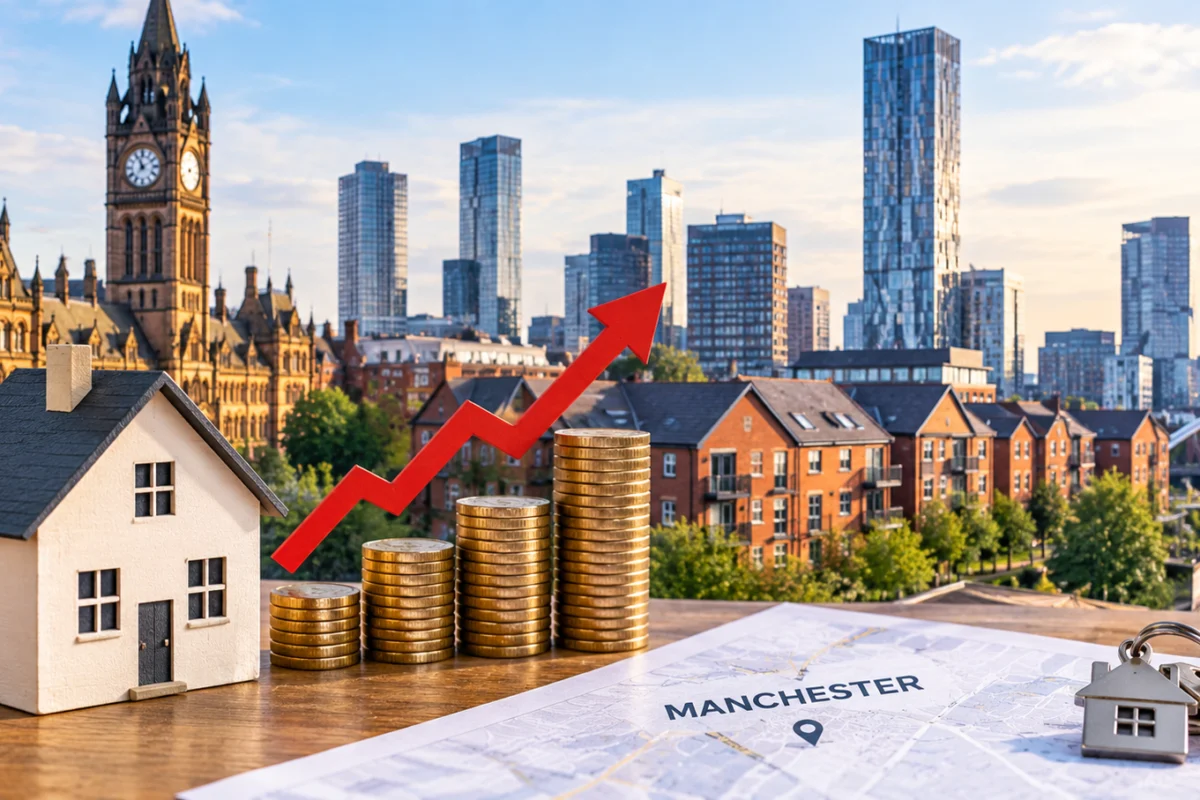
Why Is Manchester House Prices Rising? Explained
Walk through Ancoats, Salford, or Didsbury today, and it’s hard to miss it — cranes on the skyline, “sold” boards outside terraces that would have sat quietly a decade ago, and property prices that keep climbing even while much of the rest of the country’s housing market looks distinctly wobbly. So it’s no surprise so many people are typing the same question into Google: why is Manchester house prices rising, explained in a way that actually makes sense?
The short answer is that it’s not one single thing. It’s a combination of population growth, chronic undersupply, major regeneration investment, and a local economy that keeps pulling in graduates, young professionals, and employers. Let’s go through each of these properly.
The Headline Numbers First
Before getting into the “why,” it’s worth understanding the scale of what’s actually happening.
By April 2026, Manchester house prices had risen roughly 4.9% year-on-year, with the average mortgaged property reaching around £254,000 — up from about £249,000 the previous year. That growth rate is genuinely striking when set against the national picture, where UK asking prices fell 0.6% in June 2026, the biggest June drop in 14 years. In other words, while much of the UK housing market has been cooling, Manchester has been doing the opposite.
Zoom out further, and the picture becomes even more dramatic: Manchester house prices have risen by around 63% over the past decade, a pace of growth that reflects how fundamentally the city’s property market has shifted from a relatively affordable alternative to London into a genuinely competitive urban market in its own right.
Reason One: A Persistent Supply and Demand Imbalance
If there’s a single thread running through almost every explanation of Manchester’s rising prices, it’s this: there simply aren’t enough homes being built to match demand.
Analysts have consistently pointed to the basic imbalance between housing supply and demand as the single most significant factor behind Manchester’s price growth. Even with new developments coming forward across the city, housing delivery hasn’t caught up with the scale of need created by population growth, strong rental demand from students and young professionals, and ongoing household formation.
This isn’t a uniquely Manchester problem — it echoes a wider national supply shortfall, with government estimates suggesting the UK needs around 300,000 additional properties a year beyond what’s currently being delivered. But Manchester feels this shortage more acutely than many other cities, precisely because so many people want to live there.
Reason Two: Manchester’s Population Boom
Manchester’s population has grown by roughly 23% since 2011, a remarkable increase that’s expected to push the city’s population toward around 635,000 by 2026. That’s not a small shift — it represents hundreds of thousands of additional people who all need somewhere to live, in a city that hasn’t been able to build fast enough to keep pace.
A big part of this growth comes from graduate retention. Manchester is home to several major universities, and a striking number of students who study there choose to stay after graduating, drawn by the city’s job market, culture, and relatively lower cost of living compared with London. Every graduate who stays instead of moving away adds to housing demand, whether they’re renting a flat in the city centre or eventually looking to buy their first home.
Reason Three: Regeneration Is Reshaping Entire Neighbourhoods
Drive or walk through areas like Ancoats and New Islington, and you’re looking at some of the clearest physical evidence of why prices are climbing. These neighbourhoods have seen some of the fastest property price growth in the entire city, with annual increases in the region of 5% to 6%, driven directly by sustained regeneration investment.
Levenshulme and Hulme are following a similar pattern, each recording annual growth of around 4% to 5%, as investment in transport links, public spaces, and new housing developments makes these areas increasingly attractive to young professionals and families who might previously have looked elsewhere.
This regeneration isn’t limited to a handful of postcodes, either. Wider investment through initiatives like the £1 billion Good Growth Fund, alongside the ongoing Metrolink expansion and Bee Network integration, is steadily improving connectivity across Greater Manchester, making previously overlooked areas far more appealing to buyers who want good transport links without paying central Manchester prices.
Reason Four: A Strong Local Economy and Job Market
Property prices don’t rise in a vacuum — they rise where people want to live and work. Manchester’s continued appeal to employers, investors, and skilled workers plays a direct role in sustaining housing demand.
The city has increasingly positioned itself as a genuine alternative to London for certain industries, particularly in media, tech, and financial services, offering employers lower costs while still providing access to a large, well-educated workforce. As more employers set up or expand operations in the city, more workers relocate there, and that steady inflow of people with stable incomes and mortgage eligibility continues to support house price growth even when national conditions are shakier.
Reason Five: Falling Mortgage Rates Have Improved Affordability
Interest rates play a huge role in how much buyers can afford to borrow, and 2026 has brought a modest but meaningful shift here. Several major lenders, including NatWest, Barclays, TSB, and Santander, cut mortgage rates during the year, which has improved affordability for both first-time buyers and existing homeowners looking to move.
With the base rate holding steady at 3.75%, buyers have had a slightly clearer picture to plan around, even if fixed-rate deals sitting near 5% remain the realistic assumption for most 2026 purchases. Lower borrowing costs, even incrementally lower, tend to bring more buyers into the market at any given price point — which adds further pressure to an already undersupplied housing stock.
What About First-Time Buyers?
One detail that often gets lost in broader “prices are rising” headlines is just how active Manchester’s first-time buyer market remains, despite those rising prices.
The average first-time buyer in Manchester paid around £232,000 in April 2026, roughly £15,000 below the city’s overall average house price. Even more notably, first-time buyers accounted for 70.2% of mortgaged purchases in Manchester during 2025 — the highest proportion recorded outside London.
That level of first-time buyer activity matters because it keeps the whole property chain moving. When new buyers can still get onto the ladder, existing homeowners are able to sell and move up, which supports transactions and price stability across every part of the market, not just at the entry level.
Are Prices Rising Everywhere in Manchester Equally?
Not quite. While the citywide average tells one story, price growth varies noticeably depending on property type and location.
Semi-detached houses have outperformed other property types, rising by around 3.8%, partly thanks to a lingering “work-from-home effect” that’s increased demand for extra space, particularly in family-friendly neighbourhoods and popular school catchment areas. Terraced houses have grown more modestly, at around 2.5%, while flats and apartments have remained largely flat, with growth close to 0%.
This uneven pattern is worth understanding if you’re trying to make sense of Manchester’s property market for your own decision-making — a citywide “prices are rising” headline can mask very different realities depending on whether you’re looking at a family semi in Levenshulme or a city-centre apartment.
New Rules Are Also Reshaping the Market
It’s not just supply, demand, and regeneration driving change — regulation is playing a role too. The Renters’ Rights Act 2025 came into force on 1 May 2026, fundamentally changing the rules for Manchester’s large private rental sector. With such a significant proportion of the city’s housing stock rented out to students and young professionals, changes to landlord and tenant regulation can influence how investors approach the market, potentially affecting both rental supply and, indirectly, sales activity.
Separately, stamp duty changes that took effect in April 2026 have already reduced transaction volumes nationally, and while Manchester hasn’t been fully insulated from that effect, its underlying demand has so far proven resilient enough to keep prices climbing regardless.
Will Manchester House Prices Keep Rising?
The broad consensus among market analysts is that Manchester prices are likely to continue rising through the rest of 2026, with most forecasts pointing to growth in the region of 3% to 4% for the year overall, though the pace could moderate if mortgage rates stop falling or wider economic uncertainty increases.
It’s a reasonable note of caution. Manchester’s growth over the past decade shouldn’t be read as a guarantee that prices will keep climbing at the same pace indefinitely. The city’s fundamentals — population growth, regeneration, and economic opportunity — remain strong, but any market can be affected by external shocks, whether that’s a renewed rise in interest rates or a broader economic slowdown.
What This Means If You’re Buying or Selling in Manchester
If you’re weighing up a purchase in Manchester, understanding why prices are rising should shape how you approach the search. Areas benefiting from active regeneration, like Ancoats, New Islington, and Hulme, may continue to see above-average growth, but often come with above-average price tags too. Meanwhile, areas slightly further out with strong transport links but less hype may offer better long-term value as connectivity continues to improve.
For sellers, the current climate — resilient demand, falling mortgage rates, and strong first-time buyer activity — remains broadly favourable, though it’s still worth getting realistic, up-to-date valuations rather than assuming citywide averages apply directly to your specific street or property type.
And for anyone buying in a market where prices are actively rising, it’s worth being especially thorough at the survey stage. Instructing a RICS-regulated surveyor as soon as an offer is accepted, checking lease terms and ground rent on leasehold properties, and confirming EWS1 status on flats where relevant are all sensible steps to avoid being caught out in a fast-moving market.
Frequently Asked Questions
Why is Manchester house prices rising faster than the UK average? Manchester combines strong population growth, chronic housing undersupply, major regeneration investment, and a resilient local job market — a mix that’s kept demand high even as national house price growth has slowed.
Which Manchester areas have the fastest-rising house prices? Ancoats and New Islington, Levenshulme, and Hulme currently show some of the fastest growth in the city, largely thanks to ongoing regeneration and improved transport connectivity in these neighbourhoods.
Are Manchester house prices expected to keep rising in 2026? Most analysts expect growth of around 3% to 4% for 2026 overall, supported by continued supply shortages and stable mortgage conditions, though the pace could slow if interest rates rise or the wider economy weakens.
Is it still possible to buy as a first-time buyer in Manchester? Yes — first-time buyers made up over 70% of mortgaged purchases in Manchester in 2025, the highest proportion outside London, helped by average first-time buyer prices sitting noticeably below the citywide average.
Final Thoughts
So, why is Manchester house prices rising, explained simply? It comes down to more people wanting to live in the city than there are homes to house them, backed by sustained regeneration investment, a strong local economy, and mortgage conditions that have modestly improved over the past year. None of these factors are new individually, but together, they’ve kept Manchester growing while much of the rest of the UK housing market has cooled.
Whether that trend continues at the same pace depends on factors well beyond any one city’s control — interest rates, national economic conditions, and how quickly new housing supply can actually be delivered. For now, though, Manchester remains one of the clearest examples in the UK of what sustained demand, meeting limited supply, actually looks like in practice.
This article is for general information purposes and reflects market data and analysis reported at the time of writing. Property prices and market conditions can change, so always seek up-to-date valuations and independent financial advice before making any property purchase or sale decision.



Join the conversation