

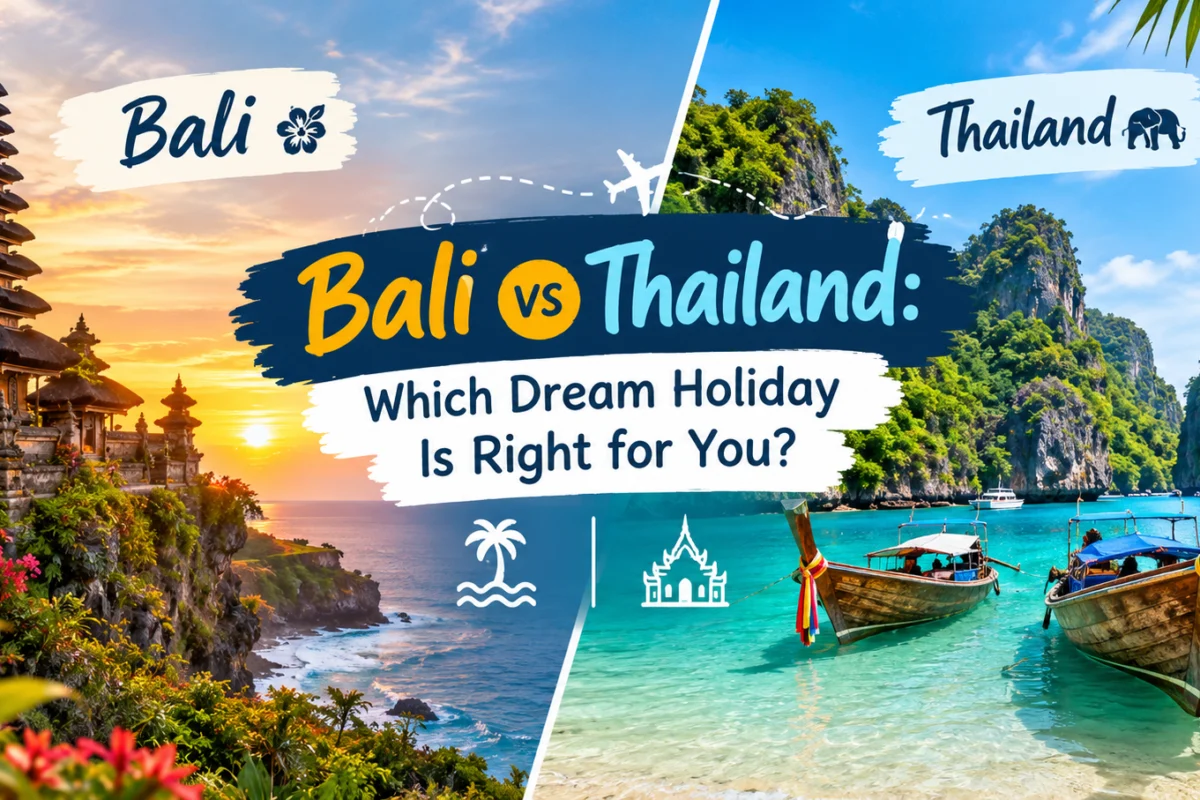
Bali vs Thailand :- Ask ten well-travelled friends where to go for a tropical escape and you’ll probably get five votes for each side. The Bali vs Thailand debate is one of the most common dilemmas in travel, and it’s easy to see why. Both offer warm water, golden temples, spectacular food, and prices that make a UK high street feel like a different planet. Yet the two feel remarkably different once you’re actually there. This guide breaks down the Bali vs Thailand question honestly, so you can book the trip that suits the way you like to travel rather than the one with the prettiest Instagram feed.
The Quick Verdict
If you want a short answer to Bali vs Thailand, here it is. Thailand tends to win on variety, island hopping, nightlife, easy transport, and sheer choice at every budget. Bali tends to win on atmosphere, spirituality, rice-terrace scenery, surf, and a slower, more creative pace. Neither is objectively better, and the rest of this article explains why the right answer depends almost entirely on who you are and what you want from a holiday.
Getting There From the UK
For most British travellers, the journey is the first real difference in Bali vs Thailand. Thailand is simply easier to reach. Direct flights run from London to Bangkok, with a flight time of around eleven to twelve hours, and plenty of one-stop options through the Gulf, Asia, and Europe from regional airports as well. Once you’ve landed in Bangkok, domestic flights to Phuket, Krabi, Koh Samui, and Chiang Mai are frequent and inexpensive.
Bali is a longer haul. Most itineraries from the UK involve at least one stop, typically in Singapore, Kuala Lumpur, Doha, Dubai, or Bangkok itself, which pushes total journey time to somewhere between sixteen and twenty-plus hours depending on connections. That extra travel time matters if you only have a week. In the Bali vs Thailand contest, flights are usually the single biggest cost on a Bali trip and one of the main reasons people choose Thailand for shorter breaks. If you’re travelling for ten days or more, the extra journey is much easier to justify.
Visas and Entry
Entry rules change regularly, so treat anything you read here, and anywhere else, as a starting point and confirm with the official government sources before you book. As things stand, British passport holders have generally been able to enter Thailand for a short stay without a visa, though the permitted length and any new arrival requirements have been adjusted more than once in recent years.
Bali, as part of Indonesia, has typically required a visa on arrival or an e-visa for tourists, plus a separate tourist levy for visitors to the island. The costs are modest, but it is one more form to organise, and it’s one more small difference worth noting in the Bali vs Thailand comparison. Either way, always check that your passport has the required validity remaining, which is commonly six months from your arrival date.
When to Go: The Weather Puzzle
Seasons are where Bali vs Thailand gets genuinely interesting, because the two destinations have opposite rhythms for much of the year. Bali sits south of the equator and enjoys its dry season from roughly April to October, with May, June, September, and October often cited as the sweet spot for first-timers who want good weather without the peak-season crowds. The wettest months run from around December through February.
Thailand is more complicated because it’s a long country with two coastlines. The cool, dry season from November to February is generally the most popular time for the whole country, but the Andaman coast, including Phuket, Krabi, and Koh Lanta, is at its best from roughly November to April, while the Gulf islands of Koh Samui, Koh Phangan, and Koh Tao tend to be driest earlier in the year, from January through to early autumn. Northern Thailand has a hazy burning season in the spring, which can affect air quality around Chiang Mai.
The practical takeaway for the Bali vs Thailand decision is simple. If you’re escaping a grey British winter, Thailand is usually the safer bet from November to March. If you’re planning a summer trip, Bali’s dry season makes it the stronger choice for reliable sunshine.
Beaches: Two Very Different Experiences
Both places are famous for their coastlines, but beach lovers should know that Bali vs Thailand is not an apples-to-apples comparison. Thailand’s beaches are what most people picture when they imagine a tropical paradise: soft white sand, calm turquoise water, limestone cliffs rising out of the sea, and islands you can reach by longtail boat. The Andaman side is dramatic and photogenic, while the Gulf side is calmer and gentler. Island hopping is effortless, and you can easily sample several distinct beach moods in a single trip.
Bali’s beaches have more edge. Many have strong surf, rocky sections, and darker volcanic sand, which makes them wonderful for surfers and sunset watchers but less ideal for lazy swimming, particularly with children. Pockets of calmer water do exist, including around Sanur and Nusa Dua, and the nearby Nusa islands and the Gili Islands offer clearer, more postcard-like scenes. The honest summary of Bali vs Thailand beaches is that Thailand is better for classic tropical swimming and island hopping, while Bali is better for surf culture, clifftop beach clubs, and dramatic coastal views.
Culture, Temples, and Spirituality
This is where Bali pulls ahead for many travellers. Bali is a predominantly Hindu island in a mostly Muslim country, and daily life revolves around offerings, ceremonies, and temples in a way that is visible on almost every street. Small woven baskets of flowers and incense appear on pavements and doorsteps each morning, and festivals fill the calendar throughout the year. For visitors, that means temple visits like Uluwatu and Tanah Lot, sacred water rituals, traditional dance performances, and a landscape that feels deeply intertwined with its beliefs.
Thailand’s culture is equally rich but expresses itself differently. Buddhism shapes everyday life, with golden temples in every town, saffron-robed monks collecting alms at dawn, and spectacular historical sites such as Ayutthaya, Sukhothai, and the Grand Palace in Bangkok. Northern cities like Chiang Mai add a distinct Lanna heritage, night markets, and elephant sanctuaries that focus on ethical care. In the Bali vs Thailand cultural contest, Bali feels more immersive and intimate, while Thailand offers more variety, history, and big-city energy.
Food: Can You Really Go Wrong?
You genuinely can’t go far wrong with either, and food is one of the most enjoyable parts of the Bali vs Thailand comparison. Thai cuisine is a global favourite for good reason, balancing sweet, sour, salty, and spicy flavours in dishes such as pad thai, green curry, tom yum, and mango sticky rice, much of it available for next to nothing from street stalls and night markets. Regional specialities, from Northern khao soi to Southern seafood curries, reward the curious eater.
Balinese and Indonesian food is more varied than many visitors expect. Nasi goreng, satay, and babi guling, the famous suckling pig dish, sit alongside a thriving café scene in Ubud and Canggu that leans heavily toward healthy bowls, smoothies, vegan menus, and specialty coffee. If you’re vegetarian or plant-based, Bali is arguably more accommodating, though Thailand’s vegetarian festival and abundant fresh produce make it perfectly manageable too.
Cost: Where Does Your Money Go Further?
Both are budget-friendly compared with the UK, and in a straight Bali vs Thailand cost contest the gap is smaller than people assume. Basic accommodation, street food, and local transport are cheap in both. Thailand tends to have more ultra-budget options at the bottom end, along with a vast range of inexpensive hostels, guesthouses, and street-food meals. Bali’s villa culture can be remarkable value, with private pool villas available at prices that would barely cover a mid-range hotel room in Europe, but it can also get expensive in popular areas like Seminyak, Uluwatu, and parts of Canggu where beach clubs and boutique stays charge premium prices.
The bigger swing factor is your flight. Because Thailand is cheaper and easier to reach from the UK, it often costs less overall for a week or two, while the same trip to Bali may cost more upfront but make up some of the difference with good-value accommodation once you arrive. The sensible approach is to compare actual return fares for your dates rather than assuming either destination is automatically cheaper.
Getting Around
Transport is one of the least glamorous but most important differences in Bali vs Thailand. Thailand has a well-developed network of domestic flights, trains, buses, ferries, taxis, ride-hailing apps, and in Bangkok an excellent metro and skytrain system. Moving between destinations is straightforward, even for first-time visitors.
Bali has little in the way of public transport. Most visitors rely on private drivers, ride-hailing, or scooters, and traffic around Canggu, Seminyak, and Ubud can be slow and chaotic. Hiring a driver for the day is usually inexpensive and removes the stress, while renting a scooter requires confidence and the correct licence and insurance. If you dislike the idea of coordinating transport everywhere you go, this tilts the Bali vs Thailand decision toward Thailand.
Nightlife and Social Scene
Thailand offers nightlife on a grand scale, from the rooftop bars of Bangkok and the clubs of Phuket’s Patong to the famous full moon parties on Koh Phangan, along with quieter beach bars on the smaller islands. Bali’s scene is more stylish and boutique, centred on beach clubs, cocktail bars, and live music venues in Seminyak, Canggu, and Uluwatu. In the Bali vs Thailand nightlife debate, the simple summary is that Thailand has more choice and scale, while Bali tends to feel more relaxed and design-conscious.
It’s also worth remembering that laws and penalties around drugs are strict across the region, and Indonesia in particular enforces them severely. Whatever the reputation of certain parties, don’t take risks with anything illegal.
Adventure, Surf, and Diving
Active travellers have plenty to love on both sides. Bali is a world-famous surfing destination with breaks to suit beginners and experts alike, from Kuta and Canggu to Uluwatu and Padang Padang. Sunrise treks up Mount Batur, white-water rafting near Ubud, waterfall hunting, and cycling through rice terraces round out the menu.
Thailand counters with world-class diving and snorkelling around Koh Tao and the Similan Islands, rock climbing at Railay in Krabi, jungle trekking in the north, and sea kayaking among the limestone karsts of Phang Nga Bay. For underwater adventures, Thailand has the edge in the Bali vs Thailand debate, while for surfing, Bali takes it comfortably.
Honeymoons, Families, and Solo Travellers
Different travellers will tip the Bali vs Thailand scale in different directions. Couples seeking romance often love Bali’s private pool villas, spa culture, clifftop sunsets, and jungle hideaways in Ubud, while others prefer Thailand’s island-hopping and beach variety. Families usually find Thailand easier thanks to calmer swimming beaches, family-friendly resorts, and simple logistics, though Bali has plenty of kid-friendly options in areas like Sanur and Nusa Dua.
Solo travellers are well served by both. Thailand has a well-worn backpacker trail with hostels, group tours, and easy transport, making it very simple to meet people. Bali has an equally strong community of digital nomads, yoga practitioners, and wellness travellers, particularly around Ubud and Canggu, where co-working spaces and retreats make long stays easy.
Safety and Common Sense
Both destinations welcome millions of visitors each year, and most trips pass without incident. Standard precautions apply: take out proper travel insurance, keep an eye on your belongings in crowded areas, be careful with scooters, and use licensed taxis or reputable ride-hailing apps. In Bali, scooter accidents are a leading cause of tourist injuries, so be honest about your experience before you hire one. In Thailand, watch for common tourist-targeted scams, particularly around Bangkok’s major attractions, and be cautious in rough seas, where tourist boats can be affected by weather.
Accommodation Styles Compared
Where you sleep shapes a trip, and it’s another area where Bali vs Thailand diverges. Bali is famous for its villas, many with private pools, tucked among rice paddies or perched above the ocean, plus eco-lodges and yoga retreats. Thailand offers everything from simple beach bungalows to luxury island resorts and big-city high-rises, with an enormous range at every price point. Neither is short of options, but your preference for a private villa versus a lively resort is worth considering early, because it often decides which side of the Bali vs Thailand argument you land on.
Crowds and Overtourism
It’s only fair to mention that both destinations can feel busy at peak times. Popular spots like Phi Phi, Patong, Canggu, and Ubud’s centre can be packed in high season, and traffic in Bali has become a genuine complaint for many visitors. The good news is that quieter corners exist in both, from Thailand’s lesser-known islands and northern villages to Bali’s Sidemen valley and northern coast. Travelling in the shoulder months and venturing beyond the headline sights is the simplest way to enjoy either place at a calmer pace, and it’s one of the smartest tips for anyone weighing up Bali vs Thailand for a first visit.
Can You Combine Both?
Absolutely, and many travellers do. If you have two or three weeks, pairing the two is easier than it sounds, since Bangkok and Bali are linked by frequent, affordable regional flights. A popular approach is to spend a week in Thailand’s islands and then fly to Bali for a slower, culture-focused second half. Doing this turns the Bali vs Thailand question from a choice into a sequence, though be aware that you’ll lose a day or so to travel each time you move.
Bali vs Thailand Which One Should You Choose?
Pulling the Bali vs Thailand comparison together, a few simple rules emerge. Choose Thailand if you want easier flights from the UK, the best classic beaches, vibrant nightlife, simple transport, and a huge range of budgets and experiences. Choose Bali if you want a slower, more spiritual atmosphere, lush rice terraces, surf, wellness retreats, and the feel of an island where culture and nature are woven into daily life.
If you’re travelling in the British winter, Thailand usually wins on weather. If you’re travelling in the summer, Bali’s dry season gives it the edge. If you only have a week, Thailand’s shorter journey is hard to beat. If you have two weeks or more, Bali’s extra flight time becomes much easier to justify.
The Bottom Line
There is no wrong answer in the Bali vs Thailand debate, only the answer that fits your trip. Both destinations deliver warm weather, friendly people, remarkable food, and experiences that stay with you long after the tan fades. Think honestly about your travel dates, how much time you have, and what you want to feel when you arrive, and the right choice usually becomes obvious. Whichever you pick, book flexible where you can, check the latest entry requirements, and leave a little room in the itinerary for the unplanned moments, because they’re often the ones you’ll remember most.



Join the conversation