

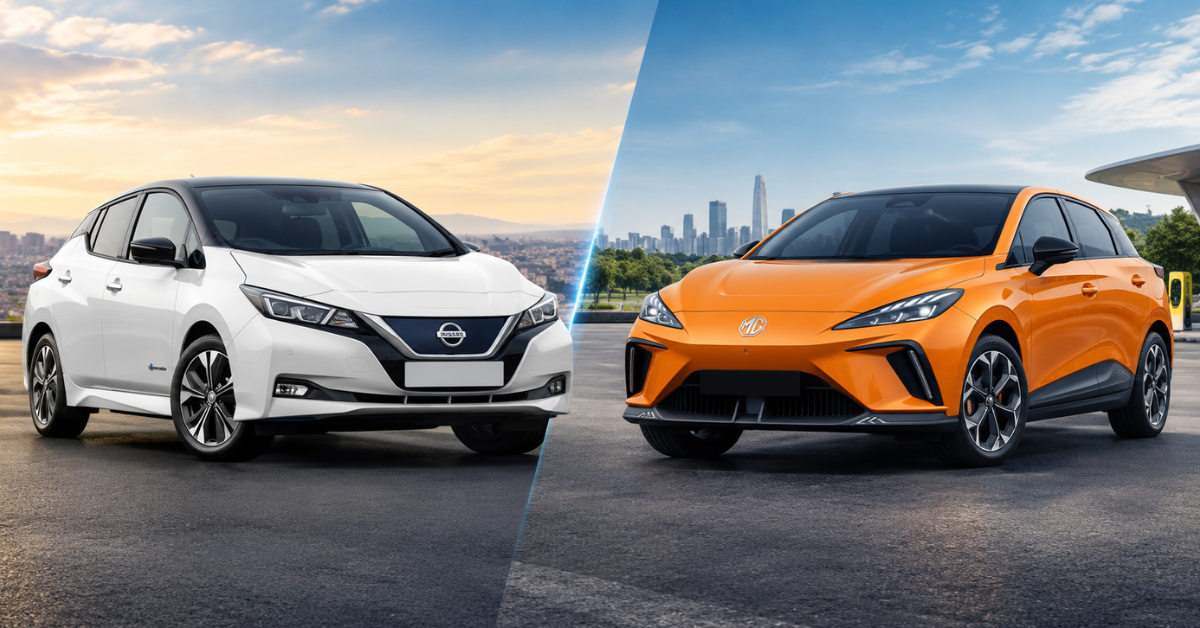
The UK’s electric hatchback segment has never been more competitive, and the Nissan Leaf vs MG4 debate keeps coming up in every buyer’s shortlist. Both are now genuinely mainstream electric cars — no longer “alternative” purchases, but sensible, well-equipped, tech-loaded family vehicles that happen to run on batteries instead of petrol.
If you’re trying to decide between the Nissan Leaf vs MG4 in 2026, this guide breaks down everything that matters: pricing, real-world range, charging speed, interior tech, connected-car (IoT) features, running costs, and which car actually makes more sense for UK driveways. This Nissan Leaf vs MG4 comparison is based on the latest confirmed 2026 UK pricing and specifications. Let’s get into it.
Quick Verdict: Nissan Leaf vs MG4 at a Glance
If you want the short answer to the Nissan Leaf vs MG4 question before the deep dive: the MG4 is the value and driving-dynamics champion, while the Nissan Leaf is the tech-forward, higher-range, more premium-feeling all-rounder. Neither is a bad choice — it genuinely comes down to budget, priorities, and how much range you need day-to-day.
| Category | Nissan Leaf (2026) | MG4 EV (2026) |
|---|---|---|
| Starting price (after grant) | From £28,849 | From £26,995 |
| Battery options | 52kWh / 75kWh | 64kWh / 77kWh |
| Max WLTP range | Up to 375–386 miles | Up to 338 miles |
| 0-62mph | 7.5–8.3 seconds | 6.5–7.7 seconds |
| Rapid charge (10-80%) | Around 30 minutes | 30–40 minutes |
| Body style | Compact SUV/crossover | Rear-wheel-drive hatchback |
| Connected app / IoT | NissanConnect + Google built-in | MG iSMART app |
Nissan Leaf 2026: Overview
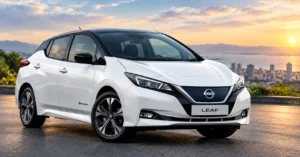
Before we get into the full Nissan Leaf vs MG4 breakdown, let’s look at the Leaf on its own merits.
The Nissan Leaf has quietly been one of the most important EVs in automotive history — it was one of the first mass-market electric cars, and the 2026 model marks a dramatic reinvention. Gone is the old hatchback shape; the new Leaf has switched to a sleeker, more SUV-influenced crossover silhouette that puts it firmly in line with rivals like the Volkswagen ID.3 and Kia EV4.
Nissan Leaf Pricing in the UK
Pricing has become a genuine strong point for the new Leaf. Thanks to the UK’s Electric Car Grant, the entry-level 52kWh Engage trim starts from around £28,849 including the grant, with the bigger 75kWh battery models sitting closer to £32,000–£40,000 depending on trim. Nissan is one of only a handful of manufacturers qualifying for the full £3,750 grant discount, which has made the Leaf noticeably better value than it looked on paper just a year ago.
Range and Battery Options
There are two battery sizes on offer:
- Standard Range (52kWh): up to 271–280 miles WLTP
- Extended Range (75kWh): up to 375–386 miles WLTP
That bigger-battery figure puts the Leaf comfortably ahead of the MG4 on paper range, and real-world testing suggests owners can expect roughly 300 miles from the larger battery in mixed driving — a strong result for this class of car. At a steady 70mph, Nissan estimates the smaller battery will manage up to 190 miles, which is a useful figure for anyone doing regular motorway trips.
Performance and Charging
The 52kWh model uses a 174hp motor (0-62mph in around 8.3 seconds), while the 75kWh version steps up to 215hp for a slightly quicker sprint. Both are capped at 99mph. Charging at up to 150kW DC means a 20-80% top-up takes around 30 minutes on the bigger battery, adding roughly 270 miles of range in that time.
Interior, Tech and IoT Features
This is where the new Leaf makes its biggest leap forward. The cabin is built around twin 14.3-inch displays, with Google built-in as standard — meaning native Google Maps, Google Assistant, and access to the Google Play Store without needing a phone plugged in. That’s a genuinely significant connected-car (IoT) upgrade: it puts the Leaf’s infotainment closer to what you’d expect from a smartphone than a traditional car computer.
Key connected and IoT-style features include:
- Google built-in for native navigation, voice assistant, and app downloads
- Over-the-air (OTA) software updates, so features and bug fixes can be pushed remotely
- NissanConnect app for remote pre-conditioning, charge scheduling, and vehicle status checks from a smartphone
- Vehicle-to-Load (V2L) functionality, letting the car’s battery power external devices — camping gear, tools, even household appliances during an outage
- Wireless Apple CarPlay and Android Auto
- Bose sound system with a headrest-integrated speaker for private navigation announcements
Boot space comes in at 437 litres — a genuine improvement over the outgoing model — with a variable-height boot floor to help hide charging cables.
MG4 EV 2026: Overview
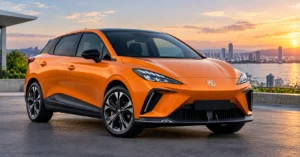
On the other side of the Nissan Leaf vs MG4 debate sits MG’s rear-wheel-drive hatchback.
The MG4 approaches things differently. Rather than chasing an SUV-style body, it sticks with a low-slung, rear-wheel-drive hatchback layout that’s been praised repeatedly for how it drives — something that’s relatively rare in an affordable EV.
MG4 Pricing in the UK
The MG4 undercuts the Leaf at almost every trim level. Pricing for 2026 starts from around £26,995–£29,995 for the Long Range model, with the Extended Range variant around £32,995 and the performance-focused XPOWER dual-motor version at roughly £33,995. Even the mid-range trims stay comfortably under £33,000, which keeps the MG4 firmly positioned as the budget-conscious buyer’s EV of choice.
Range and Battery Options
MG has simplified the lineup for 2026, dropping the old entry-level 49-51kWh option in favour of two core batteries:
- Long Range (64kWh): up to 280–281 miles WLTP
- Extended Range (77kWh): up to 338 miles WLTP
While that tops out below the Leaf’s maximum figure, it’s still a genuinely usable range for daily driving and the occasional longer trip, and the MG4 has consistently outperformed rivals like the BYD Dolphin and Citroën ë-C4 on real-world efficiency.
Performance and Charging
This is where the MG4 pulls ahead. Its rear-wheel-drive setup and lower centre of gravity make it noticeably more engaging than most electric hatchbacks in this price range. The Long Range model produces 188bhp and hits 0-62mph in 7.5–7.9 seconds, while the Extended Range steps up to around 241hp and 6.5 seconds. The range-topping XPOWER dual-motor variant is aimed squarely at enthusiasts wanting genuine hot-hatch pace from an EV.
Charging tops out at 144-154kW depending on battery, with a 10-80% DC charge taking roughly 30-40 minutes.
Interior, Tech and IoT Features
The facelifted 2026 MG4 brings a significant interior upgrade, swapping out some of the touch-sensitive controls for physical climate buttons — a small but appreciated change for usability. The centre stack now runs a 12.8-inch touchscreen alongside a 10.25-inch driver display.
On the connected-car and IoT side, the MG4 offers:
- MG iSMART app for remote lock/unlock, charge status, climate pre-conditioning, and vehicle location
- MG Pilot driver-assistance suite, now using a dual-camera vision-based system for more accurate lane-keeping, adaptive cruise, and collision warnings
- Standard Apple CarPlay and Android Auto
- Remote diagnostics and software update capability, though Nissan’s Google-built-in system currently offers a deeper level of native app integration
The MG4’s IoT ecosystem is solid and covers the essentials most owners actually use day-to-day, but it doesn’t go quite as far as the Leaf’s Google-integrated infotainment setup.
Nissan Leaf vs MG4: Head-to-Head Comparison
Now that we’ve covered each car individually, here’s a direct Nissan Leaf vs MG4 breakdown across the factors that matter most to UK buyers.
Price and Value for Money
In the Nissan Leaf vs MG4 price battle, the MG4 wins on pure entry price, undercutting the Leaf by roughly £1,800-£2,000 at the base level. However, once you compare like-for-like range (75kWh Leaf vs 77kWh MG4 Extended Range), the pricing gap narrows considerably, and the Leaf’s extra range and tech arguably justify the difference for many buyers.
Range and Real-World Usability
The Nissan Leaf’s 75kWh battery gives it a clear edge for anyone regularly covering long distances, with a genuine 300+ mile real-world range. The MG4’s 338-mile WLTP figure on the Extended Range model is still excellent, but the Leaf simply goes further between charges at the top of the range.
Driving Experience
This is arguably the MG4’s strongest card. Its rear-wheel-drive platform and sharper handling make it the more enjoyable car to actually drive, particularly on B-roads. The Leaf prioritises comfort and refinement instead, soaking up bumps beautifully but feeling noticeably softer and less engaging behind the wheel.
Practicality
The Leaf’s new SUV-style body gives it a boot capacity of 437 litres versus the MG4’s smaller hatchback boot, along with a slightly higher driving position that some buyers will prefer for visibility and ease of loading.
Technology and IoT Integration
Here the Nissan Leaf edges ahead thanks to Google built-in, giving owners native access to Maps, Assistant, and app downloads without relying on a phone connection. Both cars offer capable companion apps (NissanConnect and MG iSMART) for remote charge scheduling and climate control, which is now considered a baseline expectation for any modern connected EV.
Running Costs
Both vehicles sit in the lowest Vehicle Excise Duty band as EVs and avoid the luxury car supplement across most trims, since neither typically crosses the £40,000 threshold. Company car drivers on both models benefit from the lowest Benefit-in-Kind tax bracket, making either car a smart choice for salary sacrifice or fleet schemes.
Which Should You Buy: Nissan Leaf VS MG4?
Still torn on the Nissan Leaf vs MG4 decision? Here’s a simple way to decide:
- Choose the Nissan Leaf if: you want maximum range, more boot space, a more premium-feeling interior, and the most advanced native infotainment tech (Google built-in) currently available at this price point.
- Choose the MG4 if: you want the lowest entry price, sharper and more engaging handling, and you don’t need the absolute longest range on the market.
Both cars represent genuinely strong value in the UK’s electric hatchback and crossover segment, and both benefit from the government’s Electric Car Grant, which has reshaped pricing across the class in 2026. Whichever you choose, you’re getting a well-built, well-supported EV backed by a manufacturer with years of experience refining these platforms. Ultimately, the Nissan Leaf vs MG4 decision comes down to whether you value range and tech or price and driving fun.
Frequently Asked Questions
Here are quick answers to the most common Nissan Leaf vs MG4 questions UK buyers ask.
Is the Nissan Leaf bigger than the MG4?
Yes. The 2026 Leaf has moved to a compact SUV/crossover body style with more boot space (437 litres), while the MG4 remains a traditional, lower-slung hatchback.
Which has better range, the Leaf or the MG4?
The Nissan Leaf’s top-spec 75kWh battery offers up to 375–386 miles WLTP, ahead of the MG4 Extended Range’s 338 miles.
Is the MG4 cheaper than the Nissan Leaf?
Yes, at entry level. The MG4 starts from around £26,995–£29,995, while the Leaf starts from roughly £28,849 after the Electric Car Grant.
Do both cars have smartphone apps for remote control?
Yes — the Leaf uses the NissanConnect app and the MG4 uses MG iSMART, both allowing remote charge scheduling, climate pre-conditioning, and vehicle status checks.
Which car is more fun to drive?
The MG4’s rear-wheel-drive layout gives it the edge for engaging, sharper handling, while the Leaf focuses on ride comfort and refinement.
Conclusion
Godailybuzz:- the Nissan Leaf vs MG4 debate comes down to your priorities as a UK buyer. Nissan Leaf vs MG4 shoppers chasing maximum range, premium tech, and a roomier boot should lean toward the Leaf, while Nissan Leaf vs MG4 buyers on a tighter budget who want sharper handling should pick the MG4. Every Nissan Leaf vs MG4 comparison confirms both are strong, well-built electric cars backed by the Electric Car Grant. Whichever way this Nissan Leaf vs MG4 decision goes, you win, and that’s why the Nissan Leaf vs MG4 rivalry remains one of 2026’s closest EV contests.

Join the conversation