

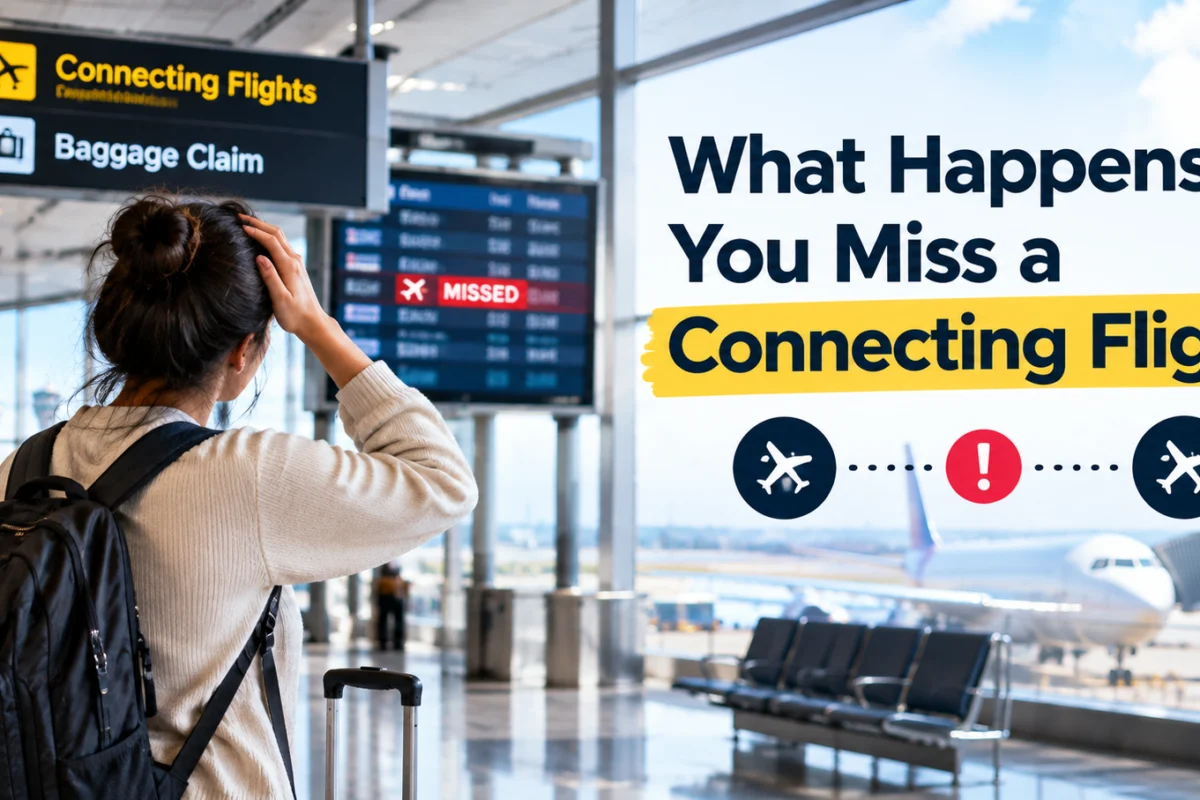
What Happens If You Miss a Connecting Flight ? :- You’re sprinting through a terminal, boarding pass crumpled in your fist, watching the departure board flip over to a gate that’s now closed. It’s one of the most stomach-dropping moments in modern travel, and if it’s ever happened to you, you already know the panic that follows. So what happens if you miss a connecting flight? The honest answer is: it depends almost entirely on one detail buried in your booking confirmation that most travellers never think to check until it’s too late.
This guide walks through exactly what happens if you miss a connecting flight, why the answer changes so dramatically depending on how you booked, what your rights actually are, and what to do in the first ten minutes after you realise you’re not making that gate. By the end, you should have a clear, practical answer to what happens if you miss a connecting flight in almost any situation you’re likely to encounter.
The Single Most Important Factor: How You Booked
Before anything else, there’s one question that determines everything else in this story: were your flights part of a single booking, or did you book them separately?
This distinction is the reason two people can have an almost identical experience — both miss a connection because of a delayed first flight — and end up with completely different outcomes. Understanding what happens if you miss a connecting flight really means understanding which of these two categories you fall into.
Single booking (one PNR, even across partner airlines): If all your flights share a single booking reference, even if they’re operated by different airlines within the same alliance, the airline treats your journey as one continuous trip. They’re responsible for getting you to your final destination, not just to the connecting airport.
Separate tickets (self-transfer): If you booked each leg independently — perhaps to save money by mixing a budget airline with a full-service carrier — each ticket is a standalone contract. What happens if you miss a connecting flight in this scenario is a very different, and much less comfortable, story.
Some booking sites blur this line deliberately. They present a “combined” itinerary that looks like a single trip but actually issues two separate booking references. If you’re ever unsure, check your confirmation email for one PNR or two — it genuinely changes everything about what happens if you miss a connecting flight down the line.
Scenario One: You’re on a Single Booking
This is the version of what happens if you miss a connecting flight that most people hope for, and thankfully it’s also the more common setup for anyone who booked their whole trip through one airline or travel agent at the same time.
When your flights are on one booking and the airline caused the delay that made you miss your connection, you’re entitled to be rebooked “at the earliest opportunity.” This isn’t a courtesy — it’s a legal obligation under UK261 and EU261 regulations. The airline should do this automatically, but it’s always worth confirming at the transfer desk rather than assuming it’s been handled.
Here’s what typically happens if you miss a connecting flight under these circumstances:
You get rebooked, often for free. The airline places you on the next available flight to your final destination. If that flight isn’t until the following day, they’re required to provide “care” — meals, refreshments, and a hotel room if an overnight stay is necessary, plus transport between the airport and the hotel.
You might not have to fly the same airline. According to CAA guidance, you don’t have to wait for the next flight on your original carrier. If a different airline has an earlier available seat to your final destination, you can request rerouting onto that flight instead. In practice, airlines often push back on this because keeping you on their own network is cheaper for them, but it’s a right worth knowing about and asserting if the wait is long.
Your bags should follow you. If your luggage was checked through to your final destination as part of the through-journey, it should be automatically re-routed onto your new flight. It’s still smart to confirm this at the transfer desk rather than assuming it happens seamlessly.
You may be owed compensation. This is often the part people are most surprised by when they research what happens if you miss a connecting flight. If you arrive at your final destination three or more hours later than originally scheduled, and the disruption was the airline’s fault rather than an extraordinary circumstance like severe weather or air traffic control strikes, you can claim fixed compensation under UK261 or EU261.
The compensation bands are typically £220 for shorter journeys, up to around £350 for medium-haul, and up to £520 for long-haul routes over 3,500 km. Crucially, this amount is calculated using the distance of your entire original journey — from your very first departure airport to your final destination — not just the short connecting leg that caused the problem. That means a delayed one-hour domestic hop that makes you miss a long-haul connection can still trigger the higher compensation tier, because what happens if you miss a connecting flight is assessed on the whole trip, not the individual segment that went wrong.
To qualify, the journey generally needs to depart from a UK or EU airport on any airline, or arrive into the UK or EU on a UK or EU carrier. If your booking meets that criteria and the delay was within the airline’s control — think technical faults, crewing issues, or an overbooked schedule — you have a genuine claim.
Scenario Two: You Booked Separate Tickets
Now for the less forgiving version of what happens if you miss a connecting flight. If you booked your flights as two (or more) completely separate tickets — a common move when self-transferring to save money — the picture changes substantially.
The second airline owes you nothing. From their perspective, you simply failed to show up for your flight. They have no knowledge of, or responsibility for, whatever happened on your earlier, unrelated flight. There’s no rebooking obligation, no meal vouchers, no hotel. Your original fare for that missed leg is typically forfeited entirely.
You’ll likely need to buy a new ticket. This is the financially painful part of what happens if you miss a connecting flight on separate bookings. Depending on availability and how close to departure you’re purchasing, a same-day replacement fare can be significantly more expensive than what you originally paid.
You can still claim on the flight that actually caused the delay. Even with separate tickets, if your first flight was delayed by three hours or more and the airline was at fault, you can claim compensation for that specific flight in isolation. What you can’t do is fold the missed connection into that same claim — the two are legally unrelated, treated as entirely separate contracts.
Travel insurance becomes your best friend. Because airlines have no statutory duty to help you in this situation, a decent travel insurance policy with “missed connection” or “self-transfer” cover can be the difference between an expensive afternoon and a genuine financial hit. It’s worth checking this specific clause before you buy a policy if you’re planning a self-transfer itinerary, precisely because this is where the regulatory safety net disappears.
This is really the crux of what happens if you miss a connecting flight when tickets are booked separately: you’re largely on your own, and the responsibility for building in enough buffer time between flights sits with you rather than the airline.
What If You Simply Choose Not to Take Your Connection?
There’s a subtle but important distinction in what happens if you miss a connecting flight versus what happens if you voluntarily skip it. If you decide, for whatever reason — a change of plans, wanting to stay longer in a layover city, or anything else — not to board your connecting flight, you lose your protections entirely. Airlines are not obligated to rebook you or offer compensation in that case, and many will automatically cancel the remaining flights on your itinerary once you’re marked as a no-show on one leg. If there’s any chance you might not take a connection, it’s worth contacting the airline in advance rather than simply not showing up.
The First Ten Minutes: What to Actually Do
Knowing your rights is one thing, but what happens if you miss a connecting flight in the immediate, practical sense often comes down to how quickly and calmly you act at the airport.
Head straight to the transfer or customer service desk. Don’t queue at check-in or wander looking for signage — most major airports have a dedicated transfer desk specifically for passengers in your situation, and staff there can rebook you faster than anyone else in the terminal.
Ask for the cause of the delay in writing. This matters enormously if you later want to pursue compensation. Get the airline to confirm the reason by email, app message, or a printed note. Whether the delay was “airline’s fault” or “extraordinary circumstances” is often the entire basis of any claim.
Photograph everything. Departure boards showing the delay, gate change notices, and boarding pass timestamps are all useful evidence. If your claim is ever disputed later, this kind of documentation is what separates a straightforward payout from a drawn-out argument.
Keep every piece of paper and digital confirmation. Boarding passes, e-tickets, and rebooking confirmations should all be saved, ideally photographed and backed up somewhere other than your phone in case it dies mid-journey.
Calculate your actual delay at your final destination, not the connecting airport. This is a detail a lot of people get wrong when trying to work out what happens if you miss a connecting flight in compensation terms. The clock that matters is your arrival time at your ultimate destination compared to your original scheduled arrival — not how late you were leaving the connecting hub.
Does It Matter If It’s a Codeshare Flight?
Not really, and this is worth knowing. If your flight is sold under one airline’s code but actually operated by another — a common codeshare arrangement — your rights remain exactly the same as if you’d booked directly with the operating carrier. What happens if you miss a connecting flight doesn’t change just because the branding on your ticket differs from the airline actually flying the plane.
Does Travel Class or Ticket Price Affect What Happens If You Miss a Connecting Flight?
Not in the way people often assume. Whether you flew economy or business class, your legal rights under UK261 and EU261 are identical — compensation and rebooking obligations are based on the disruption and journey distance, not the fare you paid or the cabin you sat in. Where ticket price does matter is in rebooking priority: premium cabin passengers are sometimes moved to the front of the queue at a transfer desk simply because there are fewer seats to reallocate, but the underlying legal entitlement is the same for everyone on that booking.
Does It Matter If You Didn’t Pay for the Ticket Yourself?
No. Your right to claim compensation is based on the inconvenience you personally experienced, not on who paid for the ticket. If a relative booked your flight, you redeemed air miles, or you were travelling as a lap infant on someone else’s booking, what happens if you miss a connecting flight is assessed the same way as it would be for any paying passenger. This surprises a lot of people, who assume gifted or points-based tickets carry fewer protections. They don’t.
What About Non-EU, Non-UK Routes?
If your entire journey takes place outside UK and EU jurisdiction — say, a connection made entirely within the United States — the picture changes again. Domestic missed connections in some countries, including the US, generally don’t come with a statutory compensation right the way UK261 and EU261 provide. What happens if you miss a connecting flight there often comes down to individual airline policy rather than law: most major carriers will still rebook you on the next available flight and may offer meal vouchers, but this is a goodwill gesture rather than a legal requirement, and it varies significantly between airlines. It’s worth checking the specific carrier’s contract of carriage before you fly if this is a route you take often.
If you’ve worked out that you’re owed compensation, don’t assume there’s a tight window to act. Under EU261 and UK261 rules, claim periods vary depending on the country where your journey began — commonly ranging from around two years in some jurisdictions up to six years in the UK, and even longer in a few EU countries. There’s genuinely no rush to claim the same week it happens, though doing it sooner while your documentation is fresh and easy to find is obviously more convenient.
Return Journeys and Multiple Passengers
If disruption affects both your outbound and return legs of a trip, what happens if you miss a connecting flight applies separately to each journey — you can claim for both if both were genuinely disrupted through the airline’s fault. Similarly, these rights apply per passenger, not per booking. If you were travelling with family or friends on the same reservation, each person affected has their own independent right to claim, regardless of who paid for the tickets or whose name the booking is under.
How to Avoid Ever Needing to Ask This Question Again
The best answer to what happens if you miss a connecting flight is, of course, simply not missing it in the first place. A few habits make a genuine difference:
Build in generous connection time, especially on self-transfer itineraries where you’re responsible for your own buffer. Airport-recommended minimum connection times are exactly that — minimums, not comfortable margins, and cutting it close is the single biggest reason people end up researching what happens if you miss a connecting flight in the first place.
Book everything on one ticket where possible. Even if it costs slightly more upfront, the protection you gain if something goes wrong often outweighs the saving from piecing together separate cheap fares.
Check in with hand luggage only when you can, so a missed connection doesn’t also mean waiting to see where your bags ended up.
Buy travel insurance that specifically covers self-transfer connections if you do choose to book separately, since that’s precisely where you’re most exposed.
The Bottom Line
What Happens If You Miss a Connecting Flight? So, what happens if you miss a connecting flight? If everything was booked on a single reservation and the airline caused the delay, you’re in a genuinely strong position — automatic rebooking, care while you wait, and potential compensation of £220 to £520 depending on your journey’s overall distance. If you booked separate tickets, the situation flips: you’re largely responsible for your own recovery, and travel insurance becomes far more important than any airline obligation.
The lesson worth carrying into your next trip is this: the moment you book, not the moment you miss the connection, is really when your protection level gets decided. Check your booking reference, understand which category you fall into, and you’ll never be caught off guard wondering what happens if you miss a connecting flight again.

Join the conversation